
Local service guide
Junk Removal in Kansas City, MO: Plan Your Pickup
Arrange Junk Removal in Kansas City, MO by sending an inventory and access photos, requesting a written total, and agreeing on disposal destinations before booking. Flag chemicals, major appliances, whole tires, waste oil and lead-acid vehicle batteries. Missouri DNR’s June 2014 guidance identifies landfill restrictions for those nonchemical categories; MARC describes a regional household hazardous waste program for chemicals. Ask the hauler which items it accepts and which need another arrangement. [1] [2]
Define the pickup before requesting prices
Photograph the items and the route to the truck. List bulky furniture, loose bags, shelving and anything you want dismantled. Describe stairs, elevator access, narrow doorways and parking. If you need indoor carrying, request a quote from the items’ current positions.
Request a written total covering loading, dismantling, hauling and disposal. Ask whether the hauler prices by item, truck space, weight or labor. For a truck-space quote, request the truck’s capacity and the space allocated to your load. Agree on how you will approve extra work or a price change before loading starts.
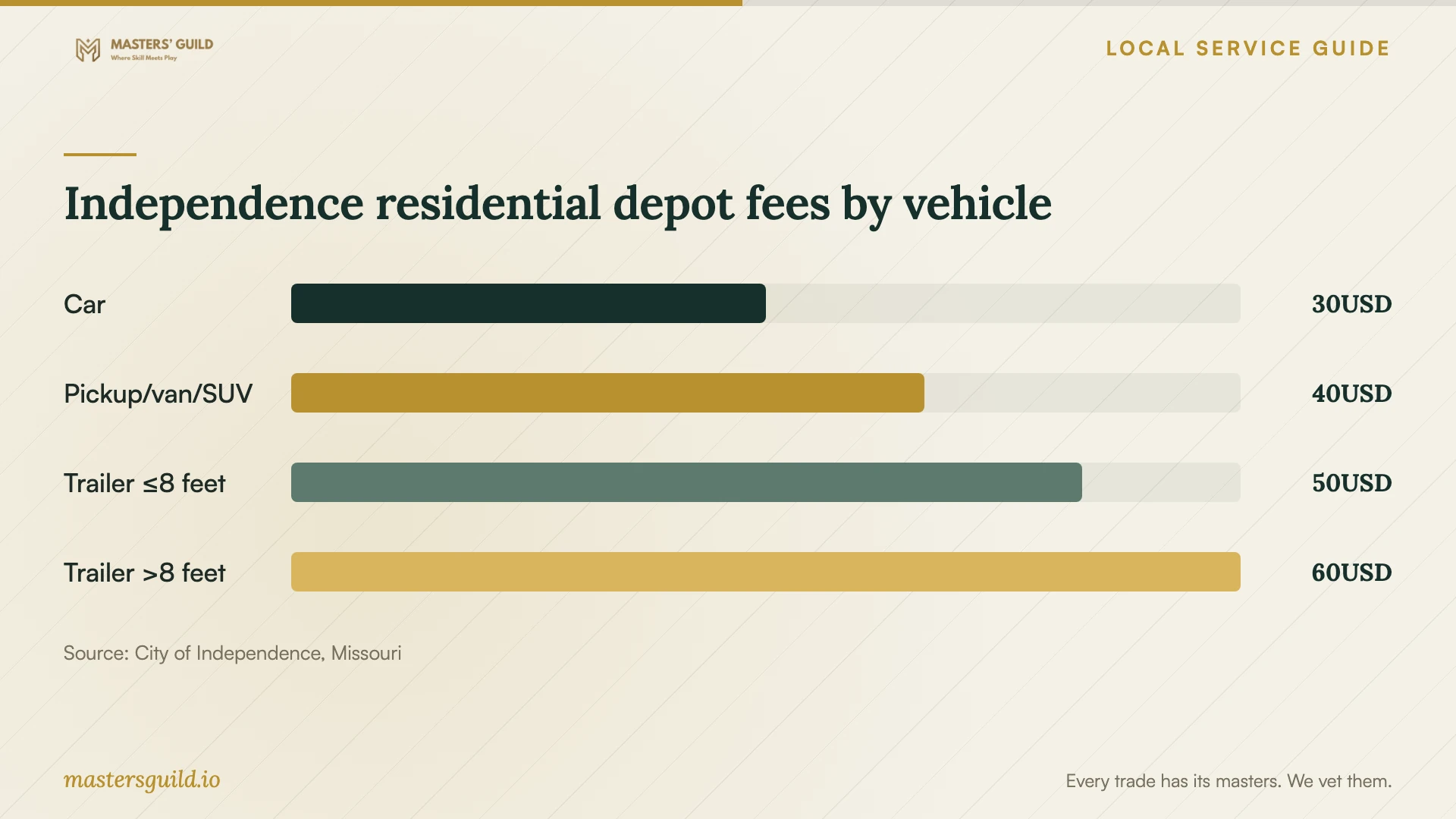
Treat the Independence chart as a restricted self-haul reference. The city publishes vehicle-based depot fees and separate tire and appliance charges. Those fees do not establish a private pickup price for your home. Request a hauling quote for your inventory and carrying requirements. [3]
Separate chemicals from the ordinary junk
MARC identifies paint, cleaners, lawn and garden products, automotive fluids, bug sprays and fluorescent lights as household hazardous waste examples. It also identifies products labeled flammable, toxic, corrosive or reactive. List these items apart from furniture and other household contents when describing the job. [1]
MARC describes permanent collection facilities in Kansas City, Missouri, and Lee’s Summit, plus mobile events. Participating communities’ residents can use the regional program at no charge with residency proof. Residents of nonparticipating communities may use the Lee’s Summit facility for a fee. Confirm participation, material acceptance and operating arrangements before making a trip. [1]
Have the hauler identify excluded chemicals in writing. Decide who will handle them before pickup day. Keep product labels visible and avoid mixing products to reduce the number of containers.
Name appliances, tires and batteries in the quote
Missouri DNR’s fact sheet dated June 1, 2014, lists refrigerators, freezers, washers, dryers, stoves, ovens, dishwashers and water heaters among major appliances banned from landfills. The guidance recommends asking about retailer take-back or acceptance by scrap and recycling facilities. Use that guidance to question the hauler, and confirm current destination requirements before removal. [2]
The same 2014 guidance lists whole tires, waste oil and lead-acid batteries among landfill-banned items. It states that Missouri retailers must accept tires being replaced during a new-tire purchase and used lead-acid batteries exchanged for new ones. It notes possible tire handling fees. Ask the retailer about current arrangements, including acceptance without a purchase. [2]
Request a separate line for each special item and its disposal charge. For refrigerators and freezers, ask who handles refrigerant-related work and whether the price includes it. Describe appliance connections and agree on who will disconnect each unit before arrival.
Agree on access and inspect the finished work
Choose the carrying scope before accepting an offer. Request indoor removal if you want the crew to carry items out, or a garage or curbside quote if you plan to stage them yourself. Ask for proof of insurance, an arrival window and the process for reporting property damage. Coordinate shared loading areas and elevators with your property manager.
Walk through the job with the crew before loading. Point out items that stay and confirm the agreed total. Keep documents, keys and valuables away from the removal area. Before the truck leaves, inspect the cleared space and request an itemized receipt and any disposal documentation you agreed upon.
Independence residential depot fees by vehicle
Local details that affect your job
Check regional chemical-disposal eligibility
MARC’s Solid Waste Management District covers Cass, Clay, Jackson, Platte and Ray counties in Missouri. County coverage alone does not establish no-charge access: MARC requires community participation and residency proof. Before taking chemicals to the Kansas City facility, confirm your address qualifies and your materials meet its acceptance rules. MARC lists 816-701-8226 for program information. [1]
Independence’s depot season has ended
Independence limits its Drop-Off Depot to Independence residents’ residential waste and excludes commercial waste. The city publishes second-Saturday operation from April through October, 8 a.m. to 3 p.m., at 875 S. Vista Ave. Under that schedule, October 10 was the last scheduled 2026 date and had passed by October 16. Eligible households should confirm the next season’s schedule before planning self-haul. Bring a valid driver’s license or recent utility bill and cash or a local check. [3]
Choose a disposal route for each item
| Your situation | Route to consider | Confirm before proceeding |
|---|---|---|
| Furniture or a mixed household cleanout | Request a private hauling quote | Carrying, dismantling, exclusions and total price |
| Paint, cleaners or garden chemicals | Check MARC household hazardous waste collection | Community participation, material acceptance and residency proof |
| Major appliances | Consider retailer take-back or recycling, as DNR’s 2014 guidance recommends | Current acceptance, disconnection, destination and item charge |
| Whole tires or lead-acid vehicle batteries | Ask a replacement retailer about the exchange routes in DNR’s 2014 guidance | Current purchase requirements, acceptance and any tire handling fee |
| Considering the Independence depot | Check Independence residency and residential-waste eligibility | The published 2026 season ended October 10; confirm next season’s schedule |
Your hiring checklist
- Photograph the full load and the carrying route.
- Describe stairs, parking and requested dismantling.
- List chemicals, appliances, tires and battery types apart from ordinary junk.
- Get a written total, exclusions and a process for approving changes.
- Request disposal destinations and proof of insurance.
- Agree on appliance disconnection and building access.
- Mark items that stay and inspect the space before departure.
Frequently Asked Questions
How much should I budget for private junk removal?
Request a quote for your inventory and access conditions. Ask for the total, special-item charges and circumstances that permit a price change. Use the Independence chart only to understand that city’s restricted municipal drop-off fees, not to price a crew carrying items from your home. [3]
Can the crew take paint and cleaning products?
Request written acceptance before booking. MARC classifies paint and cleaners as household hazardous waste and describes a separate regional collection program. If you plan to use that program yourself, confirm community eligibility, accepted materials and residency documentation. [1]
How should I arrange refrigerator removal?
Ask the hauler to identify the destination and explain disconnection and refrigerant-handling responsibilities. DNR’s June 2014 guidance lists refrigerators among landfill-banned appliances and recommends retailer take-back, donation of working units, or scrap and recycling acceptance. Confirm current facility requirements before removal. [2]
Can a Kansas City resident use the Independence depot?
The published rules restrict the depot to Independence residents and require a valid driver’s license or recent utility bill. A Kansas City address does not meet that residency rule. Eligible Independence residents should confirm the next season’s dates because the published 2026 schedule ended October 10. [3]
Sources and scope
This guide combines the sources below with practical planning guidance. Figures apply to the stated geography and period; request a written quote for your property.