
Local service guide
Roof Cleaning and Repair in Jersey City, NJ
Arrange Roof Cleaning and Repair by asking contractors to separate cleaning, leak investigation, and repairs in their quotes. Before authorizing roof-covering work in Jersey City, confirm your building type: the city lists roof-covering repair or replacement on detached one- and two-family dwellings as ordinary maintenance without a construction permit, while preserving historic approval requirements. For an attached home or larger building, ask Construction Code to confirm the requirements for your proposed scope. [1]
Choose the scope before comparing contractors
Describe what you want the contractor to assess: surface staining, accumulated debris, a suspected leak, damaged covering, or a combination. Send photographs taken from a safe location and identify any interior water marks. Ask the contractor to explain which observations support the proposed cleaning or repair and which areas still need inspection.
For cleaning, request the proposed products, application method, rinsing procedure, and protection for plants, windows, and adjoining property. Ask how the contractor will check compatibility with your roof material and any manufacturer instructions. For repairs, request photographs identifying the work area, the materials to be used, and any exclusions involving concealed damage.
If your concern involves water entering the home, ask for an investigation and repair proposal before approving cosmetic cleaning. Request separate descriptions for temporary protection and the proposed lasting repair. Agree on who will document completion and how you should report another leak.
Confirm permits and historic approvals for your address
Jersey City’s ordinary-maintenance list includes repair or replacement of existing roof covering on detached one- and two-family dwellings. The city also lists repair, replacement, or installation of exterior gutters and leaders under ordinary maintenance for all structures. Keep these categories separate when reviewing a combined roof and gutter proposal. [1]
For an attached rowhouse, a building with more dwelling units, or work extending beyond roof covering, ask Construction Code to review the exact scope before you rely on the detached-home exemption. Give the city the address, building type, proposed materials, and a description of any work involving the supporting structure. Ask the contractor to identify who will handle any required applications. [1]
The city directs owners to its zoning map to check historic-district status. For properties in a historic district, it instructs owners to seek Historic Preservation approval before submitting to construction. Its ordinary-maintenance page also states that the no-permit provisions do not supersede historic approval requirements. Ask which approval applies to your proposed work before agreeing to a start date. [1] [2]
Compare complete quotes and control changes
Give each contractor the same job description and request itemized prices for inspection, cleaning, repairs, gutter work, access equipment, and disposal where applicable. Ask whether the total includes taxes and application charges. Use the written scope to compare offers; request clarification when one contractor includes work another leaves out.
Ask for proof of insurance and an explanation of who will perform the work. Request the proposed schedule, payment stages, cleanup responsibilities, and written terms for any workmanship warranty. For uncertain damage, agree on a process requiring photographs, a revised price, and your approval before the contractor expands the job.
Prepare access and allow for weather
Walk through the proposed access route with the contractor. Identify where the crew will place ladders, hoses, equipment, and debris containers. Ask how the crew will protect entrances and keep household members away from the work area. Obtain the neighbor’s agreement before including their property in an access plan.
For rehabilitation work that requires entry onto adjoining property to provide protection, Jersey City’s prior-approvals guidance requires written owner consent before entry. Discuss that requirement with the contractor if the repair plan depends on neighboring land or buildings. [2]
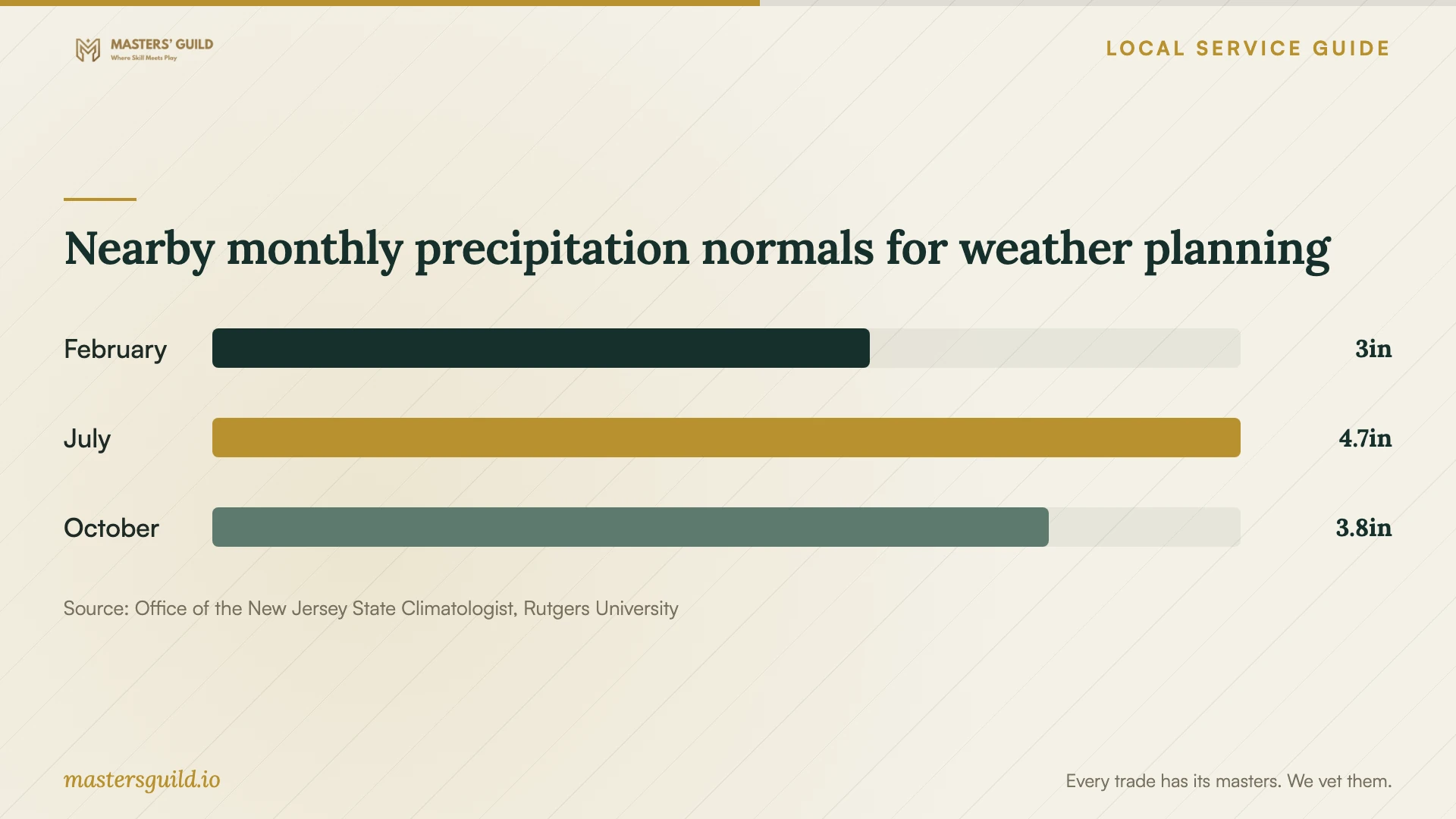
Ask the contractor to specify acceptable weather conditions, the rescheduling process, and how they will protect any unfinished repair. Rutgers publishes measurable precipitation normals throughout the year at nearby Newark Liberty International Airport. Use the regional figures below as a reason to include a weather contingency, rather than choosing a guaranteed dry month. [3]
Nearby monthly precipitation normals for weather planning
Local details that affect your job
Detached status changes the permit question
The city’s roof-covering exemption specifies detached one- and two-family dwellings. If you own an attached home, ask Construction Code about your scope before accepting a no-permit proposal based on the number of dwelling units alone. [1]
Historic review remains a separate step
Check the city’s zoning map for historic-district status. Jersey City requires Historic Preservation approval before construction submission for properties in a historic district, and its ordinary-maintenance provisions preserve historic approval requirements. [1] [2]
Neighbor access needs advance agreement
If rehabilitation work requires entry onto adjoining property to safeguard it, the city requires written consent from that property’s owner before entry. Ask the contractor to identify that need while preparing the quote so you can arrange permission before scheduling. [2]
Match the proposed work to your next step
| Situation | Next step |
|---|---|
| Staining or debris without a defined repair scope | Request a material-specific cleaning proposal and ask the contractor to flag areas needing inspection. |
| Roof-covering repair on a detached one- or two-family dwelling | Check the city’s ordinary-maintenance provision and address historic approval requirements. |
| Roof-covering work on an attached home or larger residential building | Ask Construction Code to confirm requirements; the cited roof-covering exemption specifies detached one- and two-family dwellings. |
| Property in a historic district | Seek Historic Preservation approval before construction submission and clarify approval requirements before starting. |
| Repair protection requires entry onto adjoining property | Obtain the adjoining owner’s written consent before entry. |
Your hiring checklist
- Describe the problem and provide photographs taken from a safe location.
- Separate cleaning, investigation, repairs, and gutter work in the quote.
- Confirm building type and ask the city about the proposed repair scope.
- Check historic status and clarify applicable approvals.
- Review insurance, roof-material compatibility, and property protection.
- Agree on access arrangements and obtain any needed neighbor consent.
- Record weather contingencies, change approval, payment stages, and cleanup responsibilities.
Frequently Asked Questions
Does a small roof repair need a permit?
Confirm the building type and scope. Jersey City lists existing roof-covering repair or replacement on detached one- and two-family dwellings as ordinary maintenance without a construction permit. Ask Construction Code about attached buildings or work beyond that scope. Historic approval requirements still apply. [1]
Can I combine gutter replacement with roof work?
You can request a combined quote, with separate line items. Jersey City lists repair, replacement, or installation of exterior gutters and leaders as ordinary maintenance for all structures. Confirm the roof work’s requirements on its own and check historic approvals. [1]
How should I compare cleaning and repair prices?
Ask contractors to quote the same scope and identify access costs, cleaning methods, repair materials, disposal, and exclusions. Require your approval for added work. A combined total without those details gives you little basis for deciding which services to authorize.
Which month should I book?
Choose a contractor who explains weather limits and offers a clear rescheduling process. The nearby Newark airport’s 1991–2020 precipitation normals include precipitation in every month. Those regional averages cannot predict suitable working conditions on your appointment date. [3]
Sources and scope
This guide combines the sources below with practical planning guidance. Figures apply to the stated geography and period; request a written quote for your property.