
Local service guide
Duct cleaning in Jersey City, NJ: Hiring Guide
Arrange duct cleaning in Jersey City after a contractor shows you contamination that warrants it, then compare written whole-system scopes and plan legal equipment access. EPA recommends cleaning as needed for conditions such as substantial mold growth, vermin, or excessive debris. Before booking, check street parking restrictions and clarify whether proposed repairs fall within the city’s ordinary-maintenance rules. [1] [2] [3]
Establish whether you need cleaning
Ask the contractor to show you the problem before agreeing to a cleaning package. EPA identifies substantial visible mold inside hard-surface ducts or HVAC components, vermin infestation, and excessive dust or debris as reasons to consider cleaning. A dusty return register can reflect normal airflow through the grille; you can vacuum or remove and clean that register. [3]
Treat a mold claim as a separate question requiring evidence. EPA says an expert may need laboratory analysis to confirm that a substance is mold. Wet or moldy duct insulation requires replacement, and the contractor must address the moisture source to prevent recurrence. Ask for photographs, the affected material, and a separate explanation of corrective work. [3]
Avoid hiring on a promise to prevent illness or deliver energy savings through duct cleaning alone. EPA says cleaning has not been shown to prevent health problems and finds little evidence that cleaning only ducts improves system efficiency. Discuss unexplained symptoms with your doctor rather than relying on a cleaner’s diagnosis. [3]
Compare scope before comparing totals
Request a written agreement naming the system and components the crew will clean. EPA describes system cleaning as including supply and return ducts, registers, coils, drain pans, fans, and air-handler housing. Leaving a contaminated component untreated can contaminate the system again. Ask providers to explain exclusions before you compare their totals. [3]
Ask how the crew will collect debris, protect furnishings, and close access openings. EPA recommends equipment that exhausts outdoors or HEPA vacuum equipment when exhausting indoors. The provider should use methods suited to the duct material and seal and reinsulate access holes after cleaning. [3]
Give each bidder the same description: number of systems, equipment locations, accessible registers, suspected contamination, and access constraints. Ask for the total price, optional work, expected time without heating or cooling, and the process for approving changes. Request separate line items for dryer exhaust, bathroom exhaust, repairs, and chemical treatments so you can choose the work you intend to buy.
Do not treat EPA’s published cost discussion as a current local estimate. Its guidance carries an October 1997 publication identifier and provides no Jersey City price sample. Use site-specific written estimates for your budget. [3]
Arrange building access and system downtime
If you live in a condominium or a building with shared equipment, ask management which ducts serve your home and who can authorize access. Confirm any elevator reservation, work-hour rules, insurance paperwork, and access to mechanical rooms before setting the appointment. Tell the contractor whether the crew must carry equipment upstairs or use a designated entrance.
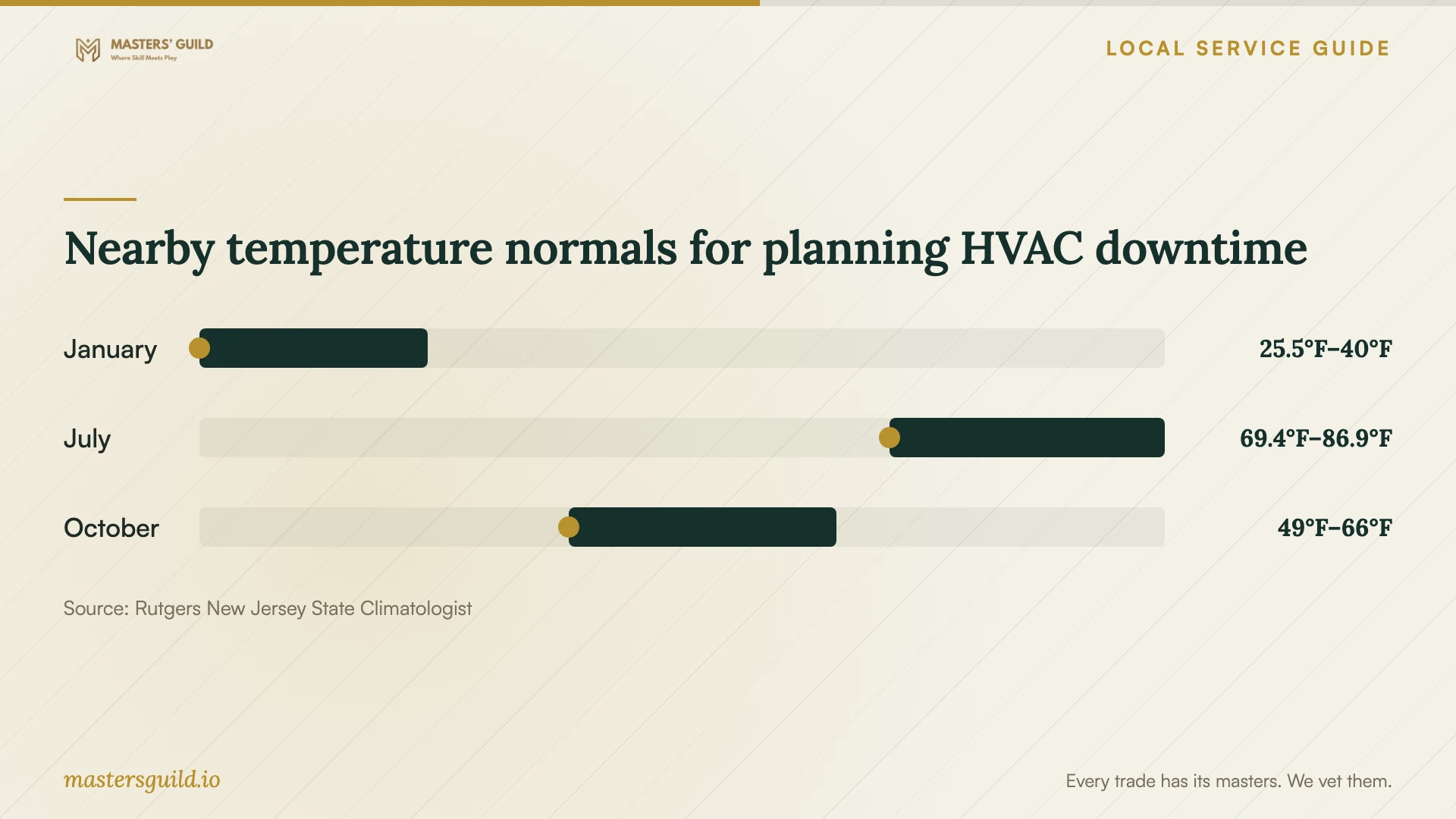
Ask how long the crew expects to keep the system off and whether exterior doors or windows must remain open for equipment. Nearby Newark Airport’s 1991–2020 normals show a January average daily minimum of 25.5°F and maximum of 40.0°F. Use that regional context to discuss winter downtime; it does not establish a need for cleaning. [4]
Check the result before closing the job
Agree on completion evidence before work starts. EPA recommends a visual inspection and asking the provider to show each cleaned component. Request photographs of otherwise inaccessible areas, inspect supply and return locations, and have the crew demonstrate that registers are secure and the system operates after cleaning. [3]
Review proposed sanitizers or internal coatings before authorizing them. EPA cautions that research has not established their effectiveness and potential adverse effects in duct cleaning. Ask for the product label, approved use, duct material compatibility, and the reason physical cleaning and moisture correction would not suffice. [3]
Nearby temperature normals for planning HVAC downtime
Local details that affect your job
Resolve parking before the crew arrives
Jersey City requires resident parking permits for stays beyond two hours in many areas. Posted signs identify permit zones, street-cleaning restrictions, and other limits. Send the contractor photographs of the signs near your entrance and ask who will arrange lawful parking for the equipment vehicle. Check with the Parking Division about the applicable arrangement; do not assume a resident permit covers a contractor’s vehicle. [1]
Check repair scope against city maintenance rules
The city’s no-permit ordinary-maintenance list includes ductwork repair and replacement, but the city says those allowances do not supersede historic approvals. Its page does not name duct cleaning as a separate category. If a cleaner proposes alterations beyond the listed maintenance work, ask Construction Code to review the exact scope before approving it. For a historic property, clarify historic approval requirements as well. [2]
Choose the next step from the evidence
| Finding | Next step | Hiring implication |
|---|---|---|
| Dust on a return grille alone | Clean the grille and assess the system | EPA says this does not establish heavy duct contamination |
| Excessive debris or particles leaving supply registers | Request an inspection and written cleaning scope | Ask the provider to show the contamination |
| Wet or moldy duct insulation | Address moisture and discuss replacement | EPA says affected insulation cannot be effectively cleaned |
| Proposed ductwork repair or replacement | Compare the scope with city ordinary-maintenance rules | Clarify historic approvals and any work beyond those rules |
Your hiring checklist
- Describe the concern and collect photographs before requesting estimates.
- Give bidders the same system count, access details, and requested scope.
- Ask management to confirm authorization for shared equipment or restricted rooms.
- Send parking-sign photographs and agree on equipment access.
- Get the total, exclusions, downtime, and change-approval process in writing.
- Approve repairs and chemical treatments as separate decisions.
- Request completion photographs and a system-operation demonstration.
Frequently Asked Questions
How often should I book duct cleaning?
EPA recommends cleaning as needed, rather than on a fixed routine. Ask a provider to show substantial contamination before agreeing to repeat service. [3]
Does an EPA-certified duct cleaner offer extra protection?
EPA does not certify, endorse, or approve duct-cleaning companies. Ask about relevant experience, references, cleaning methods, and a written scope instead. [3]
Does the city require a permit for duct repairs?
Jersey City lists ductwork repair and replacement under ordinary maintenance requiring no permit, while retaining historic-approval requirements. Ask Construction Code about the specific proposal if it includes other alterations. [2]
Should I combine cleaning with fall furnace service?
Ask for separate scopes. EPA recommends inspecting and servicing fuel-burning furnaces before each heating season, but recommends duct cleaning only as needed. Furnace service does not establish that ducts require cleaning. [3]
Sources and scope
This guide combines the sources below with practical planning guidance. Figures apply to the stated geography and period; request a written quote for your property.