
Local service guide
Jacksonville gardening: Hiring and Planting Guide
Arrange gardening by defining the beds, plants, cleanup and aftercare you want before comparing written quotes. Separate hand weeding from chemical treatment and agree who will water new plants. As of October 16, 2026, Phase III watering restrictions apply here. Confirm your assigned day and establishment allowances before ordering plants; Nocatee customers need JEA’s zone schedule. [1] [2]
Define the job before comparing quotes
Walk the garden with each bidder and identify what stays, what comes out and which plants need care. Request separate prices for bed weeding, shrub pruning, planting, mulch and debris removal. Mark seedlings and other plants you want protected. Agree whether the gardener will haul waste away or place suitable material in your compost area.
For an overgrown garden, request an initial cleanup quote and a separate maintenance proposal. Specify the beds included, visit tasks, access arrangements and approval process for extra work. Ask whether the gardener charges by time or by a defined result. Compare totals after each bidder has priced the same scope.
Ask for proof of liability insurance and a written list of exclusions. Identify tree work, irrigation repairs and chemical applications as separate items, with the person responsible for each. For damaged or weak tree branches, UF/IFAS recommends hiring an ISA-certified arborist. [3]
Agree on watering before ordering plants
As of October 16, 2026, the district’s Phase III guidance limits established landscape irrigation to one assigned day per week, no more than three-quarters of an inch and no more than one hour per zone. Water only when needed and outside the prohibited 8 a.m. to 6 p.m. period. [2]
The standard residential schedule assigns Saturday to odd-numbered or unnumbered addresses and Sunday to even-numbered addresses. Nocatee customers follow JEA’s reclaimed-water zone schedule, so specific days may differ while the one-day weekly limit remains. Determine your applicable day before arranging watering visits or setting the timer. [2]
For new plants and sod, the district’s Phase III guidance allows daily watering for the first 15 days, up to three days per week for the next 30 days, and two days per week for the final 15 days. These temporary allowances replace the ordinary establishment schedule. Confirm applicable times and watering methods before installation. [1] [2]
Assign responsibility for checking soil moisture between visits and request written aftercare instructions. The district recommends delaying new sod or other landscaping with high water needs until conditions improve, where possible. Recheck the temporary shortage restrictions near the installation date. [2]
Choose seasonal work that suits the plants
For an October refresh, UF/IFAS’s North Florida calendar identifies native wildflower seeding, herbs such as dill and sage, and cool-season crops including arugula and spinach. Review the proposed plant list and watering needs before purchase, using the current shortage restrictions to plan establishment. [2] [3]
Identify shrubs before authorizing pruning. UF/IFAS recommends pruning azaleas after flowering and no later than mid-July to protect the next spring’s blooms. Its calendar places pruning of non-spring-flowering shrubs and trees in January. Specify deadheading and plant inspection separately from size reduction. [3]
Ask the gardener to explain any autumn lawn fertilizer proposal. The North Florida calendar places the last lawn fertilizer application around mid- to late September. Consider that regional horticultural guidance alongside the city’s application restrictions. [1] [3]
Separate hand weeding from pesticide treatment
Write down whether weed control means pulling weeds or applying a product. FDACS says lawn maintenance companies can pull weeds in turf and plant beds. Ordinary lawn maintenance does not authorize turf pesticide applications or weed-and-feed treatments. [5]
For limited pesticide applications to beds and ornamental plants, ask to see the individual applicator’s numbered JL identification card. FDACS limits this certification to specified caution-labeled products and handheld equipment. It excludes turf applications and does not authorize uncertified coworkers to apply products under the credential holder’s supervision. [5]
For edible beds, request the product name, target pest and harvest waiting period before approving treatment. UF/IFAS advises checking that both the vegetable and pest appear on the label and observing the interval before harvest. Ask the gardener to identify the problem and explain non-pesticide options first. [4]
Include follow-up care in an edible-garden proposal
Check the site before paying for vegetable-bed installation. UF/IFAS recommends a well-drained location near water with at least six hours of direct sunlight daily. Ask whether the proposal includes soil testing, preparation, planting, thinning and follow-up care. [4]
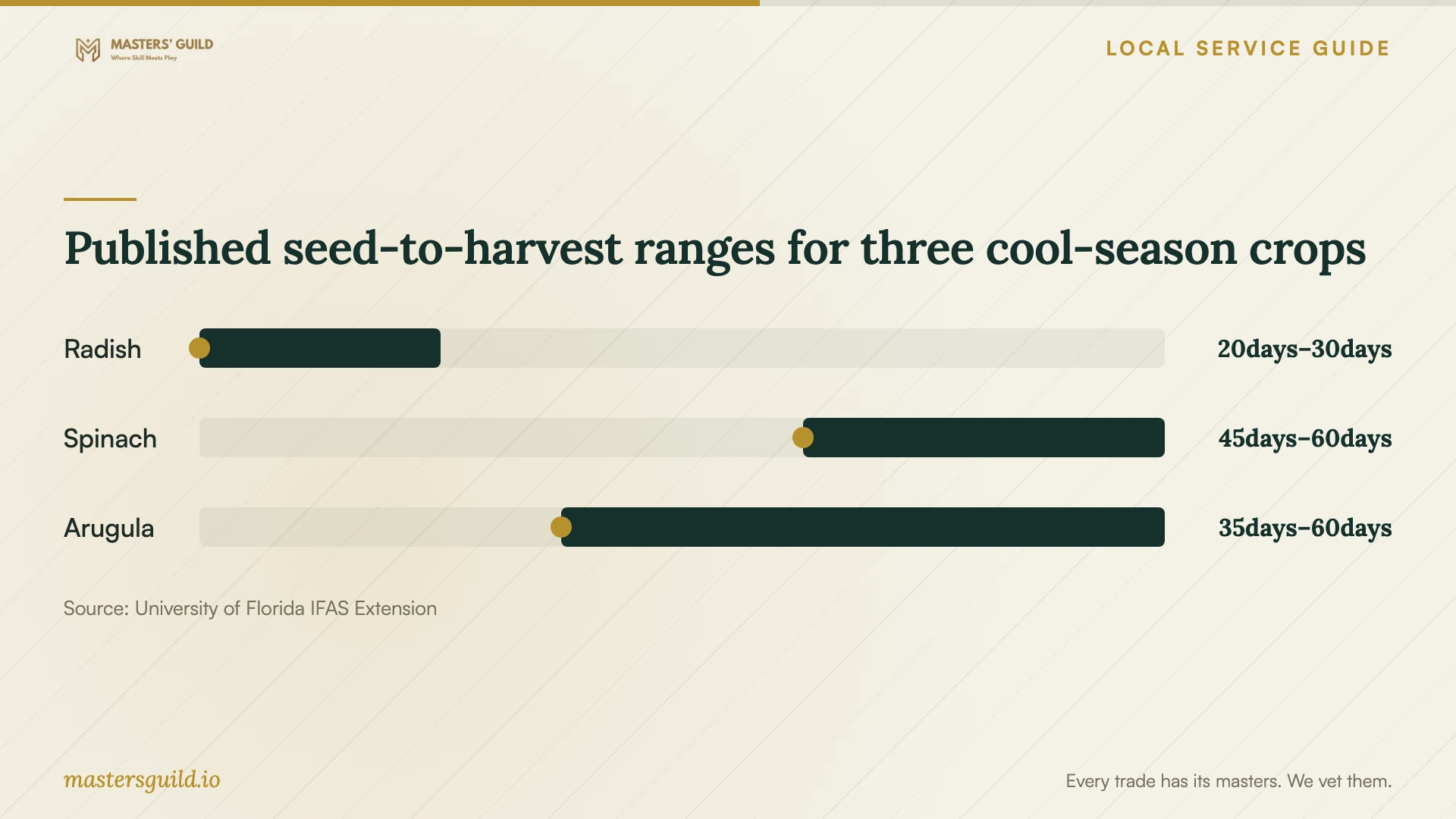
UF/IFAS lists North Florida planting windows of September through March for radish and arugula, and October through November for spinach. Use its published seed-to-harvest ranges to discuss follow-up visits. Treat them as planning references rather than promised harvest dates for your bed. [4]
Published seed-to-harvest ranges for three cool-season crops
Local details that affect your job
Check the shortage schedule and Nocatee exception
Jacksonville states that Phase III restrictions supersede its usual seasonal schedule. Before arranging aftercare, identify whether the standard address-based day or Nocatee’s JEA zone schedule applies to your property. Both irrigation pages direct Nocatee residents to the zone schedule. The city relays the district’s shortage declaration; these pages represent one origin for that declaration. [1] [2]
Mark waterfront buffers and confirm spreader equipment
Jacksonville requires a deflector shield when using a rotary fertilizer spreader. Its page specifies a 3-foot fertilizer-free zone beside water bodies, wetlands, canals and seawalls with a shield or drop spreader, plus a separate minimum 6-foot low-maintenance zone. The page also lists an unshielded-spreader buffer despite its rotary-shield requirement. Specify a shield on rotary equipment and seek city clarification before considering an unshielded configuration. Have the bidder mark both zones before quoting treatment. [1]
Agree on fertilizer weather delays and cleanup
The city prohibits fertilizer application during listed flood or tropical-storm watches and warnings, within a hurricane’s three-day cone of uncertainty, and when heavy rain is expected. Agree on rescheduling terms. Require cleanup of spilled fertilizer and keep clippings and garden debris out of drains, ditches and waterways. [1]
Match the work to the proposal
| Your priority | Request | Point to resolve |
|---|---|---|
| Overgrown beds | Defined cleanup and disposal scope | Which plants stay and how waste leaves |
| New planting | Plant list and written aftercare | Phase III establishment allowances and applicable address or Nocatee zone schedule |
| Bed spraying | Named applicator’s credentials | JL certification has product and equipment limits |
| Waterfront fertilizer | Marked buffers and equipment description | Rotary shield requirement, 3-foot fertilizer buffer and separate 6-foot low-maintenance zone |
| Vegetable beds | Site assessment and follow-up tasks | Drainage, water access and at least six hours of direct sun daily |
Your hiring checklist
- Send photos and identify each bed, shrub and planting area.
- Mark plants to retain and areas the crew must avoid.
- Request separate cleanup, maintenance, materials and hauling charges.
- Agree on gate access, pets, parking and use of your water supply.
- Confirm your applicable watering schedule before arranging aftercare.
- Record who checks new plants and handles watering between visits.
- Ask who will apply treatments and review that person’s credentials.
- Approve plant substitutions and extra work before the gardener proceeds.
Frequently Asked Questions
How much should I budget for gardening?
Request written quotes for your beds and tasks. Ask bidders to separate labor, plants, mulch, disposal and follow-up visits. Set an approval limit for additional work and compare proposals with matching scopes.
Can a gardener spray weeds while maintaining my beds?
Check the individual’s authorization. FDACS permits limited certified landscape personnel to make specified applications to beds and ornamentals. Ask to see the applicator’s JL card. That certification excludes turf pesticide treatment. [5]
Should I postpone planting during the shortage?
Discuss postponement if the planting needs substantial water or you cannot provide aftercare. The district recommends delaying new sod and other landscaping with high water needs where possible. Confirm current establishment allowances before choosing an installation date. [2]
Does the standard weekend watering schedule apply in Nocatee?
Nocatee customers need JEA’s reclaimed-water zone schedule. The district says specific watering days may differ from its standard address-based schedule. Under the current Phase III declaration, the one-day weekly landscape irrigation limit remains. [2]
Sources and scope
This guide combines the sources below with practical planning guidance. Figures apply to the stated geography and period; request a written quote for your property.