
Local service guide
Jacksonville duct cleaning: Scope and Hiring Guide
Arrange duct cleaning in Jacksonville after an inspection identifies a reason to consider it: substantial visible mold inside hard-surface ducts or on HVAC components, vermin infestation, ducts clogged with excessive dust or debris, or particles actually entering the home from supply registers. Compare written scopes and total prices before booking. EPA recommends cleaning as needed. Correct underlying moisture or infestation problems, and arrange replacement of wet or moldy duct insulation. [1]
Ask the inspector to show the problem
Ask to see the affected areas inside your own system before accepting a cleaning recommendation. EPA identifies substantial visible mold inside hard-surface ducts or on other heating and cooling components, vermin infestation, and ducts clogged with excessive dust or debris or releasing particles through supply registers as reasons to consider cleaning. [1]
For suspected mold, ask which material it affects and how the provider identified it. EPA says an expert must confirm whether a substance is mold and may need laboratory analysis. Wet or moldy duct insulation needs removal and replacement. Have the provider explain how someone will correct the moisture source before approving the proposed work. [1]
Keep expectations specific. EPA says duct cleaning has not been shown to prevent health problems, and little evidence supports efficiency improvements from cleaning ducts alone. Ask the bidder to name the condition they intend to correct and show how they will verify completion. [1]
Compare complete written scopes
Get written estimates from at least three providers. EPA advises homeowners who choose system cleaning to ensure the provider includes all system components and has the qualifications to clean them. Ask each bidder to identify supply and return ducts, registers, grilles, coils, drain pans, blower components, and air-handler housing in the estimate. [1]
Compare current written quotes for the same scope. Ask each bidder to list exclusions, access work, optional treatments, and the total price. Require your approval before the crew adds repairs or replacement sections. If you want dryer-exhaust cleaning, request a separate description and price so you can see what you are buying.
EPA's national consumer guidance gives a broad reference of $450 to $1,000 per heating and cooling system, depending on scope, size, access, region, and contamination. Treat that figure as background from the guidance, not a current Jacksonville price or a ceiling for your quote. [1]
Agree on materials, methods, and chemical use
Have the provider identify your duct materials before selecting tools. EPA calls for soft-bristled brushes on fiberglass duct board and fiberglass-lined metal ducts. Ask how the crew will protect furnishings, contain debris, and seal and reinsulate access openings. EPA recommends equipment that exhausts outside or HEPA vacuum equipment when exhaust remains indoors. [1]
Ask for a separate explanation before approving a biocide or an interior coating. EPA's guidance states that no biocides are registered for fiberglass duct board or fiberglass-lined ducts. Ask to see the proposed product label, approved uses, and the reason physical cleaning and moisture correction would not address the problem. [1]
Ask what the crew intends to open, disconnect, or remove, and request the responsible contractor's credentials and proof of insurance. Use the Florida scope question below to clarify responsibility before signing. Do not treat an industry certificate as an answer to a question about applicable state contracting requirements.
Prepare access and inspect the completed work
Clear a path to the air handler and the registers the crew expects to reach. Tell the provider about access restrictions, pets, and rooms you need to use. Confirm expected work duration and cooling interruption. Ask how the crew will secure any open access points if the work extends beyond the appointment.
Before accepting completion, ask the crew to show cleaned components and photographs of areas you cannot inspect. EPA recommends visual inspection and checks for clean registers, intact fiberglass, sealed access openings, and proper system operation. Review any remaining debris or damage with the provider before the crew leaves. [1]
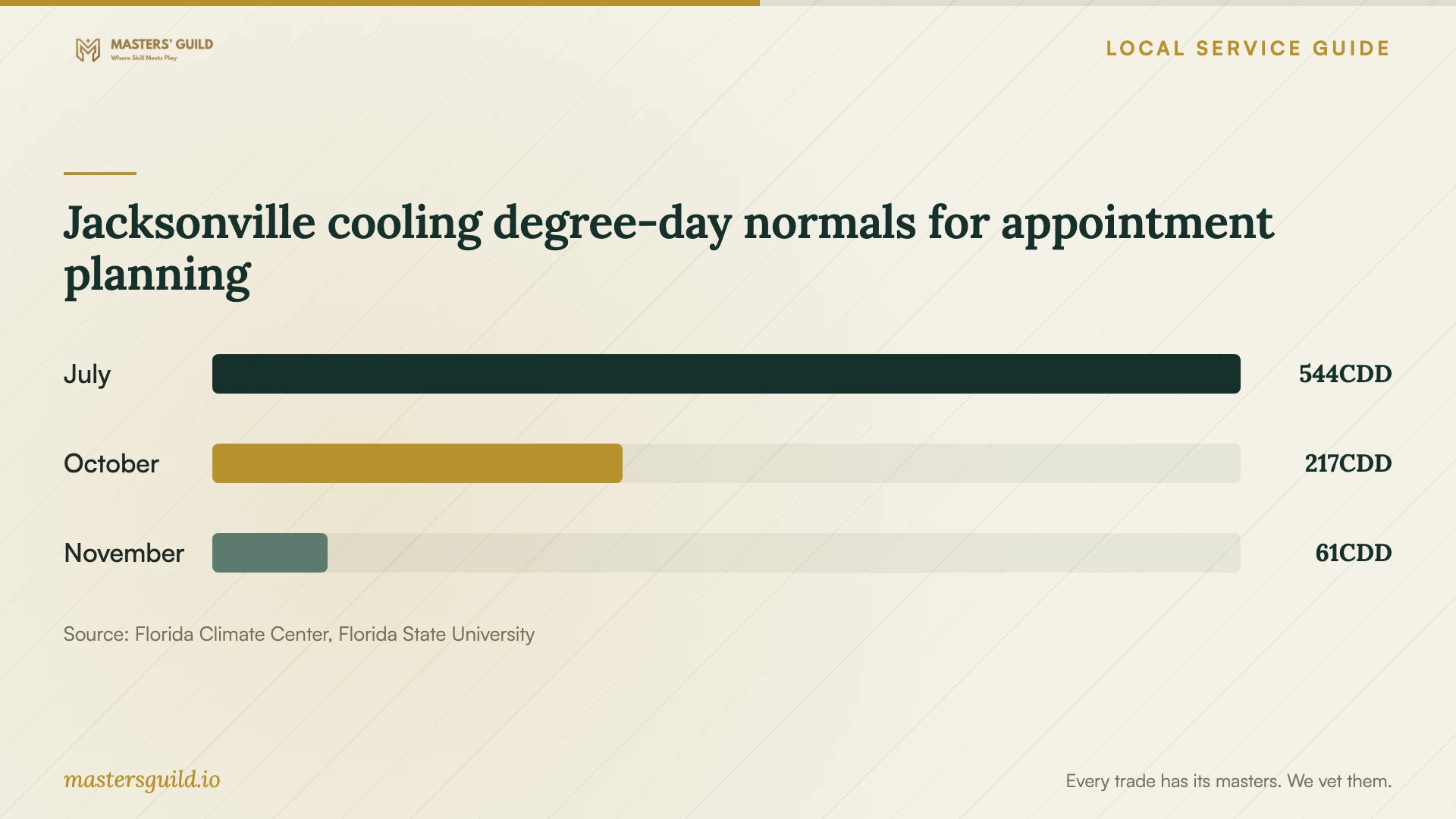
Jacksonville cooling degree-day normals for appointment planning
Local details that affect your job
Ask Jacksonville about added mechanical work
If the proposal expands into duct alterations or HVAC repairs, describe the added scope to Jacksonville's Building Inspection Division before authorizing it. The city lists mechanical permits and inspections assistance at 904-255-8500 and [email protected]. Ask whether your exact work requires a permit and who should obtain it; the contact page does not establish a cleaning exemption. [3]
Clarify Florida's disassembly distinction
The Florida Senate's 2025 statutory text included duct cleaning and equipment sanitizing requiring partial system disassembly within sheet metal, air-conditioning, and mechanical contractor definitions. That historical text provides a specific question for a Jacksonville bid: will the crew partially disassemble the system, and which contractor will take responsibility? Ask the state licensing department or the city's mechanical office to confirm the current classification and requirements before approving that scope. [2] [3]
Match the inspection finding to the next step
| Finding or proposal | Next step |
|---|---|
| Dust on a return grille alone | Clean the grille; ask for evidence before buying whole-system cleaning. |
| Vermin infestation, clogged ducts with excessive debris, or particles entering through supply registers | Consider cleaning and correct the underlying cause. |
| Substantial visible mold inside hard-surface ducts or on HVAC components | Ask for identification of the affected material and moisture correction. |
| Wet or moldy duct insulation | Arrange removal and replacement of affected insulation. |
| Partial disassembly, duct alterations, or HVAC repairs | Identify the responsible contractor and confirm current scope and permit requirements. |
Your hiring checklist
- Describe the problem that prompted your request and ask for inspection photographs.
- Give bidders the same list of systems and components to include.
- Request contractor credentials, references, and proof of insurance.
- Ask about duct materials, tools, debris containment, and access repairs.
- Require separate approval for chemicals, repairs, and replacement sections.
- Confirm access arrangements, expected duration, and cooling interruption.
- Review cleaned components and check system operation with the crew.
Frequently Asked Questions
Should I schedule cleaning every year?
EPA recommends cleaning as needed rather than on a routine schedule. Ask the provider to document the condition that warrants cleaning before agreeing to recurring visits. [1]
Does a musty smell confirm mold?
Ask the provider to show the affected material and investigate moisture. EPA says an expert must identify suspected mold and may need laboratory analysis for confirmation. [1]
Can cleaning only the registers solve system contamination?
Ask the bidder to explain the limits of register cleaning. EPA warns that leaving a contaminated system component uncleaned can lead to recontamination of the system. [1]
Does EPA certify duct cleaners?
No. EPA says it does not certify, endorse, or approve duct-cleaning companies. Ask for relevant credentials, references, and an explanation of the proposed methods. [1]
Sources and scope
This guide combines the sources below with practical planning guidance. Figures apply to the stated geography and period; request a written quote for your property.