
Local service guide
Lawn mowing in Jackson, MS: Scheduling and Quotes
Lawn mowing in Jackson, MS should start with a yard assessment and a written scope covering cutting height, visit frequency, trimming, clipping handling and rain delays. Ask the provider to identify your grass before recommending weekly or biweekly visits. Mississippi State University Extension advises removing no more than one-third of the grass height per mowing, so choose a schedule that follows growth rather than a fixed calendar alone. [1]
Choose a schedule your grass can tolerate
Ask the person quoting the work to explain the proposed cutting height and how much growth they expect between visits. In its dated 2005 mowing guidance, Mississippi State Extension explains that fast-growing hybrid bermudagrass may require several cuts a week, while centipedegrass under low water and fertility management may need a cut every two weeks. Those examples describe different growing conditions, not a universal service timetable. [1]
Use the one-third rule to review the plan after service starts. If the grass becomes too tall between appointments, ask for a shorter interval or a staged recovery cut. Avoid asking a crew to remove all excess height in one pass. Extension links extreme mowing heights with scalping, thinning and potential turf loss. [1]
For an ongoing agreement, specify how you will approve schedule changes as growth slows or accelerates. Ask whether the provider charges per completed visit, bills a fixed monthly amount, or requires a seasonal commitment. Record how skipped visits affect the bill.
Compare the same work in each quote
Request an itemized quote for your actual yard. Give each provider the same photos and access information, including the narrowest gate, slopes, fenced areas and obstacles. Ask them to distinguish the initial cleanup charge from the recurring mowing charge, then name any conditions that could change either amount.
Define the finish you expect: mowing areas, string trimming, edging boundaries and clearing clippings from hard surfaces. Ask whether the crew leaves clippings in the lawn, bags them or removes them from the property. Extension says clippings fall into the turf canopy and decompose quickly when the crew follows the one-third rule; excess clippings from irregular mowing can collect on the surface. [1]
Before accepting, ask for evidence of liability insurance and a clear process for reporting damage. Record who moves furniture, collects pet waste and clears branches before arrival. Keep leaf removal, bed maintenance and other extras separate unless you want them included in the written agreement.
Set a rain-delay and catch-up plan
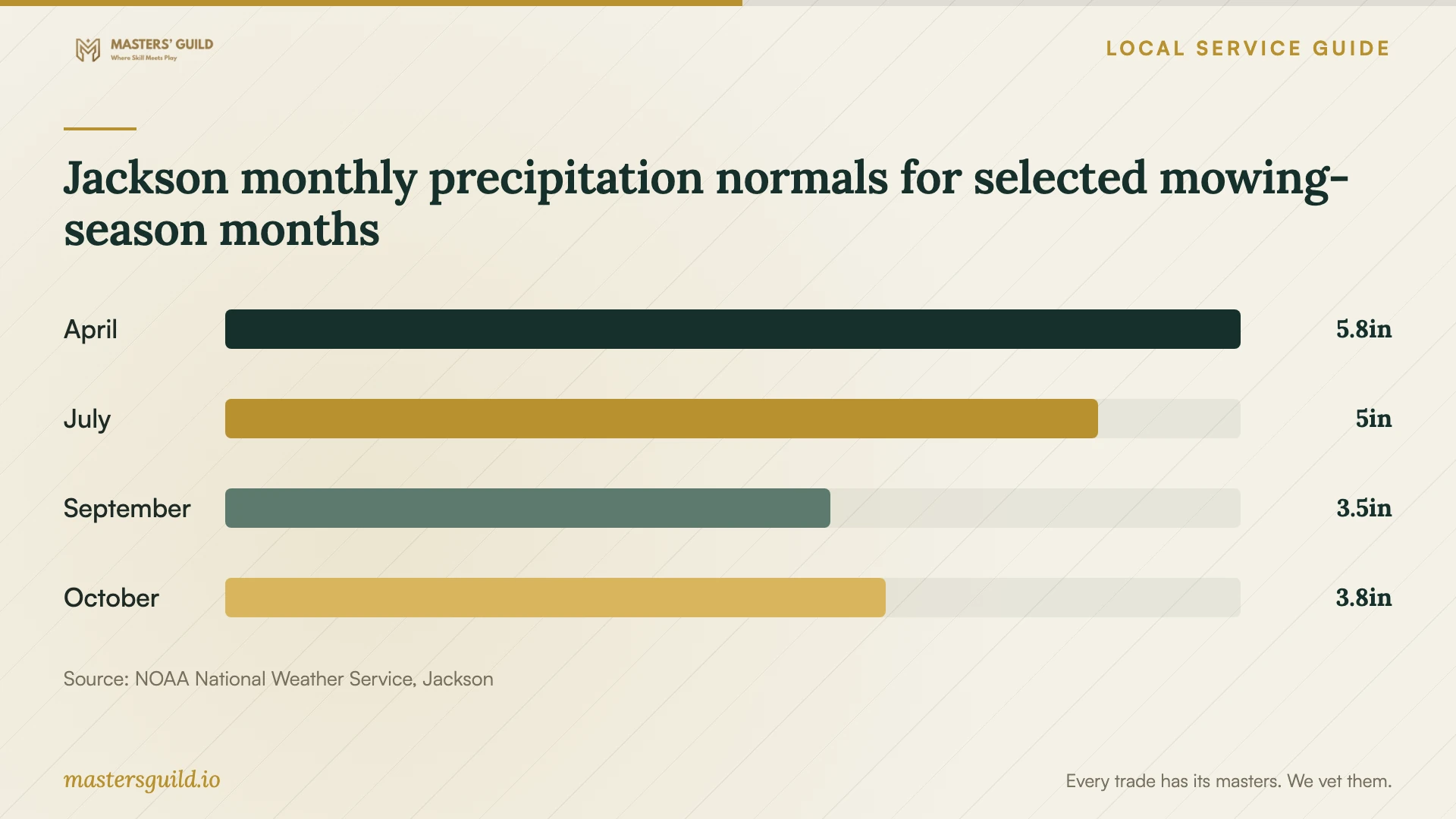
Include a weather policy in the agreement. Jackson's National Weather Service climate table reports measurable average precipitation in every month of the 1991–2020 normal period. For mowing practice, Mississippi State Extension advises avoiding wet leaves from rain or heavy dew, especially when disease pressure is present. [4] [1]
Ask how the provider communicates a postponement, when they expect to return and whether you must approve a catch-up charge. Specify that the crew should contact you before entering areas with standing water or leaving visible wheel damage. After an extended delay, discuss the cutting height before the next visit so the crew can respect the one-third rule. [1]
Use the climate chart as a reason to discuss flexibility. It summarizes historical monthly rainfall, not the number of wet mowing days or the conditions at your property. Check the lawn with your provider when deciding whether to proceed. [4]
Separate recovery work from recurring care
For an overgrown yard, request an inspection before accepting a routine mowing price. Show the provider any debris, hidden obstacles or inaccessible areas you know about. Ask for a written first-visit scope that separates debris collection, cutting and disposal, with approval required before extra work.
If a city notice prompted the job, confirm the required correction with the issuing office and give the provider that information. Jackson's Community Improvement division works with property owners to correct public-nuisance violations and lists the 2018 International Property Maintenance Code with amendments. Its page does not state a grass-height threshold or a universal correction deadline. [2]
Jackson monthly precipitation normals for selected mowing-season months
Local details that affect your job
Jackson code notices need a notice-specific scope
The city's Community Improvement division seeks voluntary owner compliance and works with owners to correct violations. If you received a notice, ask the division to clarify the affected area and required correction, then attach those details to the mowing agreement. Do not assume that completing a cut resolves the notice; ask the issuing office how to confirm compliance. [2]
Mississippi shade guidance changes the equipment plan
For shaded parts of your yard, apply Mississippi State Extension's regional guidance: raise the mowing height and reduce traffic where possible. The publication identifies riding-mower wheels beneath shade trees as a cause of turf decline and suggests string trimming or mulch where tight turns create problems. Ask the provider to inspect tree areas and specify their approach before promising a uniform cut across the property. [3]
Match the service agreement to your yard
| Your situation | Request | Decision point |
|---|---|---|
| Grass outgrows the interval | Review visit frequency and cutting height | Keep removal within one-third of total height per mowing. |
| Thin turf beneath trees | Inspect shade and mower turning areas | Discuss a higher cut and reduced mower traffic. |
| Wet grass on service day | Use the agreed postponement process | Extension advises avoiding wet-leaf mowing, particularly under disease pressure. |
| Overgrowth with a city notice | Quote the initial work against the notice | Confirm required corrections with Community Improvement. |
Your hiring checklist
- Send current photos of the front, back, side yards and any overgrowth.
- Measure the narrowest gate and explain parking and access arrangements.
- Ask the provider to identify the grass and propose cutting heights for sunny and shaded areas.
- Get separate prices for the first cleanup and recurring visits.
- List mowing, trimming, edging, clipping handling and disposal in the agreement.
- Agree on rain delays, skipped-visit billing and approval of extra charges.
- Share any city notice and confirm its requirements with the issuing office.
Frequently Asked Questions
Should I choose weekly or biweekly mowing?
Choose the interval that lets the crew remove no more than one-third of the grass height. Mississippi State Extension describes different needs for fast-growing hybrid bermudagrass and low-input centipedegrass. Ask the provider to assess your grass and revise the interval when growth changes. [1]
Should the provider bag the clippings?
Ask the provider to explain the choice and include any bagging or removal charge in the quote. Extension says clippings decompose quickly within the canopy when mowing follows the one-third rule. Discuss how the crew will handle excess clippings after an overdue cut. [1]
Can mowing fix thin grass under trees?
Adjusting mowing may help, but assess the light first. Mississippi State Extension says no turfgrass grows in complete shade and identifies bermudagrass as poorly suited to shade. Ask for a higher cutting height and less traffic, then discuss alternatives if the area lacks enough light. [3]
What should a mowing quote include?
Ask for the areas covered, cutting approach, visit frequency, trimming and edging scope, clipping handling, access arrangements and payment terms. Separate the first cleanup from repeat visits. Include the process for weather delays, damage reports and approval of additional work.
Sources and scope
This guide combines the sources below with practical planning guidance. Figures apply to the stated geography and period; request a written quote for your property.