
Local service guide
Legal Document Preparation in Irving, TX
For Legal Document Preparation in Irving, choose help according to the judgment your paperwork requires: seek an attorney for advice about wording or legal consequences, and arrange notarization for a document you have already selected and completed. Texas bars nonattorney notaries from preparing, selecting, or advising on legal documents. Before accepting a quote, identify who handles legal review, signatures, filing or recording, and corrections. [4]
Choose who supplies the legal judgment
Start by describing the result you want, such as arranging authority for someone to act for you, updating estate documents, or handling paperwork connected with your home. Ask the proposed provider who will decide which document and wording fit that result. If you need that advice, seek an attorney and ask whether the engagement includes reviewing your circumstances.
The Texas Secretary of State prohibits nonattorney notaries from preparing, drafting, selecting, or advising about legal documents. It also says a nonattorney notary cannot decide which notarial certificate to attach. Treat an offer to notarize as a separate service from legal drafting, and ask anyone offering both services to identify the attorney responsible for the legal work. [4]
Describe unresolved questions before asking for a fixed price. For example, tell the attorney if you are unsure who should receive an interest in your home or what authority you want another person to have. Ask the attorney to explain the proposed document before you approve a final draft.
Compare quotes by deliverable
Request an itemized quote for preparation, attorney review, revisions, signing arrangements, delivery, and government charges. Ask whether you receive editable drafts, signed originals, copies, and confirmation of filing or recording. Give competing providers the same description so you can compare the work they promise.
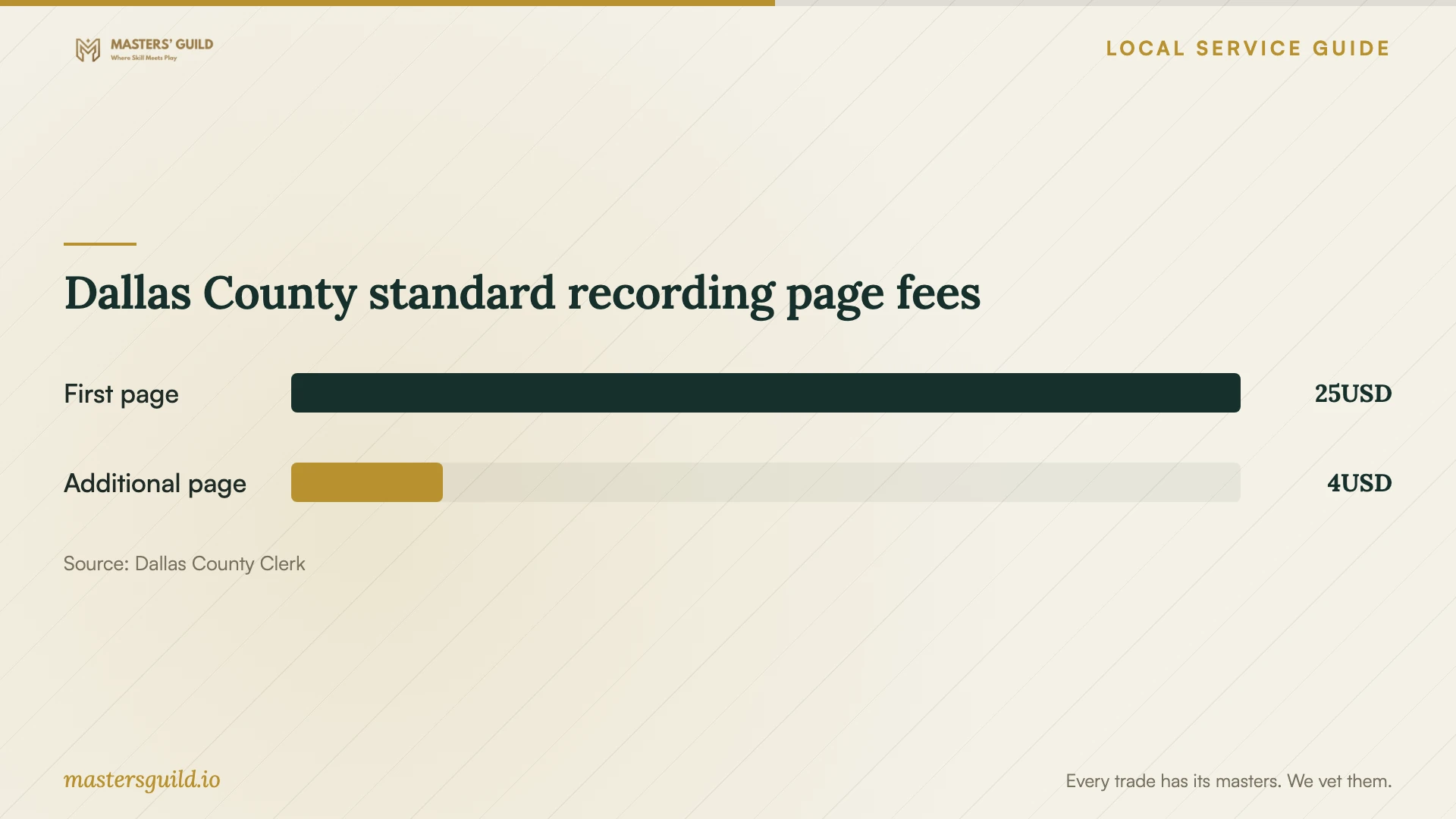
For Dallas County standard recording, the clerk lists $25 for the first page and $4 for each remaining page. The recording division lists plain copies at $1 per page and adds $5 per document for certification. These are published county charges, not prices for preparing a will, power of attorney, or deed. [3]
Ask the provider to name the fee category that applies to your document and explain any extra charges. The county publishes exceptions and separate schedules for some documents, so avoid treating the standard page rate as a universal filing price. Agree who pays additional charges if the final document has more pages than the draft. [3]
Separate document completion from submission
Ask for separate dates for your first draft, your review, signing, and submission. Specify who checks names and property information, who obtains supporting records, and who responds if the receiving office rejects the submission. Ask for a copy of the final paperwork before anyone delivers it.
For Dallas County district-court civil and family cases, attorneys must file electronically. Self-represented litigants may file electronically or submit paper pleadings at the designated civil file desk. The District Clerk does not accept County Court at Law pleadings. Have the provider identify the court, clerk, and existing case number before quoting filing assistance. [2]
The District Clerk warns self-represented divorce filers that mistakes can lead to dismissal and additional fees, and that the clerk cannot advise them how to file or pursue a case. If your job involves court proceedings, ask an attorney to define the legal work and any representation you need. [2]
Prepare for signing and handover
Ask the attorney or document issuer to confirm the signing instructions before booking an appointment. Have the notary confirm acceptable identification and the appointment arrangements. Texas guidance says that, unless a notary knows the signer or uses a credible witness, the notary must identify the signer through a government-issued identification card or a United States passport. [4]
At handover, compare the final document with the draft you approved. Check spelling, addresses, named parties, attachments, and blank spaces. Ask who keeps the originals and how you can obtain another copy. If the quote includes submission, request the receipt and a copy showing what the office accepted.
Dallas County standard recording page fees
Local details that affect your job
Property recording has its own supporting requirements
For a Dallas County property recording, tell your provider whether the paperwork conveys property or follows a court action. The County Clerk requires photo ID for documents submitted that convey property from one person to another. It also requires a certified copy when someone presents a court document for recording as a result of court action. Include obtaining that copy and arranging submission in the scope. [1]
Use the recording office's payment and return rules
The Dallas County Recording Division lists its address as 500 Elm Street, Suite 2100, Dallas, and its hours as 8:00 a.m. to 4:30 p.m., Monday through Friday, except court-approved holidays. It does not accept personal checks. For mailed assumed-name certificates or withdrawals, its fee page requires a self-addressed stamped envelope to return the file-stamped duplicate. Confirm the requirements for your document before choosing mail or an in-person visit. [3]
Match the task to the help you need
| Your situation | Arrange | Clarify before paying |
|---|---|---|
| You need help choosing wording or a document | Attorney advice and drafting | A nonattorney notary cannot select, draft, or advise on legal documents. |
| You have a completed document requiring notarization | A notary appointment | Confirm identification and the required certificate with the document issuer; a nonattorney notary cannot choose it. |
| You need a Dallas County district-court filing | A filing plan for the correct case | Attorneys must e-file; self-represented litigants have paper and electronic options. |
| You need to record a court document affecting property | Certified-copy retrieval and recording arrangements | The Recording Division requires a certified copy for court documents presented for recording as a result of court action. |
Your hiring checklist
- Describe the outcome you want and list questions you need an attorney to answer.
- Ask who selects the document and who takes responsibility for legal review.
- Provide existing documents and relevant case or property information through an agreed secure channel.
- Request separate prices for professional work, notarization, copies, and government charges.
- Confirm the receiving court or recording office and who handles submission.
- Agree draft, review, and signing dates, plus responsibility for corrections.
- Request signed originals, submission receipts, and accepted copies at handover.
Frequently Asked Questions
Can a notary prepare my legal documents?
A Texas nonattorney notary cannot prepare, draft, select, or give advice concerning legal documents. If someone offers drafting and notarization together, ask which attorney provides the legal work and what the engagement covers. [4]
Does the county recording fee include document preparation?
The published standard recording fee covers county recording: $25 for the first page and $4 for each additional page. Ask your provider to quote preparation, legal review, and other services as separate items. [3]
Can I file Dallas County civil or family paperwork myself?
For district-court cases, the District Clerk permits self-represented litigants to file paper pleadings at the designated file desk or file electronically. Confirm that your case belongs with that clerk; the District Clerk does not accept County Court at Law pleadings. [2]
Sources and scope
This guide combines the sources below with practical planning guidance. Figures apply to the stated geography and period; request a written quote for your property.