
Local service guide
Duct and Vent Cleaning in Irving, TX
Arrange Duct and Vent Cleaning in Irving by asking the contractor to show the contamination, provide a written whole-system scope, and explain any proposed repairs before you approve work. EPA recommends cleaning as needed for substantial contamination, rather than on a routine schedule. For HVAC installation, repair or maintenance, verify the contractor’s Texas license; ask Irving Inspections about permits if the proposal includes alterations. [1] [2] [3]
Decide whether cleaning addresses the problem
Start with the reason you are considering the service. EPA says return registers can collect dust during normal operation, and homeowners can vacuum or remove and clean those grilles. Ask the contractor to show you conditions inside the system before accepting a whole-home cleaning recommendation. [1]
Consider cleaning when an inspection reveals substantial visible mold growth on hard surfaces, vermin, or excessive dust and debris clogging ducts or escaping through supply registers. Ask the contractor to identify and correct the underlying cause. Cleaning without correcting moisture or another source of contamination can leave you facing the same problem again. [1]
Treat promises of allergy relief or lower energy bills with caution. EPA says duct cleaning has not been shown to prevent health problems, and little evidence supports improved efficiency from cleaning ducts alone. Ask an HVAC contractor to investigate cooling complaints instead of assuming cleaning will resolve them. [1]
Get a scope you can compare
Ask at least three providers for written estimates. EPA advises homeowners to agree on the total cost and scope before work begins. Give each bidder the same description of your concern and ask them to explain which components they will inspect and clean. [1]
Request separate entries for supply ducts, return ducts, registers, grilles, air-handler housing, blower, coils and drain pans. EPA describes these as components involved in system cleaning and warns that leaving a contaminated component untreated can contaminate the system again. Have the provider explain any component they exclude or refer to another contractor. [1]
Ask how the crew will collect debris and protect furnishings. EPA recommends vacuum equipment that exhausts outside, or HEPA vacuum equipment when exhaust stays indoors. Have the contractor identify your duct materials and explain how the tools will protect fiberglass lining or flexible duct. [1]
Keep dryer-exhaust cleaning as a separate written line if you want it included. Ask the bidder to describe the route and endpoint they intend to clean. Do not assume that a quote using the word vents includes that work.
Handle mold claims and added work before approval
Ask to see any material the provider calls mold. EPA explains that appearance alone may not establish whether a substance is mold; an expert assessment and laboratory analysis may be necessary. Wet or moldy duct insulation needs removal and replacement because cleaning cannot address it effectively. [1]
Request the product label and a written reason before approving a chemical treatment. EPA says no biocides are registered for fiberglass duct board or fiberglass-lined ducts. Ask the provider to identify the duct material, explain the proposed use and address moisture control before you decide. [1]
Pause approval when the proposed job expands into duct alterations, equipment repair or replacement. Request a revised scope that names the contractor responsible for each task, the permit arrangements and the added cost. Use the local checks below before agreeing.
Plan access and inspect the completed work
Before the visit, clear access to registers, the air handler and any agreed attic entry. Tell the crew about fragile furnishings and arrange a place for pets. Ask how long the work will interrupt cooling and whether anyone needs to leave during a proposed treatment.
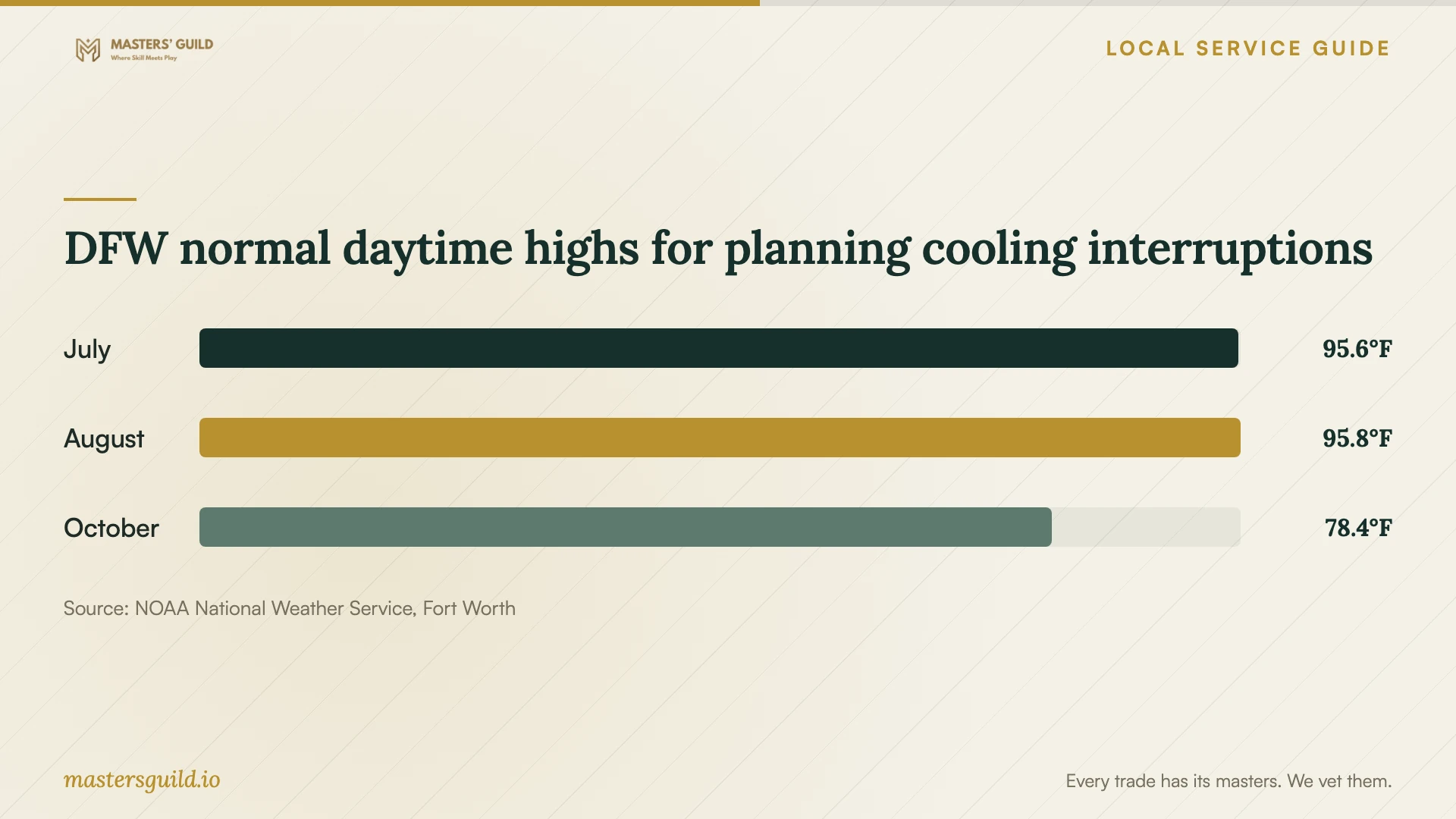
For regional scheduling context, the National Weather Service reports DFW normal high temperatures of 95.6°F in July and 95.8°F in August, compared with 78.4°F in October, using 1991–2020 observations. Use the forecast and your household’s cooling needs to choose an appointment; these regional averages do not establish a cleaning season. [4]
At completion, ask the contractor to show accessible cleaned components and photographs of areas you cannot see. EPA recommends visual inspection to assess cleanliness. Check that the crew reattached registers, sealed and insulated access holes, and demonstrated system operation before you accept the work. [1]
DFW normal daytime highs for planning cooling interruptions
Local details that affect your job
Ask Irving about alterations through its permit process
Irving requires building permits to erect, enlarge, alter, move, demolish or repair a structure and directs applicants to its MGO online permit portal. Its residential guidance does not give a duct-cleaning-specific exemption. Send Inspections the proposed scope if cleaning includes duct alterations or replacement. The city lists Mechanical/HVAC among permit categories that do not require plans; that does not establish a permit exemption. [3]
Verify Texas credentials for HVAC work
TDLR says contractors who install, repair or maintain air-conditioning, refrigeration or heating systems must hold a TDLR license, and ACR companies must employ an ACR contractor at each permanent location. Use the agency’s license search when your quote includes that work. Ask which licensed contractor will take responsibility rather than relying on a cleaning credential alone. [2]
Review tax when mold remediation enters the quote
The Texas Comptroller identifies duct cleaning performed during mold remediation as a taxable real property cleaning service for residential and nonresidential property. Its guidance distinguishes other remediation tasks and discusses disaster-related exemptions. If your proposal expands into remediation, request separate descriptions of services and tax instead of assuming the same treatment applies to the entire job. [5]
Choose the next step from the inspection
| Finding | Next step | Before approving work |
|---|---|---|
| Dust on return grilles alone | Clean the accessible grilles | Ask for evidence of contamination inside the system |
| Excessive debris or particles escaping supply registers | Consider system cleaning | Agree on all affected components and debris collection |
| Wet or moldy duct insulation | Arrange replacement and moisture correction | Ask the contractor to explain the cause and replacement scope |
| Proposed HVAC repair or duct alteration | Check credentials and city permit requirements | Get a revised written scope |
Your hiring checklist
- Describe the concern and ask the provider to show the condition that warrants cleaning.
- Give bidders the same component list and request written exclusions.
- Ask who will perform any proposed HVAC repair and verify their credentials.
- Resolve permit questions with Irving Inspections before approving alterations.
- Request separate approval for chemicals, replacement parts and dryer-exhaust work.
- Agree on access, cooling interruption and protection for belongings.
- Request photographs and a final walkthrough before accepting completion.
Frequently Asked Questions
How often should I schedule duct cleaning?
EPA recommends cleaning as needed rather than on a fixed schedule. Base the decision on an inspection and documented contamination. Keep regular filter changes and heating-equipment inspections separate from the decision to clean ducts. [1]
What should I budget?
Get written quotes for your actual system and agreed components. EPA’s guidance lists a broad national reference of $450 to $1,000 per heating and cooling system, but the publication originated in 1997. Treat it as background, not a current Irving price or a ceiling on a quote. [1]
Does Irving require a permit for cleaning alone?
The supplied city guidance does not answer that specific question. It describes permits for structural work and lists Mechanical/HVAC as a permit category that needs no plans. Ask Inspections about your exact scope if the contractor proposes alterations, repair or replacement. [3]
Can a company claim EPA certification?
EPA says it does not certify, endorse or approve duct-cleaning companies. Ask about relevant credentials, references and experience with your duct materials. Verify Texas licensing for proposed HVAC installation, repair or maintenance through TDLR. [1] [2]
Sources and scope
This guide combines the sources below with practical planning guidance. Figures apply to the stated geography and period; request a written quote for your property.