
Local service guide
Pest Control Services in Irvine: Hiring Guide
To arrange Pest Control Services in Irvine, identify the pest, check whether Orange County Mosquito and Vector Control District assistance fits the problem, and request a written treatment plan from a company qualified for the work. The District lists services for mosquitoes, red imported fire ants, rats and flies. California distinguishes household pest treatment, wood-destroying pest work and fumigation through separate license branches. [1] [4]
Identify the pest before choosing a treatment
Start your request with photographs, the rooms or outdoor areas affected, and a record of when you noticed activity. Describe what you saw rather than naming a pest you cannot identify. Ask the inspector to explain the identification and show you the evidence before you authorize treatment.
Orange County residents can submit specimens to the District for insect identification by mail or office drop-off. The District requires an identification form before drop-off or at the office. Ask about specimen handling before collecting or transporting an insect you suspect could sting. [1]
For a private inspection, ask which areas the provider will examine and which access limitations could affect the findings. Include the attic, garage, exterior perimeter or affected cupboards in your discussion as appropriate. Request a written explanation of the pest, observed activity and proposed treatment areas.
Match the company’s qualifications to the proposal
California’s Structural Pest Control Board defines Branch 2 as household pest control excluding fumigation with poisonous or lethal gases. Branch 3 covers wood-destroying pests or organisms through insecticides or structural repairs and corrections, excluding that fumigation. Branch 1 covers household and wood-destroying pest control through fumigation with poisonous or lethal gases. [4]
Ask for the company’s registered name and the license details relevant to your proposal. Use the Board’s company or licensee verification option to check those details. If a termite proposal includes both localized work and fumigation, ask who will perform each part and which branch applies. [4]
The Board distinguishes individual licenses from company registration. An applicator can apply pesticides on behalf of a registered company but cannot contract for pest control work independently. Field representatives also work on behalf of registered companies. Ask whose company name will appear on your agreement, invoice and follow-up commitment. [4]
Compare the complete price and follow-up terms
Request a written price tied to the identified pest and treatment area. Ask the provider to itemize the initial visit, later visits, monitoring, exclusion work and any repairs. For recurring service, request the visit frequency, contract length, cancellation terms and charges for additional callouts.
Give each bidder the same photographs and description. Ask whether the price covers indoor work, exterior work or both, and whether you must arrange access to adjoining or shared areas. For a condominium or a home with shared landscaping, clarify responsibilities with the property manager before authorizing work outside your unit.
Before booking, request written preparation and re-entry instructions for the proposed method. Tell the provider about children, pets, aquariums and any access needs. Ask how the provider will assess results, when you should report continued activity, and whether the agreement includes another inspection or treatment.
Include mosquito sources in the inspection scope
Before purchasing recurring mosquito treatment, ask for a search for standing water. The District identifies planter saucers, clogged rain gutters, water on pool covers and neglected or non-circulating ponds as potential breeding locations. Its guidance says chlorine does not kill mosquito larvae, so discuss pool circulation and accumulated water with the provider. [3]
For ornamental ponds, the District provides free mosquitofish for placement on Orange County residents’ own properties. Its services page states that pickups are suspended and residents can request delivery. Confirm the current arrangement before planning an office visit. [1]
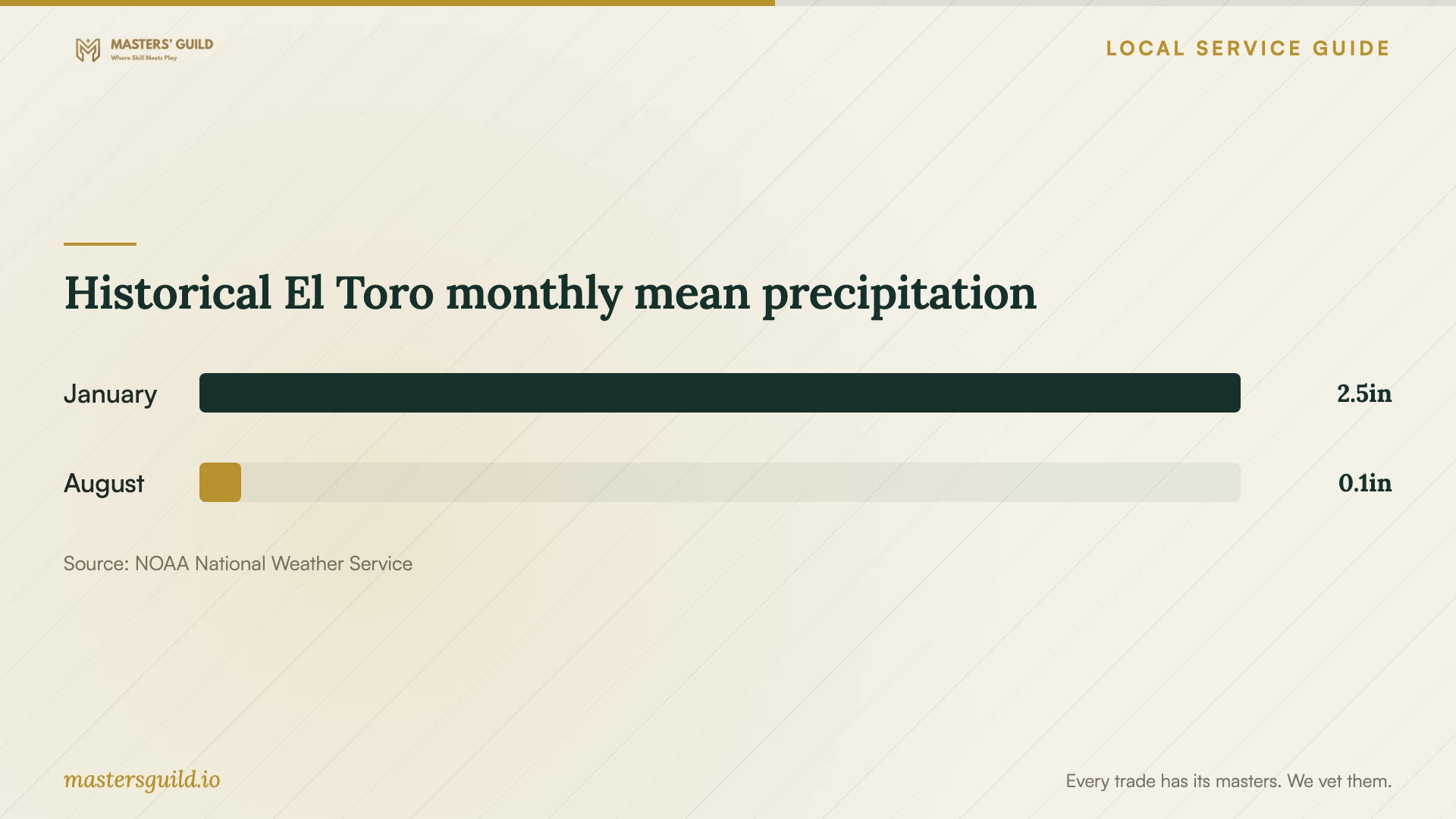
Use the historical rainfall comparison below as context for planning a gutter and drainage inspection before winter storms. The National Weather Service’s El Toro station narrative describes precipitation as concentrated in winter. After rain or irrigation, check the specific containers and drainage points identified during your inspection. [3] [5]
Historical El Toro monthly mean precipitation
Local details that affect your job
Check the District’s scope before buying private service
Orange County Mosquito and Vector Control District lists assistance for mosquitoes, red imported fire ants, rats and flies, and provides a district-boundary check on its services page. For an Irvine property, confirm coverage and ask what assistance applies to your reported problem before agreeing to private work. Do not assume the District provides every treatment, cleanup or repair included in a contractor’s proposal. [1]
Report suspected fire ants in irrigated landscaping
The District advises residents to report suspected red imported fire ants rather than treat them. Its Orange County guidance describes colonies in irrigated turf, planters and beside hardscape, often without the large mounds seen elsewhere. If you notice suspicious granular soil in those locations, report the location and flag it to your landscaper before planned work. The District warns that unsuitable pesticide treatment can cause colonies to relocate. [2]
Choose the next step for your pest problem
| Situation | Next step | Clarify before booking |
|---|---|---|
| Unidentified insect | Ask about the District’s specimen identification service. | Complete the required form and confirm specimen handling. |
| Suspected red imported fire ants | Report the location to the District. | Follow its advice against homeowner treatment. |
| Household pest treatment without fumigation | Ask about Branch 2 qualifications. | Identify the registered company responsible for the work. |
| Wood-destroying pest treatment or repairs | Ask about Branch 3 qualifications for work excluding fumigation. | Separate treatment and repair responsibilities in the proposal. |
| Fumigation proposal | Ask about Branch 1 qualifications. | Request the performing company’s details and preparation instructions. |
Your hiring checklist
- Photograph the activity and record the affected rooms or outdoor locations.
- Ask the inspector to explain the pest identification before proposing treatment.
- Request the company’s registered name and relevant license details.
- Give bidders the same treatment areas and access information.
- Separate treatment, exclusion, repairs and follow-up charges in the quote.
- Request preparation, pet precautions and re-entry instructions in writing.
- Clarify responsibility for shared landscaping or adjoining access.
- Keep the inspection findings, agreement and follow-up contact details together.
Frequently Asked Questions
Should I arrange District assistance or hire a private company?
For mosquitoes, red imported fire ants, rats or flies, check the District’s coverage and available assistance first. Describe the location and ask what it can address. Use that answer to define any remaining private inspection, treatment or repair scope. [1]
Can I treat suspected red imported fire ants myself?
The District discourages homeowner treatment and asks residents to report suspected colonies. It explains that some pesticide treatments kill workers without eliminating the colony and can prompt queens to relocate. Report the location before trying a treatment. [2]
Does a household pest license cover termite fumigation?
The Board defines Branch 2 household pest work as excluding fumigation. Branch 3 wood-destroying pest work also excludes fumigation. Branch 1 covers fumigation with poisonous or lethal gases. Ask which registered company and branch will handle the proposed method. [4]
What should a mosquito inspection include?
Ask the provider to check planter saucers, clogged gutters, pool-cover water and non-circulating ponds, all locations identified by the District. Request a written list of water sources you should address and a separate explanation of any proposed pesticide treatment. [3]
Sources and scope
This guide combines the sources below with practical planning guidance. Figures apply to the stated geography and period; request a written quote for your property.