
Local service guide
TV mounting in Indianapolis: Plan the Installation
For TV mounting in Indianapolis, choose an installer who will confirm the wall construction, TV and bracket compatibility, cable route, and power arrangement before quoting. Request separate prices for mounting, electrical work, wall repair, and old-TV removal. Before anyone drills or cuts an older painted wall, discuss paint disturbance: Indiana health guidance recommends lead-safe practices in pre-1978 homes unless testing has ruled out lead paint. [2]
Define the installation before comparing quotes
Give each installer the same description: TV model, proposed wall, bracket model if purchased, preferred screen position, and connected equipment. Include a wide photo showing the wall, nearby outlets, furniture, and fireplace if present. Ask the installer to identify any assumptions that require an on-site check.
Request an itemized quote covering the bracket, fasteners, mounting labor, cable treatment, equipment connection, cleanup, and removal of an existing bracket. Agree on who supplies missing parts and how the installer will obtain your approval for extra work. Compare the total for your intended result.
For power behind the screen, ask an electrician to assess the proposed arrangement and quote any outlet work. Keep electrical work and signal-cable routing explicit in the scope. Name the person responsible for confirming applicable local requirements before work starts.
Approve the screen position and cable route
Mark the proposed screen outline with removable tape and assess it from your usual seat. Check the position with other household members before approving holes. For an adjustable bracket, have the installer demonstrate the intended movement and confirm access to the TV connections.
Choose between a visible surface cable cover and a proposed concealed route before accepting the quote. Discuss where the installer would open the wall, how they would assess the cavity, and who would patch and paint. Agree on a fallback arrangement if inspection prevents the planned route.
For a fireplace location, provide the TV and fireplace manuals and ask the installer to review their placement requirements. Have the installer explain the attachment plan and proposed cable path before approving the location. Consider another wall if you cannot resolve those questions.
Discuss older painted walls before cutting
Tell the installer the home's construction year if you know it. Indiana's Department of Health recommends lead-safe work practices for anyone working on a pre-1978 home or child-occupied facility unless testing has concluded that no lead paint is present. Discuss how the contractor will assess paint disturbance, contain dust, and clean the work area. [2]
Avoid assuming that a small opening qualifies for EPA's minor-repair exception. EPA considers the work method as well as the disturbed area and excludes demolition of painted surface areas. It also treats non-emergency jobs in the same room within the same 30 days as one job for this assessment. Tell the installer about related recent work in that room. [3]
Plan replacement, recycling, and final setup
For a replacement job, specify who takes the old TV down, where they will place it, and whether the quote includes transport for recycling. Indiana prohibits household disposal of televisions with municipal waste intended for landfill disposal or burning. IDEM provides a county-organized collector list through Indiana E-Cycle, but accepts no electronics at its own offices. [1]
Before the installer leaves, ask for a demonstration of bracket movement, cable slack, input selection, and connected equipment. Confirm access to the outlet and connections. Keep the bracket instructions and take a photo of the finished cable arrangement for future changes.
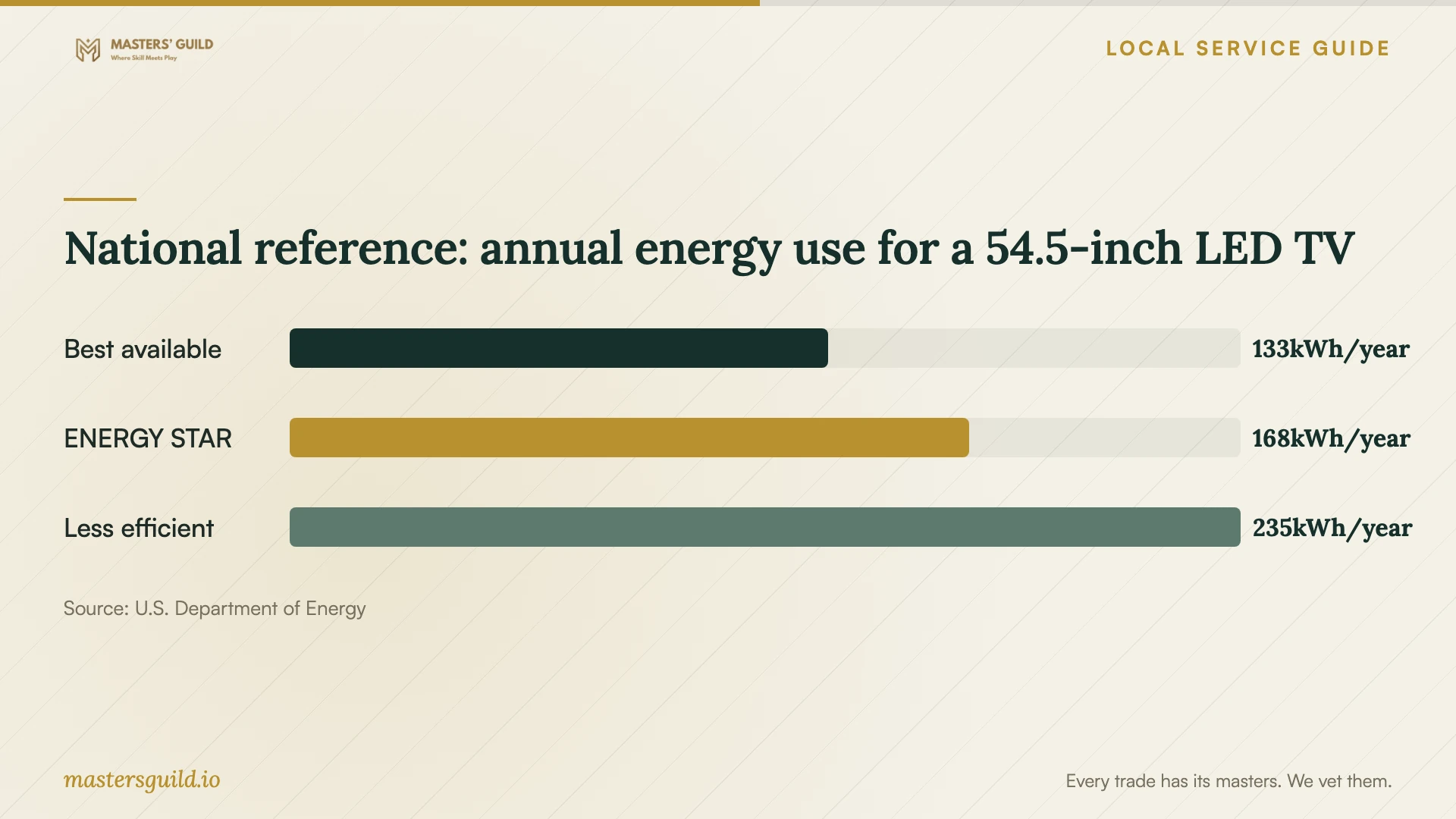
If you are buying a replacement screen, use the national energy comparison below as background. DOE's example compares efficiency levels for a 54.5-inch LED TV using December 2024 guidance. It does not measure installation costs or Indianapolis household electricity bills. DOE advises using the picture setting used for ENERGY STAR certification to maintain the associated energy savings. [4]
National reference: annual energy use for a 54.5-inch LED TV
Local details that affect your job
Indiana paint guidance affects contractor selection
For an Indianapolis home built before 1978, discuss paint testing and lead-safe work practices before approving drilling or concealed cable openings. Indiana recommends those practices unless testing rules out lead paint. Its guidance also identifies specific requirements for paint-disturbing maintenance on pre-1960 rental property, subject to the rule's minimum disturbed area and exceptions. If you rent the home, involve the owner in that assessment. [2]
Indiana requires a separate old-TV disposal plan
Include the old television's destination in the removal agreement. Indiana's household disposal prohibition means you should arrange reuse or appropriate recycling rather than landfill-bound trash. Use Indiana E-Cycle's county collector directory to investigate a drop-off option, then confirm acceptance, fees, and transport with the collector. Do not take the television to IDEM; the agency accepts no electronics. [1]
Match the quote to your installation
| Your situation | Ask before booking | Include in the scope |
|---|---|---|
| Existing outlet and surface cables | How will you attach the bracket and cover the cables? | Bracket, attachment assessment, cable cover, and setup |
| Concealed cables or new outlet | Where will you open the wall, and who handles power? | Route assessment, electrical quote, patching, and painting |
| Older painted wall | How will you assess paint disturbance and applicable lead-safe requirements? | Paint assessment, work method, dust control, and cleanup |
| Replacement television | Who transports the old screen, and which recycler will accept it? | Takedown, transport, destination, and any recycling fee |
Your hiring checklist
- Photograph the proposed wall, nearby outlets, and existing equipment.
- Send the TV model and bracket model before requesting a quote.
- Mark the proposed screen outline and assess it from your seat.
- Choose a cable treatment and identify who handles electrical work.
- Tell the installer about the home's age and recent painted-wall work.
- Agree on patching, painting, cleanup, and extra-work approval.
- Name the person responsible for old-TV transport and its destination.
- Test the TV, connections, and bracket movement before sign-off.
Frequently Asked Questions
How much should I budget for mounting?
Ask installers for an itemized quote based on your wall, TV, bracket, and cable route. Request separate amounts for mounting, electrical work, wall finishing, and removal. Confirm whether the total includes the bracket and other materials, then compare quotes for the same finished installation.
Does mounting in an older home require a lead-abatement contractor?
Do not assume that ordinary mounting is lead abatement. Indiana distinguishes renovation and maintenance from work intended to permanently eliminate lead hazards. Ask the contractor to assess the actual scope and applicable lead-safe requirements, including whether any minor-repair exception applies. [2] [3]
Can I put the old TV out with the trash?
Indiana prohibits households from discarding televisions with municipal waste intended for landfill disposal or burning. Arrange reuse or recycling and confirm collection conditions before scheduling removal. Indiana E-Cycle provides a county collector directory. [1]
Sources and scope
This guide combines the sources below with practical planning guidance. Figures apply to the stated geography and period; request a written quote for your property.