
Local service guide
Indianapolis Tax Preparation and Accounting
For Tax Preparation and accounting in Indianapolis, choose a professional who can handle your business structure, Indiana filings, and any personal return work you need. Request a written scope that separates bookkeeping cleanup, return preparation, planning, and notice support. Confirm the preparer’s PTIN and credentials: the IRS gives enrolled agents, CPAs, and attorneys unlimited representation rights, while a PTIN alone authorizes preparation without IRS representation rights. [1]
Choose the work before choosing the accountant
Describe the work you need before requesting a fee. For an annual filing engagement, identify the business entity, tax year, owner returns, and states involved. For ongoing accounting, specify bank reconciliations, financial statements, payroll coordination, and the frequency of meetings. Ask the firm to identify the person responsible for each task.
Keep cleanup separate from recurring work in the proposal. Tell the accountant about unreconciled accounts, missing receipts, mixed personal and business spending, or a change in bookkeeping software. Ask what records they need before they can commit to a filing date and how they will price additional work.
Check credentials and representation
The IRS requires compensated federal return preparers to have a PTIN and enter it on the return filed with the agency. Ask about experience with your type of business as well as credentials. The IRS notes that CPAs offer a range of services and that some specialize in tax preparation and planning. [1]
For an Indiana CPA, use the Indiana Professional Licensing Agency’s Free Search & Verify service to check license status. The agency also provides a discipline search. Match the individual’s name to the person named in your engagement agreement. [4]
For audit, collection, or appeal support, ask who will act as your representative and what the engagement includes. Enrolled agents, CPAs, and attorneys have unlimited IRS representation rights. Annual Filing Season Program participants have limited rights; uncredentialed PTIN holders outside that program have no IRS representation authority for current returns. [1]
Make Indiana planning part of the engagement
Ask the preparer to review your residence and work history before calculating county tax. Indiana bases an Indiana resident’s county tax on the county of residence on January 1. For nonresidents, the January 1 county of principal business or employment can matter. Provide dates and addresses rather than relying on your current mailing address. [2]
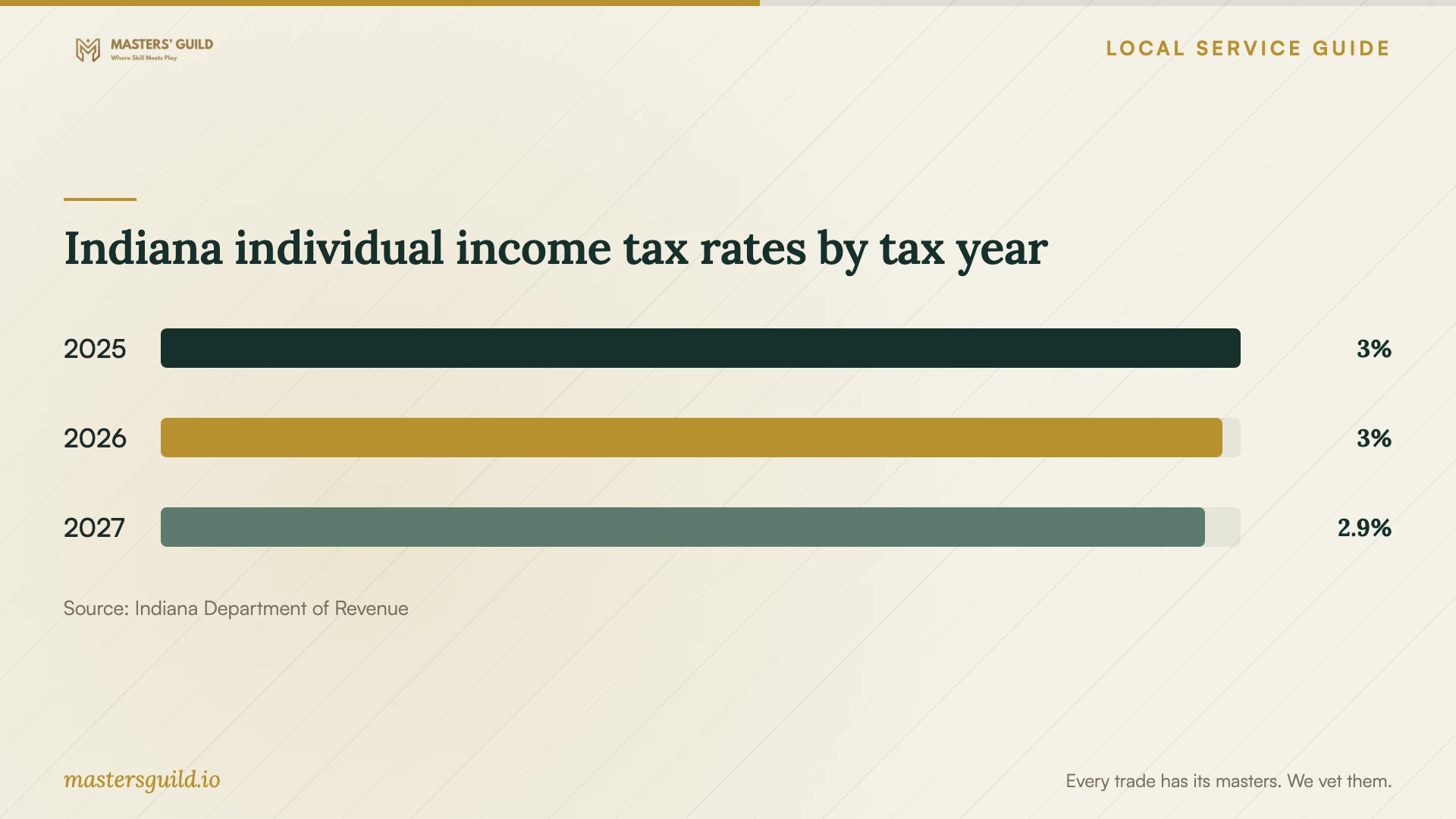
Ask which tax year the accountant is using when reviewing withholding or estimated payments. Indiana DOR lists the individual adjusted gross income tax rate as 2.95% for 2026 and 2.90% for 2027. DOR says county income tax rates may change in January and October. Request a separate review of state and county amounts. [5]
For a partnership, S corporation, or LLC taxed as either, request an Indiana Pass Through Entity Tax review before approving the original return. DOR requires an annual election and says an entity cannot amend its return to make the election after filing the original. Sole proprietorships and disregarded single-member LLCs cannot elect. [3]
Compare fees and agree on the handoff
Request a written fee proposal after the accountant reviews a sample of your records. Ask whether the fee covers federal and Indiana returns, other states, owner returns, bookkeeping adjustments, estimated-payment calculations, and a review meeting. For monthly accounting, specify transaction volume and the reports you expect to receive.
Agree on a document deadline, a review date, and a secure way to exchange records. Ask how the firm handles missing documents and e-file rejections. Before authorizing filing, review the income, deductions, payment instructions, and bank details with the preparer. Keep the completed returns and filing confirmations with your records.
For an Indiana individual return, an extension gives more time to file but does not extend the payment deadline. DOR recognizes a federal filing extension; without one, taxpayers must request an Indiana extension before the tax deadline. Ask the preparer to distinguish the filing plan from the payment plan. [2]
Indiana individual income tax rates by tax year
Local details that affect your job
County tax follows January 1 circumstances
Indiana’s county-tax rule applies to owners arranging service here, including those who move during the year. Give your preparer your January 1 county of residence and subsequent move dates. If you lived outside Indiana, provide your January 1 principal Indiana business or employment location so the preparer can assess the nonresident county-tax rule. [2]
Indiana entity elections need an annual decision
An eligible business must make its Indiana PTET election each year. Ask the accountant to document the decision before filing the original entity return, coordinate the owner credits, and check any county composite tax obligation. DOR states that PTET does not replace county tax due on Schedule Composite. [3]
Authorize Indiana notice support through INTIME
If you hire someone to handle Indiana notices, clarify account access during onboarding. DOR says the practitioner requests electronic power of attorney through INTIME and the taxpayer approves access. A paper POA-1 permits representation but does not provide access to the client’s INTIME account. [2]
Match the engagement to your next task
| Your situation | Work to request | Check before signing |
|---|---|---|
| Organized records and annual filing | Return preparation with a review meeting | PTIN, relevant business experience, and included filings |
| Unreconciled or incomplete books | A defined cleanup project before return preparation | Cleanup fee, missing-record process, and completion date |
| Eligible partnership or S corporation | Indiana PTET review before the original return | Annual election decision and owner-return coordination |
| IRS audit, collections, or appeal | Representation by an enrolled agent, CPA, or attorney | Named representative, scope, and separate fees |
| Indiana notice requiring account access | Notice review and INTIME ePOA setup | Practitioner access request and your approval |
Your hiring checklist
- Identify the entity’s tax classification, tax year, owners, and states involved.
- Gather prior returns, tax notices, and estimated-payment confirmations.
- Prepare bank and credit-card reconciliations, payroll reports, and asset purchase records.
- List residence changes and January 1 residence and work locations for the preparer’s review.
- Ask for the preparer’s credentials and the name of the person handling questions.
- Get written fees, exclusions, document deadlines, and responsibility for filing confirmations.
- Agree on whether planning, owner returns, amendments, and notice support require separate engagements.
Frequently Asked Questions
Do I need a CPA for a business tax return?
The IRS authorizes professionals with a PTIN to prepare federal returns. A CPA credential is one qualification to consider alongside relevant tax experience. Enrolled agents also have unlimited IRS representation rights. Choose someone whose experience fits your entity and whose engagement covers the help you expect. [1]
Can a sole proprietor elect Indiana PTET?
No. Indiana DOR excludes sole proprietorships and single-member LLCs disregarded for federal tax purposes. Eligible entities include partnerships, S corporations, and LLCs taxed as either. Give the accountant your tax classification before requesting PTET work. [3]
Does an Indiana filing extension give me more time to pay?
No. For individual income taxes, DOR says payment remains due at the tax deadline. Ask your preparer to estimate the payment needed with an extension and explain how you will confirm that payment. [2]
How should I compare accounting quotes?
Give each firm the same description of your records and requested work. Compare cleanup, recurring bookkeeping, entity returns, owner returns, planning meetings, and notice support as separate items. Ask who approves additional charges and when you will receive completed work.
Sources and scope
This guide combines the sources below with practical planning guidance. Figures apply to the stated geography and period; request a written quote for your property.