
Local service guide
Indianapolis snow removal: arrange the right service
Arrange snow removal in Indianapolis by asking for a written scope that covers your driveway, walking route, ice treatment, and return visits after road plowing. Choose a provider who agrees to your access needs and identifies safe snow-storage areas before work starts. INDOT excludes residential driveways from its plowing service, so arrange private driveway clearing yourself. [3]
Define the access you need before comparing quotes
Start with your departure time and the route you need to use. Tell the provider whether you need room for one vehicle or the full driveway, and identify steps, gates, and the path to your door. Request separate prices for driveway clearing, hand work, and ice treatment so you can compare the same scope.
Send photos and measurements before accepting a quote. Include the driveway entrance, narrow sections, surface type, slope, and available space for snow piles. Ask the provider to explain the equipment they intend to use and how they will protect pavement edges, landscaping, and nearby fixtures.
Agree on where you will park during a visit and how the crew will enter a locked gate. If you share a driveway, settle the clearing boundary and snow-storage location with your neighbor before booking.
Write down the storm trigger and return-visit terms
Ask the provider to define the snow depth that starts service, where they measure it, and when they expect to arrive. State whether you want clearing during a continuing storm, after snowfall ends, or both. Request a contact method for delays and a backup plan for equipment failure.
Include the driveway entrance in that discussion. INDOT says it plows interstates, U.S. routes, and state roads every two to three hours during winter storms until crews expose pavement on travel lanes. This describes state-road operations, not an Indianapolis city-street schedule or a private contractor's arrival promise. [4]
Ask whether the provider will return if road plowing leaves snow across your entrance after the first visit. Get the return charge and request procedure in writing. Also specify whether the provider inspects for ice between snow events or waits for you to call.
Separate clearing from ice treatment
Ask for distinct descriptions of snow clearing and ice treatment. INDOT defines plowing as mechanical snow and ice removal, anti-icing as pretreatment under suitable weather conditions, and de-icing as applying chlorides to help break the bond with pavement or enable plowing. These definitions help you ask what a private provider includes; they do not establish a treatment prescription for your property. [4]
Ask the provider to name the proposed treatment product, identify where they will apply it, and explain any surface restrictions in its instructions. Tell them about pets and landscaping concerns. Agree on whether they need your approval for additional applications and how they will charge for them.
Compare payment plans without guessing local prices
Request a written quote for your property. The official sources cited here do not provide residential contractor prices, so this guide offers no verified Indianapolis price range. Compare the base charge, snow-depth surcharges, hand-clearing work, ice treatment, and repeat visits before choosing. [1] [2] [3] [4]
For a per-visit arrangement, ask what counts as a billable visit during a long storm. For a seasonal plan, check the start and end dates, included visits, snowfall caps, cancellation terms, and charges after any cap. Ask for proof of insurance and the process for documenting and resolving property damage.
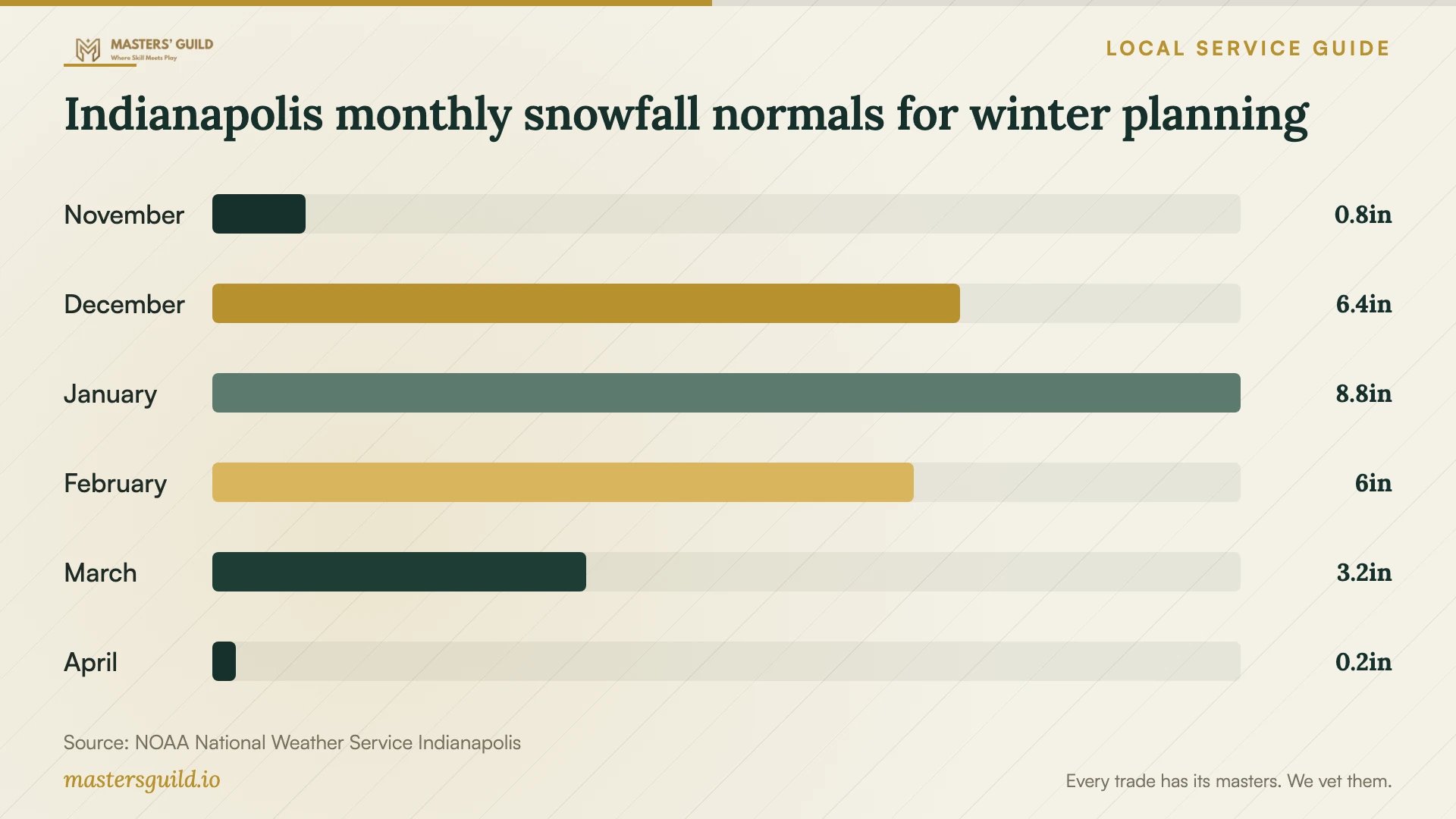
Use the snowfall chart to discuss contract dates
The National Weather Service publishes a 1991–2020 annual snowfall normal of 25.5 inches for Indianapolis. Its monthly normals include 6.4 inches in December, 8.8 in January, 6.0 in February, and 3.2 in March. Use the chart to discuss winter coverage and whether a contract includes late-season calls. [1]
Ask how the provider handles snow outside the contract dates and an ice-only event below the snow trigger. Do not convert the annual snowfall normal into an expected number of visits: the monthly totals do not tell you how many storms will meet your chosen trigger. [1]
Indianapolis monthly snowfall normals for winter planning
Local details that affect your job
Citizens Energy Group meter and vent precautions
Mark your gas meter and appliance intake and exhaust vents during the property walkthrough. Citizens Energy Group warns that snow and ice can interfere with meters and regulators, and obstructed vents can create a carbon monoxide hazard. It recommends clearing meters with a broom or by hand, keeping snow blowers and plows from damaging them, and calling 317-924-3311 if a meter becomes encased in ice or makes an unusual noise. Specify these areas as equipment exclusion zones and keep snow piles away from them. [2]
Choose the right agency for a public-road concern
INDOT plows interstates, U.S. routes, and state roads. Its FAQ assigns city streets to local city or town street departments and county roads to county highway departments or public works. INDOT does not plow residential driveways. For a state-maintained road that needs plowing or salt treatment, contact INDOT at 1-855-463-6848. For a city street or county road, contact the responsible local department. Keep that public-road report separate from a request for your contractor to clear your driveway entrance. [3]
Roof accumulation above utility equipment needs separate scope
If snow or ice hangs above your meter or regulator, discuss it as a separate job rather than adding it to ordinary driveway clearing. Citizens Energy Group advises homeowners to contact qualified roofing contractors for safe removal of accumulation above utility equipment. Ask who will perform that work and how they will protect the meter below. [2]
Match the arrangement to your access needs
| Your situation | Arrangement to discuss | Terms to confirm |
|---|---|---|
| You can wait and request help for individual storms | Per-visit clearing | Availability, dispatch process, and what counts as a billable visit |
| You need access for an early departure | Scheduled service with an agreed arrival window | Snow trigger, delay notification, and backup coverage |
| You want coverage across the winter | Seasonal agreement | Contract dates, included visits, caps, and charges beyond the cap |
| You need steps and walking routes cleared | Driveway service plus specified hand work | Exact paths, ice treatment, and completion expectations |
| Road plowing leaves snow across your entrance | Driveway-mouth return service | Whether the return is included and how to request it |
Your hiring checklist
- Photograph the driveway, walking route, steps, and existing surface damage.
- Specify the snow trigger, arrival window, and continuing-storm service.
- Confirm the price and process for driveway-mouth return visits.
- Mark meters, vents, pavement edges, and other equipment exclusion areas.
- Agree on snow-storage locations and where vehicles will park.
- Name the ice-treatment product and approval terms for extra applications.
- Review contract dates, caps, insurance, and the damage-reporting process.
Frequently Asked Questions
Does INDOT clear residential driveways?
No. INDOT excludes residential driveways from its service. Arrange driveway work with a private provider and specify entrance clearing and any return visits in the agreement. [3]
Should I choose per-visit or seasonal service?
Choose after comparing the same clearing scope under both arrangements. Ask how each provider charges for continuing storms, return visits, ice treatment, and snowfall beyond any contract cap. Base your choice on access needs and written terms.
Can the crew shovel snow off my gas meter?
Citizens Energy Group recommends a broom or hand clearing around meters and regulators, rather than a shovel. Ask the crew to keep plows and snow blowers away. Contact Citizens if the meter becomes encased in ice or makes an unusual noise. [2]
How many visits should I expect this winter?
The cited climate normals do not establish a visit count for the coming winter. Ask the provider how your chosen snow trigger, continuing-storm work, and entrance return visits affect billing. Use the forecast to plan individual events. [1]
Sources and scope
This guide combines the sources below with practical planning guidance. Figures apply to the stated geography and period; request a written quote for your property.