
Local service guide
Pest Control in Houston, TX: Hiring and Planning
For Pest Control in Houston, start with pest identification, check Texas licensing for the proposed work, and compare written treatment plans before choosing a provider. Texas requires licensing for businesses and individuals performing structural pest control for hire, with separate categories for general pests, termites, and structural fumigation. For suspected mosquito breeding sites, consider Harris County Public Health's inspection request before committing to a private treatment plan. [1] [2]
Identify the pest before choosing treatment
Give the inspector a clear starting point: photographs, the rooms or outdoor areas involved, dates of sightings, and any treatments you have tried. Describe what you observed without guessing the species. Ask the provider to explain the identification and show you the evidence supporting the proposed work.
Request a plan that connects each action to the identified problem. For rodent work, ask whether the scope includes locating entry points, sealing openings, monitoring, and removal. For suspected wood damage, ask for a termite or other wood-destroying-organism inspection rather than accepting an unexplained general pest treatment.
Match Texas credentials to the work
The Texas Department of Agriculture distinguishes pest control from termite control and structural fumigation. Its pest control category includes nuisance insects and animals such as roaches, ants, mosquitoes, rats, and mice. Termite control covers termites and other wood-destroying organisms through methods other than fumigation. Structural fumigation has its own category. [1]
Before agreeing to service, request the company's legal name, business license information, and the attending worker's license or registration details. Ask the company to explain how those credentials cover your treatment. If the proposal changes from general pest treatment to termite work or fumigation, repeat that check for the revised scope. [1]
Compare the full treatment commitment
Ask for a written quote that names the pest, treatment areas, method, preparation, and follow-up plan. Separate the inspection charge, initial treatment, repeat visits, monitoring, and any repair or exclusion work. Request the total payable amount, including any applicable charges, rather than comparing advertised starting prices.
For a recurring plan, ask how long the agreement lasts, how renewal works, and how to cancel. Have the provider identify excluded pests and explain what qualifies for a return visit. For any warranty, ask whether it covers retreatment, damage repair, or another defined obligation, and request the exclusions in writing.
Choose a proposal you can evaluate against an outcome: fewer sightings, inspection findings, trap checks, or another agreed measure. Ask when the provider will review progress and what would trigger a change in treatment. Keep photographs and visit records so you can discuss continuing activity with specifics.
Prepare the property and schedule
Request preparation and re-entry instructions before booking. Tell the provider about children, pets, aquariums, and any access constraints. Ask which rooms or outdoor areas need to remain accessible, whether anyone must leave, and when you may resume cleaning or use of treated areas. Follow the instructions for the actual proposed treatment.
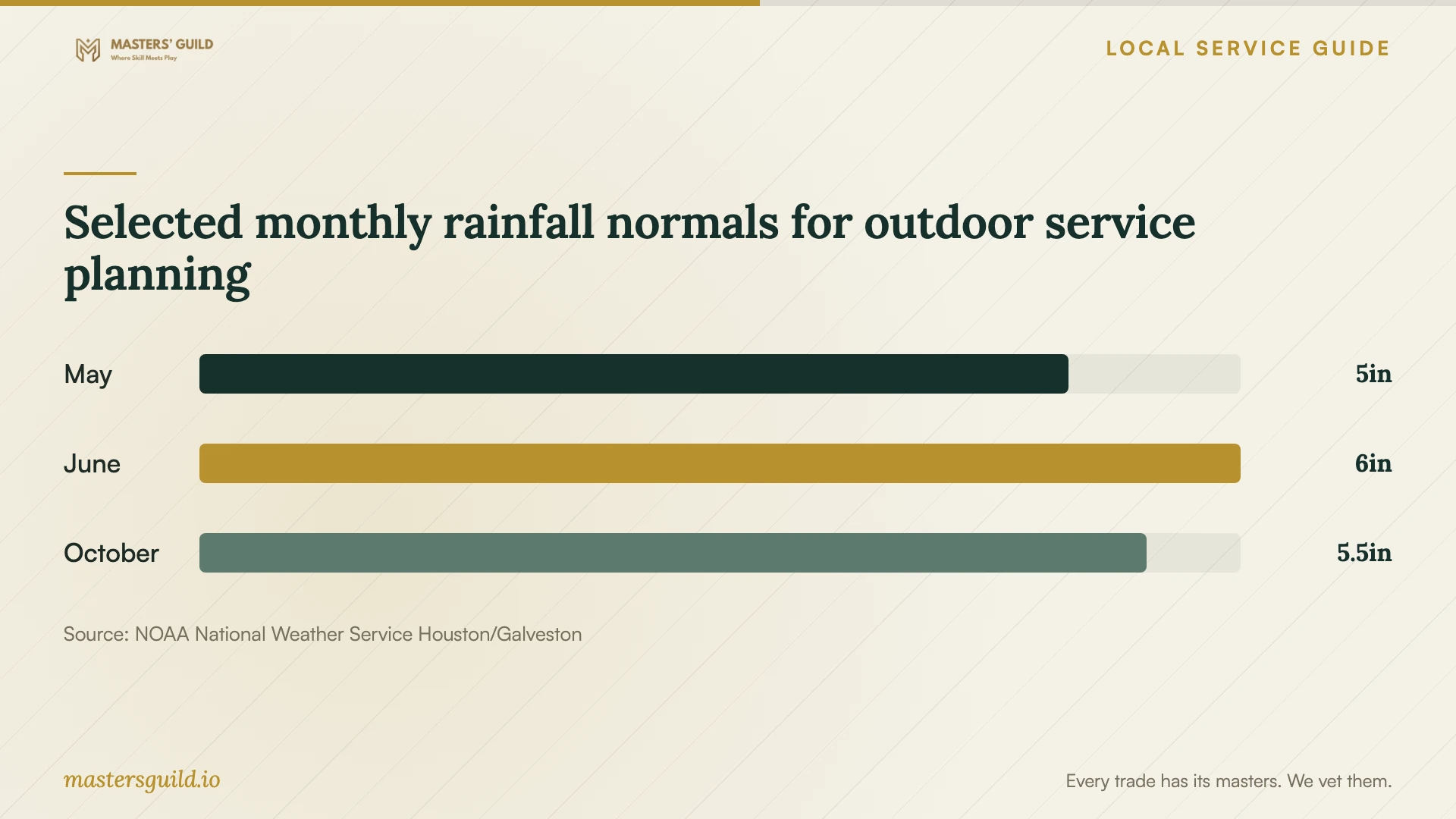
For outdoor work, ask how the provider handles rain delays and whether weather changes the application or follow-up schedule. The rainfall chart gives historical planning context for Houston Intercontinental. Use the forecast and the provider's treatment-specific instructions when arranging your visit. [4]
Selected monthly rainfall normals for outdoor service planning
Local details that affect your job
Request a mosquito breeding-site inspection
Harris County Public Health's request form asks whether mosquitoes occur during the day, at night, or both, and whether you permit a property inspection. Record those details before submitting. The county states that it processes submissions in received order, typically within three business days. If the form does not list your city, it directs you to call 713-440-4800. Ask about inspection timing before coordinating a private service visit. [2]
Use the county route for unidentified vectors
Harris County Public Health accepts public vector submissions by appointment or mail. Its surveillance program includes ticks, kissing bugs, fleas, biting midges, and sandflies. For a specimen found in Harris County, consult the submission route and request handling instructions before mailing or delivering it. Share any identification with the contractor when discussing pest-specific work. [3]
Report water leaks through the correct channel
The county's mosquito inspection form directs residents to report sewage or water-main leaks to 311 inside the City of Houston and to the local water utility outside city limits. If you observe such a leak near the affected area, make that report alongside your inspection request and tell the pest provider where it is. [2]
Choose the next step for your problem
| Situation | Next step | Clarify before booking |
|---|---|---|
| Roaches, ants, rats, or mice | Ask for identification and a scope within the Texas pest control category. | Which areas, monitoring, and entry-point work does the quote include? |
| Suspected termites or other wood-destroying organisms | Request credentials covering Texas termite control for non-fumigation work. | What evidence supports the diagnosis, and what treatment boundaries apply? |
| Proposed structural fumigation | Check credentials for the separate structural fumigation category. | What preparation, vacancy, and return instructions apply? |
| Suspected mosquito breeding sites | Consider a Harris County Public Health inspection request. | Can you describe activity times and allow inspection access? |
| Unidentified tick, flea, or kissing bug found in Harris County | Consult the county's public vector submission route. | How should you submit the specimen for identification? |
Your hiring checklist
- Photograph sightings and note affected rooms, outdoor areas, and times of activity.
- Request business and worker credential details for the proposed treatment.
- Ask the inspector to explain the pest identification and treatment boundaries.
- Compare written totals for initial work, follow-ups, monitoring, and exclusion.
- Read cancellation, renewal, return-visit, and warranty terms before agreeing.
- Obtain preparation, access, pet, and re-entry instructions before the visit.
- Agree on a progress review and keep treatment records.
Frequently Asked Questions
Does a pest control company need a Texas license?
Texas requires licensing for businesses and individuals performing structural pest control for hire. Ask for business and worker credential details, then check that the proposed work falls within the appropriate category. [1]
Can Harris County inspect mosquito breeding sites?
The county offers an inspection request form that asks about activity times, potential breeding sites, and property access. It states that submissions typically take three business days to process; it does not promise an inspection within that period. [2]
Should I book one treatment or a recurring plan?
Ask the inspector to justify the proposed frequency using the identified pest and findings at your property. Compare the complete commitment, included return visits, and cancellation terms. Request an explanation of how the provider will decide whether more treatment is necessary.
What should a useful quote include?
Request the identified pest, affected areas, treatment method, preparation, total charge, and follow-up schedule. Ask the provider to itemize exclusion or repair work and explain warranty limits. Use the same scope when requesting another quote.
Sources and scope
This guide combines the sources below with practical planning guidance. Figures apply to the stated geography and period; request a written quote for your property.