
Local service guide
Houston data recovery and backup: hiring guide
For data recovery and backup in Houston, choose a provider around the problem you need to solve: recovering files from a device, restoring business systems, or responding to a security incident. Ask for a written diagnosis, an approval limit, data-handling terms, and a demonstration that restored files work. For suspected ransomware, isolate affected devices from the network and contact an incident-response specialist before attempting restoration. CISA recommends isolation and recovery on a clean network. [4]
Define the job before handing over a device
Give the provider a short incident history: when you last opened the files, what happened next, which devices hold them, and what you have tried. List essential folders or applications by name. For an office, distinguish recovering documents from restoring the accounting application, settings, and access needed to use them.
If a device appears damaged, avoid further experiments until a specialist gives you handling instructions. Ask whether the company performs the assessment itself or sends the device elsewhere. Confirm the receiving facility, transport arrangements, and who will contact you before anyone undertakes additional work.
For suspected ransomware, CISA recommends disconnecting affected systems from the network. It recommends powering down only when network isolation is impossible because shutdown loses potential evidence held in volatile memory. Call your IT or incident-response contact from a separate phone and follow your incident plan. [4]
Compare written quotes and approval terms
Request separate amounts for assessment, recovery work, replacement storage, shipping or pickup, and expedited service. Ask what you owe if the provider recovers only part of your requested files or you decline the recovery quote. Agree on a spending limit and require approval before the provider exceeds it.
Separate a one-time recovery quote from ongoing backup charges. For the backup contract, ask for setup fees, storage limits, retention periods, monitoring responsibilities, restore assistance, and cancellation or export terms. Request a total for the scope you need rather than comparing headline prices with different inclusions.
Ask the provider to explain tax treatment on an itemized invoice. The Texas Comptroller identifies storing and retrieving customer data as taxable data processing and distinguishes it from certain professional services. Its guidance also addresses mixed taxable and nontaxable services. Have the provider confirm how it classifies your exact recovery, consulting, and storage work. [5]
Set privacy and handoff requirements
Before releasing business records, ask who can access the device and recovered files, whether subcontractors participate, and how the provider transfers your data back. Request a receipt with the device identifier and a named contact. Agree on how the provider handles passwords or recovery keys through a secure channel.
Specify when the provider will return the original device and delete its working copies. Ask for written confirmation of those steps. If you suspect unauthorized access, have your incident-response adviser approve evidence handling before you authorize wiping, disposal, or repair.
CISA recommends preserving volatile evidence and relevant logs during ransomware response. It also warns that ransomware incidents can involve stolen data. Ask a prospective incident-response provider whether its scope includes investigating access and data theft, preserving evidence, and coordinating recovery. [4]
Buy a backup plan you can restore from
Set two business targets before choosing a plan: how much recent work you can afford to lose and how long you can operate without each system. Put invoicing, bookings, customer records, and other essential functions in your preferred restoration order. Ask the provider to explain dependencies, such as the application or credentials needed to open a restored database.
CISA recommends offline, encrypted backups of critical data and regular restore testing. It notes that ransomware can delete or encrypt accessible backups. Require the provider to explain which copy remains protected if someone compromises your business account and how you will obtain that copy during an incident. [4]
Make a restore demonstration part of acceptance. Choose representative files and one essential application, then verify that you can open and use them in the agreed recovery environment. Record the backup date, missing work, elapsed restore time, and person responsible for resolving failures. Schedule future tests and name whoever reviews backup alerts.
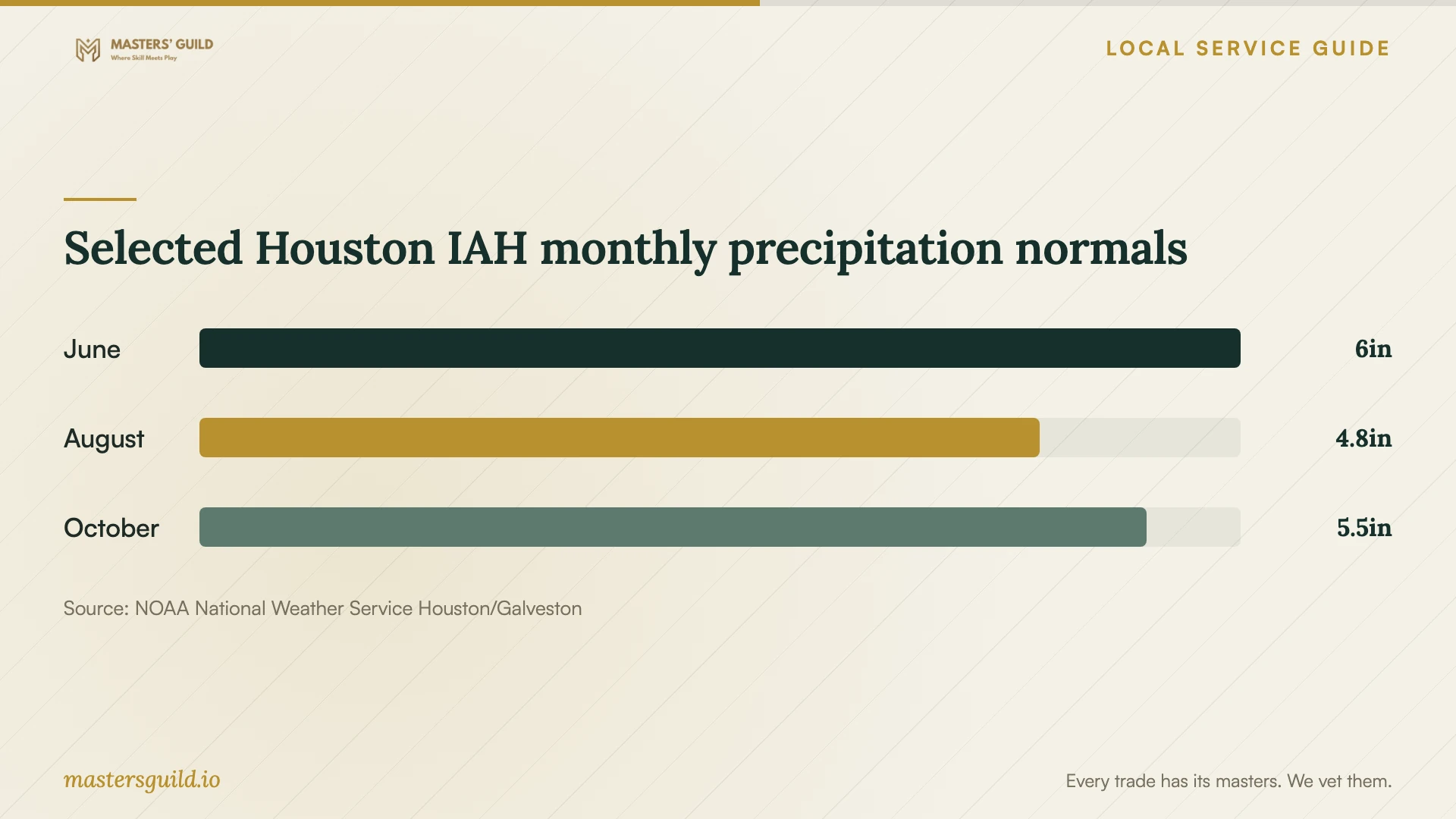
Selected Houston IAH monthly precipitation normals
Local details that affect your job
Check flood exposure at both storage addresses
The Harris County Flood Control District mapping tool offers address search, mapped floodplains, and a separate ponding view. It covers mapped floodplains within Harris County, and you can select only one main map view at a time. Review the floodplain and ponding views for your premises and any proposed physical offsite storage address within the county. Ask the provider where it keeps backup equipment and whether your alternate copy shares the same exposure. Treat the map as planning information, without assuming that an address outside a mapped floodplain is safe from all flooding. [1]
Separate Texas breach obligations from file recovery
The Texas Attorney General requires businesses and organizations with a system-security breach affecting 250 or more Texans to report as soon as practicably possible and no later than 30 days after discovery. Its guidance also requires notice to affected consumers and electronic submission by an authorized representative. If your incident may involve customer data, engage legal counsel and an incident-response provider alongside recovery work. Track the discovery date and ask counsel to assess notification obligations; do not treat a successful restore as completion of the breach response. [2] [4]
Use Houston rainfall normals as preparation context
The National Weather Service lists Houston Intercontinental precipitation normals of 6.00 inches for June, 4.84 for August, and 5.46 for October, based on 1991–2020. Use the chart as a prompt to review backup placement and restoration arrangements throughout the year. These airport climate averages do not describe flooding at your office or predict this year's storms. [3]
Choose the scope to request
| Your situation | Provider scope to request | Before approval |
|---|---|---|
| You have a backup and need working files | Backup restoration and application setup | Specify the backup date and demonstrate that essential records open. |
| A device appears damaged and has your only copy | Device assessment and recovery proposal | Ask for handling instructions, the work location, and an approval limit. |
| You suspect ransomware | Incident response, evidence preservation, and clean recovery | Isolate affected systems and agree on investigation and restoration priorities. |
| You need ongoing business backups | Backup setup, monitoring, and restore support | Require offline encrypted protection and regular restore tests. |
| The incident may affect customer information | Incident response with legal coordination | Assess Texas consumer-notice and Attorney General reporting obligations. |
Your hiring checklist
- Write down the incident history, device identifiers, and essential files or applications.
- Identify the last backup you have confirmed you can use.
- Ask who performs the work and where each device or data copy will go.
- Approve an itemized scope, spending limit, and partial-recovery payment terms.
- Agree on secure credential transfer, data access, return, and deletion procedures.
- Review floodplain and ponding information for storage addresses within Harris County.
- Require a restore demonstration and assign responsibility for future tests and alerts.
Frequently Asked Questions
How much should I budget for recovery?
Ask for a device-specific diagnosis and itemized quote before setting your budget. Compare assessment fees, recovery charges, return storage, transport, urgency, and what you owe for partial recovery. Ask the provider to explain tax treatment for each part of the work.
Should I turn off a computer with suspected ransomware?
CISA recommends isolating affected devices from the network first. It advises shutdown only when you cannot isolate them, because powering down loses potential evidence in volatile memory. Contact your incident-response adviser and follow your response plan. [4]
Is cloud backup enough for my business?
Ask the provider to explain protection against account compromise, deletion, and encryption, then demonstrate restoration. CISA recommends offline encrypted backups and regular testing, and discusses cloud protections such as delete protection and version control. Assess the configuration and recovery process before accepting the plan. [4]
Does an offsite copy need to leave Houston?
Choose its location after reviewing exposure and recovery access. For physical storage within Harris County, inspect both mapped floodplains and ponding at the proposed address. Ask the provider how you would retrieve the copy if you could not reach your premises. [1]
Sources and scope
This guide combines the sources below with practical planning guidance. Figures apply to the stated geography and period; request a written quote for your property.