
Local service guide
Translation Services in Honolulu: Documents and Costs
Choose Translation Services in Honolulu by asking the receiving office what it requires, then request a written quote for the language pair, complete document and delivery deadline. Separate written document work from spoken interpreting. For a Hawaii state court hearing, ask about court-provided language assistance before booking a private interpreter: the Judiciary provides free hearing interpreters and language help for communicating with court staff. [2]
Define the assignment before requesting quotes
Start with the person or office that will receive your document. Ask which language they need, whether they require a translator’s signed statement, whether they require notarization, and whether they accept an electronic copy. Request their instructions in writing and send those instructions with your quote request. Avoid asking a provider for a certified translation without explaining the intended use.
For a birth certificate, marriage certificate, academic record or family legal document, supply a readable scan of each page, including the reverse side if it contains text. Tell the translator how you spell names on the records you will submit alongside it. Ask them to flag unclear handwriting or conflicting spellings for your review rather than guess.
For an appointment or conversation, request an interpreter and describe the setting, language or dialect, date and expected duration. For a written submission, request a translator and describe the document and recipient. If you need both services, ask the provider to quote and describe each assignment.
Use the court language-assistance process
The Hawaiʻi State Judiciary says courts provide free interpreters for court hearings and free language services for communication with court staff outside the courtroom. Tell staff you need an interpreter when you call or visit. This guidance concerns court language assistance; it does not establish that the court will translate your personal documents for submission. [2]
The published hearing process requires you to attend court on your hearing date. You may ask the judge for an interpreter, give the judge a request letter, or show a Language ID Card available at courthouses and on the Judiciary website. Your attorney may request an interpreter orally or in writing. The judge decides whether to provide one, and an interpreter the judge provides is free. [2]
Contact court staff before your hearing to discuss your language needs and the request process. Keep your hearing date in your calendar while you arrange assistance. If you also need written translations, ask the receiving court office what you must submit before commissioning that work.
Compare the complete written quote
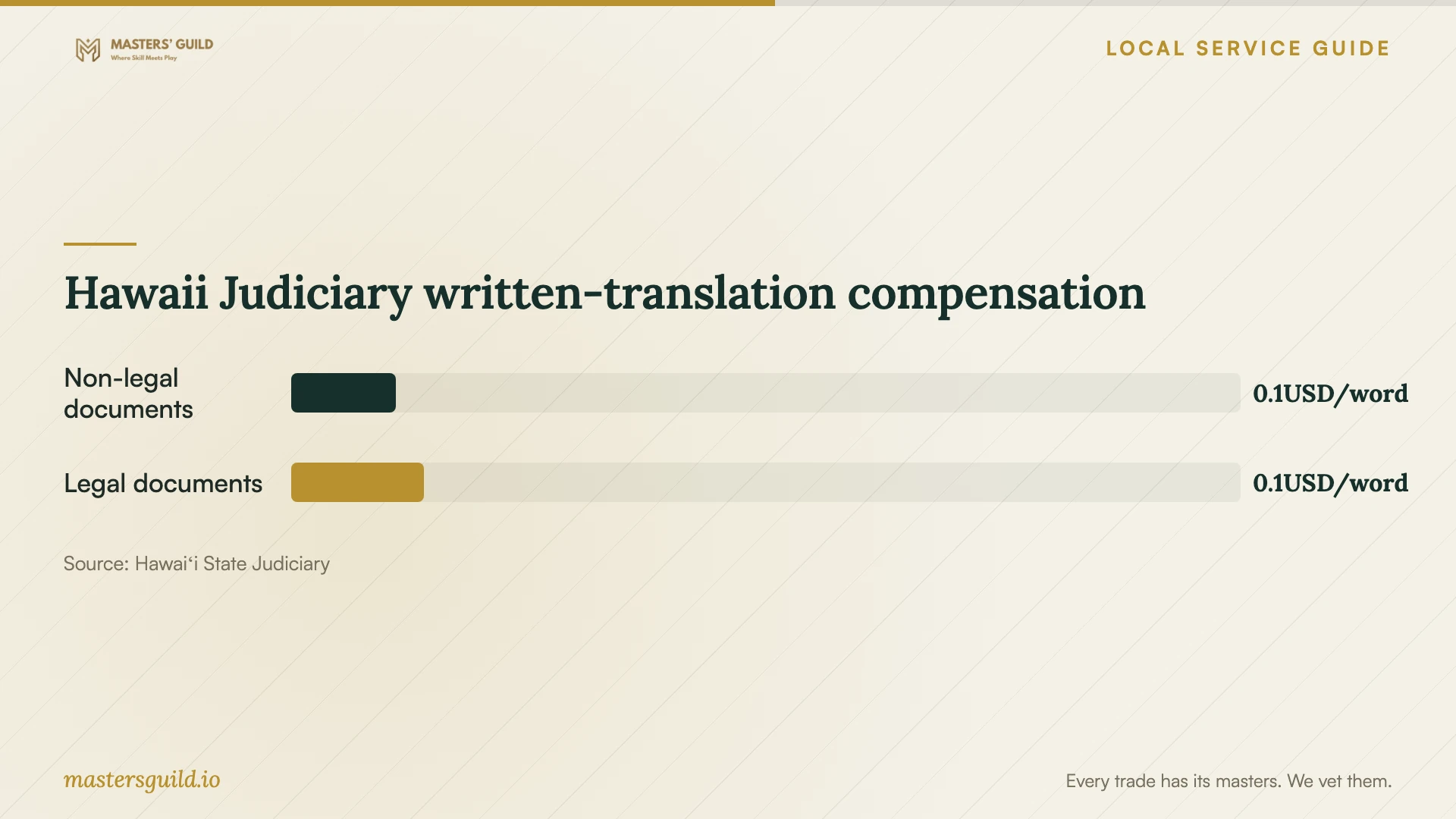
The Judiciary’s published translation fees are $0.14 per word for legal documents and $0.11 per word for non-legal documents. The page limits these fees to routine translation assignments of a court document in English and excludes work for which an interpreter already receives an hourly interpreting fee. These are Judiciary compensation figures, not a survey of private Honolulu translation prices. [1]
Ask each provider to quote the same document set and identify the billing basis: per word, per page or a fixed total. For a word-based quote, ask which document they count. For a page-based quote, ask how they define a page. Request a total that identifies any charges for certification, notarization, formatting, delivery and deadline changes.
Agree on the delivery format and correction process before paying. Ask whether the provider will correct transcription errors, how you should report them, and whether changes requested by the receiving office carry another fee. Set a delivery date that leaves you time to check names, dates, seals and page completeness before submission.
Check qualifications for the work you need
The Judiciary publishes an interpreter registry for paid assignments. Its registry guidance describes minimum court-interpreting requirements and interpreters who have taken a recognized oral exam and qualified for Tier 2 or higher. The Judiciary also states that anyone hiring a court interpreter must further determine the interpreter’s competence and qualifications. [4]
Use that registry guidance when evaluating a claim about court-interpreting credentials. For a written translation, ask separate questions about the provider’s experience with your language pair and document type, who will review the text, and what statement they will supply. Ask the receiving office whether it accepts the proposed credentials and certification wording. [4]
Before sending sensitive records, ask who can access them, how the provider transfers files, and when they delete retained copies. Share the pages needed for the assignment. If you want to redact information, ask the receiving office and translator whether the redaction would affect the work or submission.
Hawaii Judiciary written-translation compensation
Local details that affect your job
Plan Hawaii authentication time separately
For documents requiring Hawaii apostille or certification, the Lieutenant Governor’s office lists a $3 fee per document and a processing period of 7 to 10 business days. Online applicants can pay by credit card; mail applicants can use money order, cashier’s check or cash, with no personal checks. Before buying translation or authentication services, ask the overseas recipient which documents it needs authenticated and whether it expects the translator to include the authentication text. Plan translation, state processing and delivery as separate steps. [3]
Check the issue date on Hawaii vital records
The Lieutenant Governor’s instructions allow a Hawaii birth, death or marriage certificate issued after January 1, 2025 to go to that office for apostille if it bears the State Registrar’s signature and Department of Health embossed seal. If you lack the document or it predates January 1, 2025, the office instructs you to order a new certificate through the Department of Health, which forwards it for authentication. If you prepay online, send the printed apostille application to the Department of Health with the new-certificate order. Check this route before paying to translate an older certificate, and confirm how the office handles a certificate dated January 1 itself. [3]
Choose the next step for your document or appointment
| Your need | First action | Before paying |
|---|---|---|
| Written record for an official submission | Ask the receiving office for its translation requirements. | Confirm certification wording, format and correction terms. |
| Language assistance at a Hawaii state court hearing | Tell court staff your language needs and follow the hearing request process. | The judge decides whether to provide an interpreter; one the judge provides is free. |
| Hawaii document for use overseas | Ask the recipient whether it requires apostille or certification. | Allow for the state’s stated 7 to 10 business-day processing period and $3 fee per document. |
| Older Hawaii birth, death or marriage certificate needing apostille | Follow the instruction to order a new certificate if it predates January 1, 2025. | Confirm the replacement and authentication route before commissioning the translation. |
| Private court interpreter | Review the Judiciary’s registry guidance and ask about relevant qualifications. | The hiring customer remains responsible for checking competence and qualifications. |
Your hiring checklist
- Get the receiving office’s written document and translation instructions.
- Identify the source language, target language and intended use.
- Prepare readable scans of all relevant pages and confirm name spellings.
- Ask each provider to quote the same scope with an itemized total.
- Confirm the reviewer, certification wording and correction terms.
- Agree on file security, delivery format and a deadline with review time.
- Ask whether you need authentication and confirm the document route before ordering it.
Frequently Asked Questions
What should I budget for a private translation?
Request an itemized quote for your actual documents. The Judiciary publishes $0.11 per word for non-legal and $0.14 for legal routine court-document translations, but those compensation figures do not establish private retail prices. Ask the provider to specify its billing unit and charges for any additional services you request. [1]
Can I get a free interpreter for court?
Hawaii state courts provide free hearing interpreters and language help for communication with court staff. Follow the Judiciary’s request process and attend your hearing. The judge decides whether to provide an interpreter, and one the judge provides is free. [2]
Should I translate my certificate before applying for an apostille?
Ask the overseas recipient about the required sequence before commissioning work. Hawaii’s instructions require a new vital-record certificate if yours predates January 1, 2025, and the Department of Health forwards the replacement for authentication. Confirm which version the translator should use and whether to include authentication text. [3]
Does court registry inclusion settle a provider’s qualifications?
The Judiciary tells hiring customers to further determine an interpreter’s competence and qualifications. Ask about the exact assignment and language pair. For written documents, also ask about translation experience, review and the statement the provider will supply. [4]
Sources and scope
This guide combines the sources below with practical planning guidance. Figures apply to the stated geography and period; request a written quote for your property.