
Local service guide
Choosing senior care in Honolulu: Help at Home
Arrange senior care in Honolulu by listing the help your family member needs, matching those tasks to the right provider, and checking agency licensing before signing. Hawaii home care agencies provide personal care, homemaker help and respite; their home care scope excludes nursing and other clinical professional services. For public support, contact Honolulu’s Elderly Affairs Division at 808-768-7700 for screening and guidance on an assessment. [1] [3]
Choose care around the tasks your family needs
Write down what happens during a normal day: getting out of bed, bathing, dressing, eating, preparing meals and spending time alone. Include the older adult’s preferences, language and routines. Describe the help needed for each task instead of asking for a general caregiver.
Hawaii defines home care services to include personal care such as dressing, feeding and hygiene; homemaker assistance such as housekeeping, shopping and meal preparation; and respite or family support. The state excludes managing the client’s money, balancing a checkbook, nursing and other clinical professional services from this scope. [1]
If your list includes clinical tasks, ask the treating clinician which provider category fits those needs. For a hospital discharge, request written instructions identifying who will perform each task. Keep medication reminders and medication administration separate in your questions, and ask the provider to explain what its staff can undertake.
Verify the agency and its coverage
Use the Department of Health’s home care agency roster to match the provider’s name, license number, geographic area and effective and expiration dates. The state roster includes entries with expiration dates before October 15, 2026, so check the dates rather than treating inclusion as proof of a current license. Ask the Office of Health Care Assurance to resolve unclear status. [2]
Hawaii’s home care agency definition excludes an individual caregiver, including an individual incorporated as a business. For an individual hire, ask for references, relevant training, insurance information and a written agreement that identifies duties and backup arrangements. [1]
Ask an agency who supervises the caregiver, how it handles an absence and how you report concerns after office hours. Request a written care plan and agree on who receives updates. Hawaii’s licensing office provides a complaint form for concerns about licensed agencies or possible unlicensed agencies. [1]
Compare the full schedule and written cost
Obtain current, itemized written quotes for the actual tasks and hours you need. Use the same weekly schedule for each provider. Ask about minimum visit length, weekend and holiday charges, transportation, parking, cancellation notice and changes in care needs. Have the provider identify charges outside the hourly rate and calculate the total for your proposed week.
For overnight help, describe whether the caregiver may sleep or must remain awake. For continuous coverage, ask how staff handoffs and missed shifts will work. Include the older adult in the discussion about privacy, meals and household access.
Consider respite, day care and coordinated support
Honolulu’s Elderly Affairs Division describes adult day care as daytime supervision and support that may include personal care, activities, meals and health monitoring. Its caregiver respite services can include care at home or participation in an out-of-home program. Compare these options with the hours when a family caregiver needs relief. [4]
Ask about transportation and the handoff between home and a day program before choosing a schedule. Specify whether the older adult needs help from the door, assistance entering a vehicle or support during an appointment. EAD describes transportation options that include door-to-door and curb-to-curb assistance. [4]
For a plan involving several services, ask about case management. EAD describes this service as help identifying needs, developing a care plan, coordinating services and following up. Its FAQ advises Medicaid recipients to ask their health plan for a Service Coordinator. [3] [4]
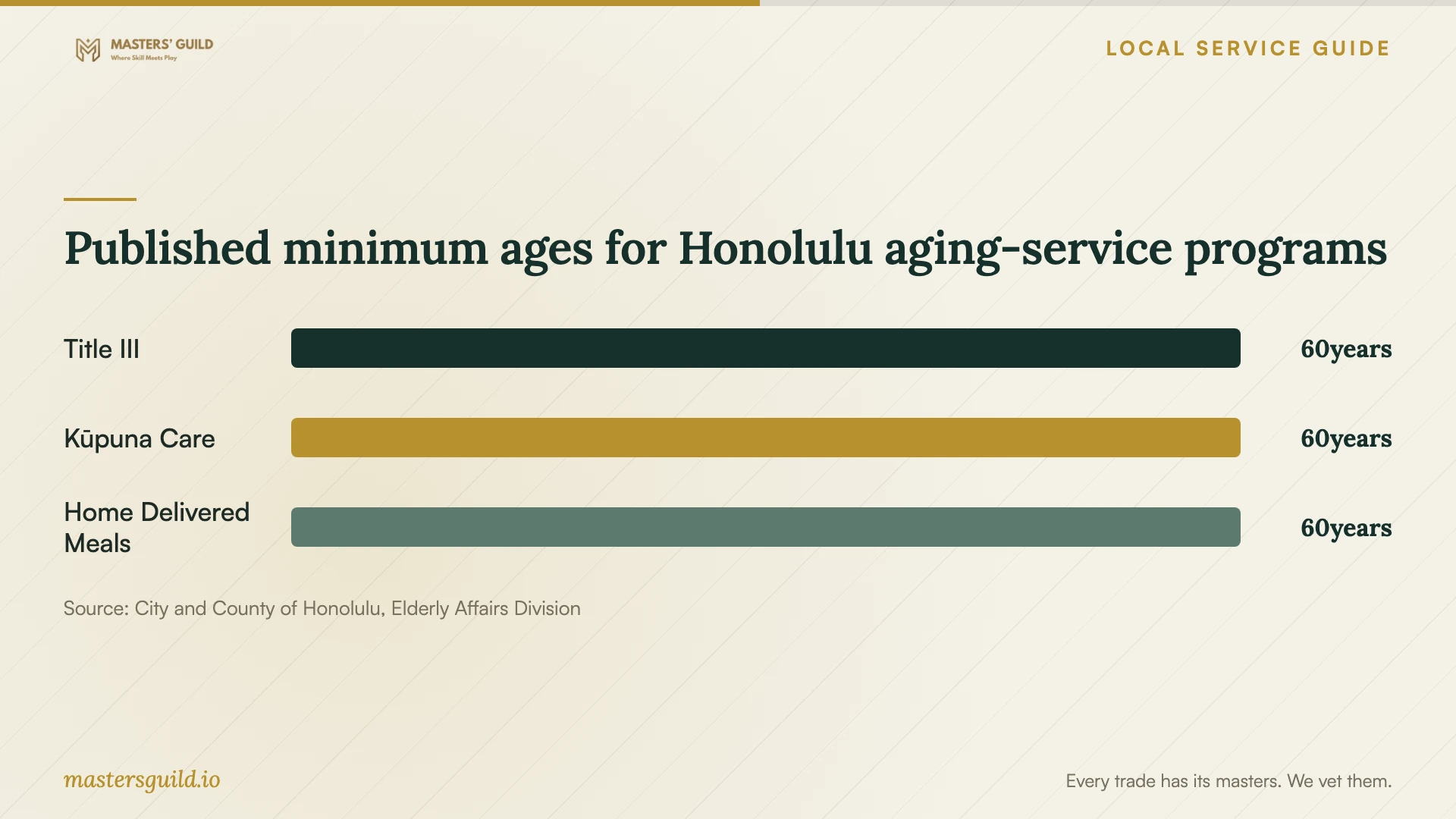
Published minimum ages for Honolulu aging-service programs
Local details that affect your job
Kūpuna Care starts with screening and an assessment
Contact EAD at 808-768-7700 to begin. Staff check basic criteria and schedule an in-home assessment if the applicant appears eligible. The city lists age 60 or older, citizenship or qualified-alien status, functional impairments, no institutional residence and no comparable government or private home- and community-based services among the requirements. Describe existing help during screening rather than assuming age alone establishes eligibility. [3] [4]
Plan for care while awaiting public support
EAD says recipients pay no out-of-pocket costs for its contracted services. It has no income or asset eligibility criterion, but collects financial information to prioritize services where waitlists exist. Staff prioritize need, including frailty, limited support and limited financial resources, rather than application order. Ask what support is available now and plan family or private coverage for any gap. [3]
Check the service area as well as the office address
The state roster separates agency addresses from geographic coverage. Its Oʻahu legend groups Waikiki, Moiliili and Kaimuki under Manoa to Kahala, while Downtown includes Nuuanu, Pauoa and Makiki-Kapiolani. Use the coverage column to shortlist agencies, then confirm staffing at the exact home address and requested times. [2]
Match the need to the first care discussion
| Main need | Option to discuss | Question to settle |
|---|---|---|
| Meals, shopping and light housework | Homemaker assistance | Which household tasks will staff complete? |
| Help dressing, eating or with hygiene | Personal care | What hands-on assistance does the person need? |
| Relief for a family caregiver | Respite at home or an out-of-home program | Which hours must another caregiver cover? |
| Daytime supervision and activities | Adult day care | How will attendance and transportation work? |
| Nursing or other clinical professional services | Home health or private duty nursing discussion | Which clinical provider should the treating clinician involve? |
Your hiring checklist
- Write the care tasks, preferred language and routines with the older adult.
- Record the proposed days, hours and start date.
- Separate personal care from clinical tasks before requesting offers.
- Check agency identity, license dates and service area; resolve unclear status with the licensing office.
- Request an itemized weekly total and cancellation terms.
- Agree on backup staffing, household access and family updates.
- Set a review date to discuss whether the arrangement meets the older adult’s needs.
Frequently Asked Questions
Does a home care agency license cover nursing?
Hawaii excludes nursing and other clinical professional services from its home care agency scope. The state identifies home health agencies and private duty nursing services as categories that normally provide those services. Ask the treating clinician to identify the appropriate arrangement. [1]
Can I hire an individual caregiver?
Hawaii excludes individual caregivers from its home care agency definition, including individuals incorporated as businesses. Check references, training, insurance and task boundaries, and write down who will cover an absence. [1]
Will Kūpuna Care start as soon as we apply?
Plan for a possible wait. EAD screens applicants and assesses those who appear eligible. Where waitlists apply, staff prioritize level of need rather than application order, and EAD says it can be difficult to estimate the wait. [3]
Can a family member receive payment for caregiving?
EAD identifies limited programs with eligibility requirements, and the care recipient must initiate the request. A Medicaid recipient should ask their health plan about the benefit. A veteran can ask their physician or VA social worker about Veteran’s Directed Home and Community-Based Services. EAD can discuss possible Community Living Program suitability for others. [3]
Sources and scope
This guide combines the sources below with practical planning guidance. Figures apply to the stated geography and period; request a written quote for your property.