
Local service guide
Pest Control in Honolulu: Hiring and Planning
Arrange Pest Control in Honolulu by booking an inspection, checking the provider’s current Hawaii license status, and comparing a pest-specific treatment plan. For rodent activity, include entry-point inspection and discuss trapping, repairs, and monitoring. Hawaii health guidance recommends exclusion and warns that indoor baiting can leave dead rodents in inaccessible spaces. [1] [3]
Give the inspector enough information to identify the pest
Describe the affected rooms, where you first noticed activity, and any previous treatments. Send photographs you can take without handling the pest. Have the inspector explain the identification and the observations supporting it before you approve treatment.
For ants, cockroaches, suspected termites, or bed bugs, request a plan that names the target pest and treatment areas. Have the provider record inaccessible areas and explain whether they need further inspection. Avoid agreeing to a general treatment without understanding which problem the provider intends to address.
Give competing providers the same property description. Include attic or crawl-space access, parking arrangements, and shared areas you cannot authorize them to enter. For a condominium, coordinate those areas with the building manager before setting the appointment.
Compare an inspection-based quote
Get an inspection-based quote for your property. Request the total price and a breakdown of treatment, entry repairs, and return visits. Identify work you must arrange with someone else, such as branch removal or building repairs. Ask which findings could change the price and require your approval before additional work.
Read the service agreement for covered pests, treatment locations, retreatment conditions, and cancellation terms. For recurring service, confirm the visit schedule and the work included at each appointment. Request proof of liability insurance and a contact for damage concerns or missed visits.
Include exclusion in the rodent plan
Hawaii’s Department of Health says rats and mice breed year-round. Its listed infestation signs include droppings, gnaw damage, holes near pipes or screens, greasy rub marks, and urine odor. Arrange an inspection when you notice signs rather than choosing a treatment date by season. [1]
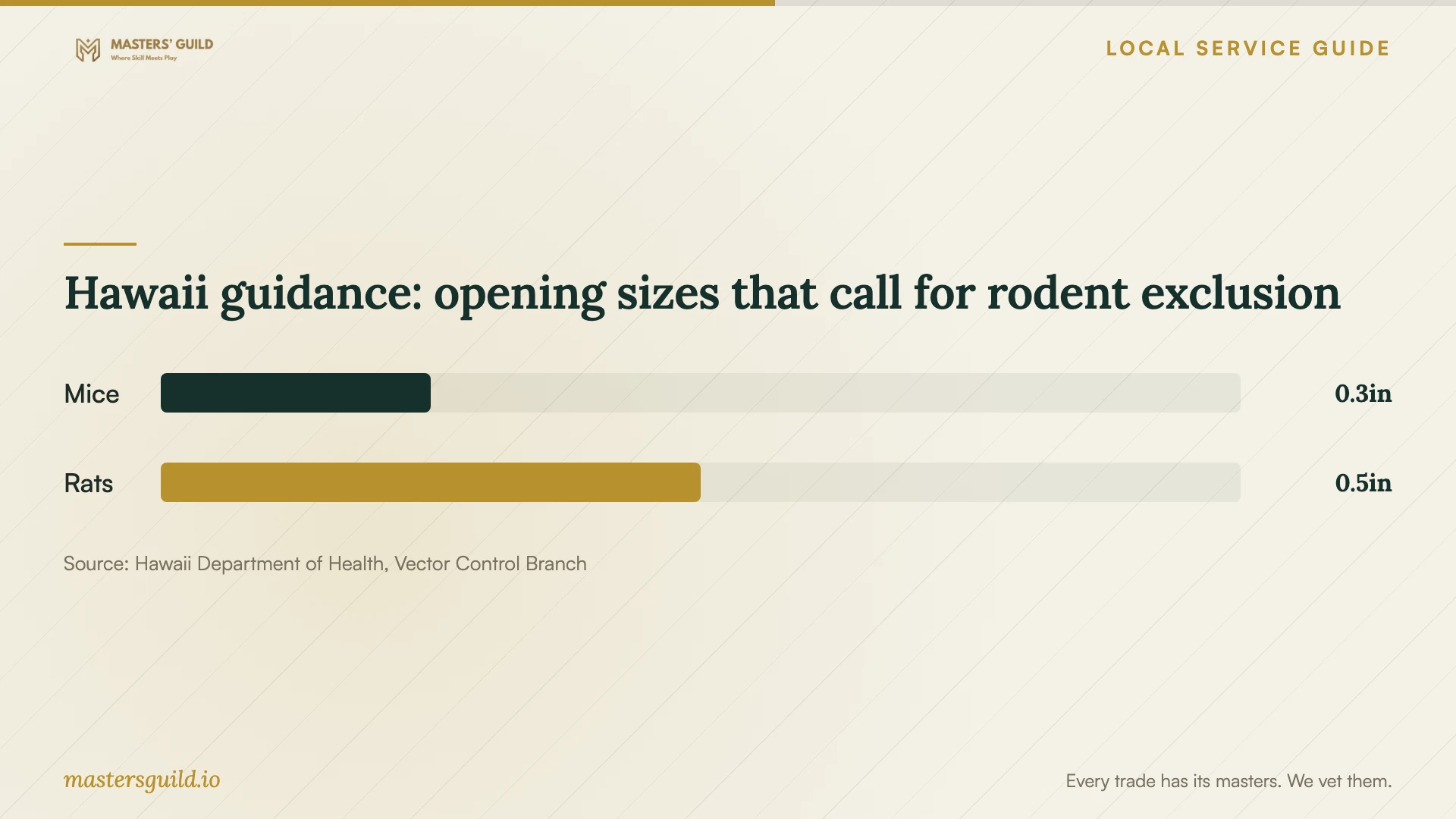
Have the inspector mark suspected entry points and explain the repair sequence. State guidance recommends closing openings larger than one-quarter inch for mice or one-half inch for rats. It lists hardware cloth, sheet metal, and mortar or concrete as suitable exclusion materials. Use the threshold chart to discuss small openings around pipes and screens, rather than judging access by the animal’s apparent size. [1]
Discuss the proposed control method before approving indoor rodent bait. The Department warns about harm to children, pets, and wildlife, plus odors from rodents dying in inaccessible areas. It says bait is not usually the first choice indoors. Establish who will check traps or stations and handle carcass retrieval. [1]
Walk through prevention tasks with the inspector. State guidance recommends securing pet food, gathering ripe fruit, reducing water sources, clearing rubbish and shelter, and removing branches overhanging roofs. Choose the tasks that apply to your property and assign responsibility for them. [1]
Prepare for treatment and track progress
Obtain preparation and re-entry instructions for the proposed treatment before choosing a date. Tell the provider about children, pets, and aquariums. Clarify what to move, cover, clean, or leave undisturbed, and arrange access to the areas the inspector needs.
Agree on what you should record after treatment and when to contact the provider. Keep a dated log of sightings and affected locations. At the return visit, review that log with the technician and ask whether the findings call for further inspection or a change in the plan.
Hawaii guidance: opening sizes that call for rodent exclusion
Local details that affect your job
Check credentials against Hawaii’s current renewal cycle
Hawaii’s Pest Control Board lists operator and field representative credentials. Its published licensing period runs from July 1, 2026 through June 30, 2028, following the June 30, 2026 renewal deadline. The Board says expired, unrenewed licensees may not practice. Use its professional-verification access to match the provider’s supplied name and credential to current status; an older card alone does not establish renewal. [3]
Plan rodent work before demolition or clearing
Hawaii’s Department of Health requires people and firms intending to demolish or clear a site to inspect for rodents and eradicate them before the project begins. It directs applicants to submit a Notice for Demolition or Land Clearing Abatement Inspection. For a Honolulu property, contact the Oahu Vector Control Branch at 808-586-4708 to clarify the notice and inspection arrangements before scheduling clearance. [2]
Choose the next step for your situation
| Situation | Next step | Clarify before accepting |
|---|---|---|
| Pest identity is uncertain | Request identification and inspection | Evidence supporting the treatment |
| Rodent signs overhead | Include roof spaces and climbing routes | Access and entry-repair responsibility |
| Provider proposes indoor rodent bait | Discuss trapping and inaccessible carcasses | Monitoring and retrieval arrangements |
| Demolition or site clearing | Arrange rodent inspection and eradication before work | Department of Health notice arrangements |
| Provider offers recurring service | Review the full agreement | Covered pests, visit scope, and cancellation |
Your hiring checklist
- Record affected locations and previous treatments; photograph signs without handling pests.
- Obtain the pest identification and inspection findings.
- Verify the provider’s current Hawaii credential and request insurance documentation.
- Review the total quote, exclusions, and recurring contract terms.
- Assign responsibility for rodent monitoring, carcass retrieval, and entry repairs.
- Read preparation and re-entry instructions before the appointment.
Frequently Asked Questions
Can I compare prices before an inspection?
Use an initial estimate to discuss your budget, then request a property-specific quote before accepting treatment. Have the provider explain assumptions and any areas they still need to inspect.
Should I wait for a particular season to address rats?
Hawaii health guidance says rats and mice breed year-round. Arrange an inspection when you notice activity and include entry points, food, water, and shelter in the discussion. [1]
Does a rodent treatment include building repairs?
Confirm this with the provider before booking. Have them identify the openings they propose to close, name the materials, and state which repairs you must arrange through someone else.
Sources and scope
This guide combines the sources below with practical planning guidance. Figures apply to the stated geography and period; request a written quote for your property.