
Local service guide
Office Relocation and Setup in Honolulu
For Office Relocation and Setup in Honolulu, choose a mover after confirming its authority for the transport work, agreeing on building access, and assigning responsibility for furniture assembly and IT testing. Hawaii’s PUC regulates property carriers by commodity and service category. Ask the mover to identify the authority covering your office shipment, then check its active status before signing. [1]
Choose a mover for the complete office scope
Ask each bidder to walk through both premises or review a detailed inventory and access photos. Include desks, modular workstations, filing cabinets, printers, monitors, and equipment that needs special handling. Mark what you will keep, move, store, or dispose of, and identify who will empty cabinets and pack loose contents.
Hawaii’s PUC says carriers transporting property for compensation over public highways require a certificate, while its motor-carrier guidance identifies exemptions and different property categories. Ask which certificate and category cover the proposed work rather than accepting a general claim that the company is licensed. Use the PUC’s active-carrier records to check the business name on the quote. [1] [2]
Request insurance documentation and written explanations of damage coverage, exclusions, deductibles, and the claims process. Ask whether the quoted company or a subcontractor will provide the truck and crew. Have the provider name the person responsible for resolving missing items, damage, or incomplete assembly.
Get a quote you can compare
Request separate descriptions of packing, transport, unpacking, assembly, storage, and IT work. For hourly quotes, ask for the crew size, minimum charge, billable travel, and treatment of waiting time. For a fixed price, ask which inventory or access changes would trigger an extra charge and how you must approve it.
Give bidders the same loading route, stairs, elevator dimensions, parking arrangement, and permitted work hours. Ask them to state responsibility for protective floor coverings, elevator padding, packing-material removal, and return visits. Keep disposal and storage charges separate so you can decide whether to include them.
Set a completion standard before choosing a bid: furniture in its assigned position, agreed assembly complete, cartons in the correct rooms, and an identified person available for the walkthrough. For equipment setup, specify the tests you expect, such as signing in, printing, making calls, and accessing shared files.
Confirm access before fixing the move date
Ask both property managers for their move instructions. Confirm dock and freight-elevator reservations, truck clearance, permitted hours, security access, and insurance paperwork. Send the agreed access plan to the crew lead and appoint someone who can unlock each location and answer placement questions.
For a portable storage unit or staging arrangement near a City street, resolve permission before delivery. Honolulu DPP states that a street-usage permit applies to work that temporarily obstructs a roadway or sidewalk and directs applicants to the Department of Transportation Services at 650 South King Street, second floor. Ask DTS about your proposed placement and who should submit the application. [3]
Treat alterations as a separate planning task. If setup includes new wiring or plumbing, Honolulu DPP says Hawaii-licensed contractors must perform that work. Ask DPP about permits for the precise scope before tying contractor completion to the truck reservation. DPP describes permit timing as highly variable. [3]
Arrange power and IT handover
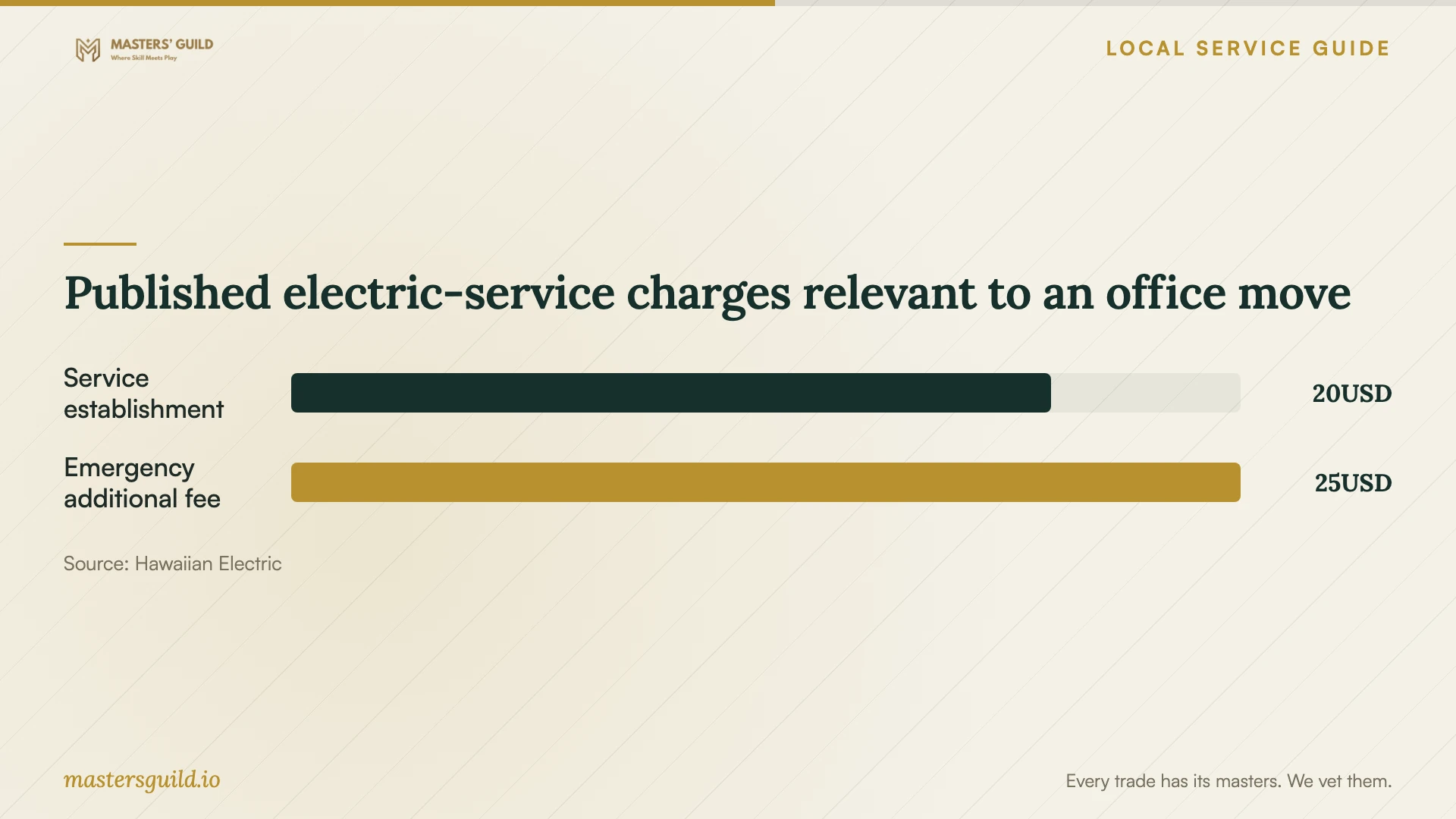
Confirm with the landlord whether you need your own electric account. For start or move requests, Hawaiian Electric publishes a one-business-day advance-notice requirement and a $20 service establishment fee. If service is off, the company gives an 8 a.m. to 4 p.m. reconnection window on the requested date. Plan equipment testing after confirmed power availability. [4]
Assign an IT lead to back up data, label devices and cables, photograph connections, and approve shutdown. Decide who will transport sensitive records and equipment. Ask the IT lead to confirm internet installation and access credentials before scheduling the final workstation tests.
Hawaiian Electric allows customers to request a stop date up to 30 days in advance. Coordinate that date with your final work at the old premises and confirm any landlord requirements. The utility treats new connections and meter-socket work through its additional electrical-services process, so distinguish an account move from physical service changes. [4]
Published electric-service charges relevant to an office move
Local details that affect your job
Curbside containers need a placement check
A building’s approval does not settle the City street question. Honolulu DPP’s portable-storage guidance directs street-usage permits for temporary roadway or sidewalk obstruction to DTS. Before ordering a container, describe its location and delivery arrangement to DTS and assign responsibility for obtaining any required permit. [3]
Do not schedule around an assumed morning reconnection
Hawaiian Electric says reconnection may occur anytime from 8 a.m. to 4 p.m. on the requested service date when power is off. Same-day emergency reconnection requires advance company approval, available resources, and an additional $25 fee. Confirm power before committing to an IT handover that depends on it. [4]
Choose the scope that matches your move
| Your situation | Scope to request | Resolve before booking |
|---|---|---|
| You will pack and handle equipment setup | Transport, agreed furniture handling, and room placement | Inventory, access, and responsibility for damage |
| You need workstations dismantled and rebuilt | Transport plus a written assembly inventory | Parts labeling, destination layout, and completion walkthrough |
| You need staff working through the move | A phased move with an assigned IT lead | Department order, shutdown approval, and restart tests |
| You want a container near a City roadway or sidewalk | Storage delivery coordinated with the placement plan | Ask DTS about street-usage permission for temporary obstruction |
Your hiring checklist
- Prepare a move inventory and destination floor plan with room or workstation labels.
- Match the carrier’s business name and proposed transport authority to PUC records.
- Confirm both buildings’ loading access, elevator reservations, security arrangements, and paperwork.
- Resolve any City street or sidewalk staging permission before ordering a container.
- Assign packing, assembly, IT disconnection, reconnection, and testing responsibilities in writing.
- Agree on extra-charge approval, damage reporting, and the final walkthrough.
Frequently Asked Questions
How much should I budget for the move?
Build your budget from written quotes for your inventory and access conditions. Ask providers to separate labor, transport, packing, assembly, storage, and IT work. Keep utility charges separate from moving charges. The published fees below describe electric-service transactions, not the cost of relocating an office. [4]
Does a mover’s PUC certificate cover electrical setup?
Check electrical work separately. The PUC regulates motor-carrier transport, while Honolulu DPP says Hawaii-licensed contractors must perform electrical and plumbing work. Describe any proposed outlet, wiring, or plumbing changes to DPP and the appropriate contractor. [1] [3]
Can we request electricity on moving day?
Hawaiian Electric requires one business day of advance notice for start or move requests. Same-day emergency meter reconnection depends on advance company approval and resource availability, with an additional $25 fee. Arrange service ahead of the equipment test. [4]
Sources and scope
This guide combines the sources below with practical planning guidance. Figures apply to the stated geography and period; request a written quote for your property.