
Local service guide
Heavy Lifting in Honolulu: Plan the Right Help
For Heavy Lifting in Honolulu, define where each item starts and ends before requesting a quote: another room, a rental truck, a storage container, or the city pickup location. Send photos, dimensions, estimated weights, and access details. If your provider will transport property for compensation over public highways, check its Hawaii PUC motor carrier certificate. For city disposal, secure the pickup appointment before arranging the carry outside. [1] [2]
Choose the scope before choosing a crew
Write an item-by-item destination list. For example, specify that the sofa goes from an upstairs room into your rental truck, while the old dresser goes to the approved bulky pickup location. Ask the provider to confirm which items it accepts, what equipment it will bring, and whether it includes disassembly and reassembly.
Flag pianos, safes, stone tables, exercise machines, and other awkward items before accepting an offer. Give the provider the model number or manufacturer weight when available. Ask it to assess the route and explain its handling plan. Do not choose a crew size from a photograph alone or assume that a general furniture quote includes specialist handling.
For an appliance, state whether you need carrying alone or disconnection and reconnection. Arrange those tasks before the lifting appointment. Honolulu DPP states that electrical and plumbing work must involve contractors licensed by the State of Hawaii; keep that work explicit in the scope. [3]
Get a quote you can compare
Ask for a written total or a written hourly arrangement with the crew size, minimum booking, and billing increments. Have the provider identify travel charges, equipment charges, stair or long-carry charges, and any other additions it proposes. Confirm when paid time starts and ends, including waiting for access or a truck.
Send the same inventory and route description to each provider. Include the floor, stair flights, landing turns, doorway measurements, and distance from the loading space to the entrance. Ask what would cause a quote change and how the provider will obtain your agreement before extra work.
If transportation forms part of the booking, request the carrier’s legal business name and PUC certificate details. The PUC requires a certificate for compensated property transportation over public highways and directs readers to active motor carrier lists through its Case and Document Management System. Describe any unusual arrangement to the PUC rather than treating a lifting-only offer as proof of transport authority. [1]
Request evidence of insurance and ask how the provider handles damage to your belongings and building. Clarify any coverage limits, exclusions, and claim steps before work starts. Photograph existing damage and agree who will protect floors, door frames, and elevator surfaces.
Coordinate disposal with the city appointment
Book city collection before booking a curbside carry. Honolulu allows one bulky appointment per address per month, except in Waikiki, where residents can make weekly appointments. Describe the items and quantities when scheduling because city crews collect only scheduled items. The city directs residents to drop-off options if the next appointment is too far away. [2]
Arrange the lifting visit around the set-out window: no earlier than 6:00 p.m. the evening before collection, with items curbside by 6:00 a.m. on appointment day. City crews do not enter private property. Keep sidewalks, driveways, drain inlets, and roadways clear when placing items. [2]
For a multi-unit building, ask the resident or property manager to identify the common pickup location. Describe unusual collection arrangements in the appointment comments, including a location away from your frontage or on another street. The city warns that omitted details can lead to non-collection. Schedule metal appliances through a separate appliance appointment. [2]
Confirm building access and container placement
Ask your building manager about moving hours, elevator reservations, loading access, protective padding, and any insurance documents it requires. Obtain the building’s instructions before choosing an arrival window. Share them with the crew and name someone who can provide access when it arrives.
For a portable storage container, settle placement before paying for lifting time. Honolulu DPP’s FAQ directs readers to the Department of Transportation Services for street usage permits when work near a city street or highway may temporarily obstruct a roadway or sidewalk. Confirm the proposed location and responsibility for the permit with the container provider and DTS. [3]
Walk the route before arrival. Remove loose rugs and small obstacles, empty drawers where appropriate, and keep children and pets away from the work area. Leave the crew room to inspect the item and route before lifting. If an item will not fit, pause and agree on a revised plan before anyone forces it through a doorway.
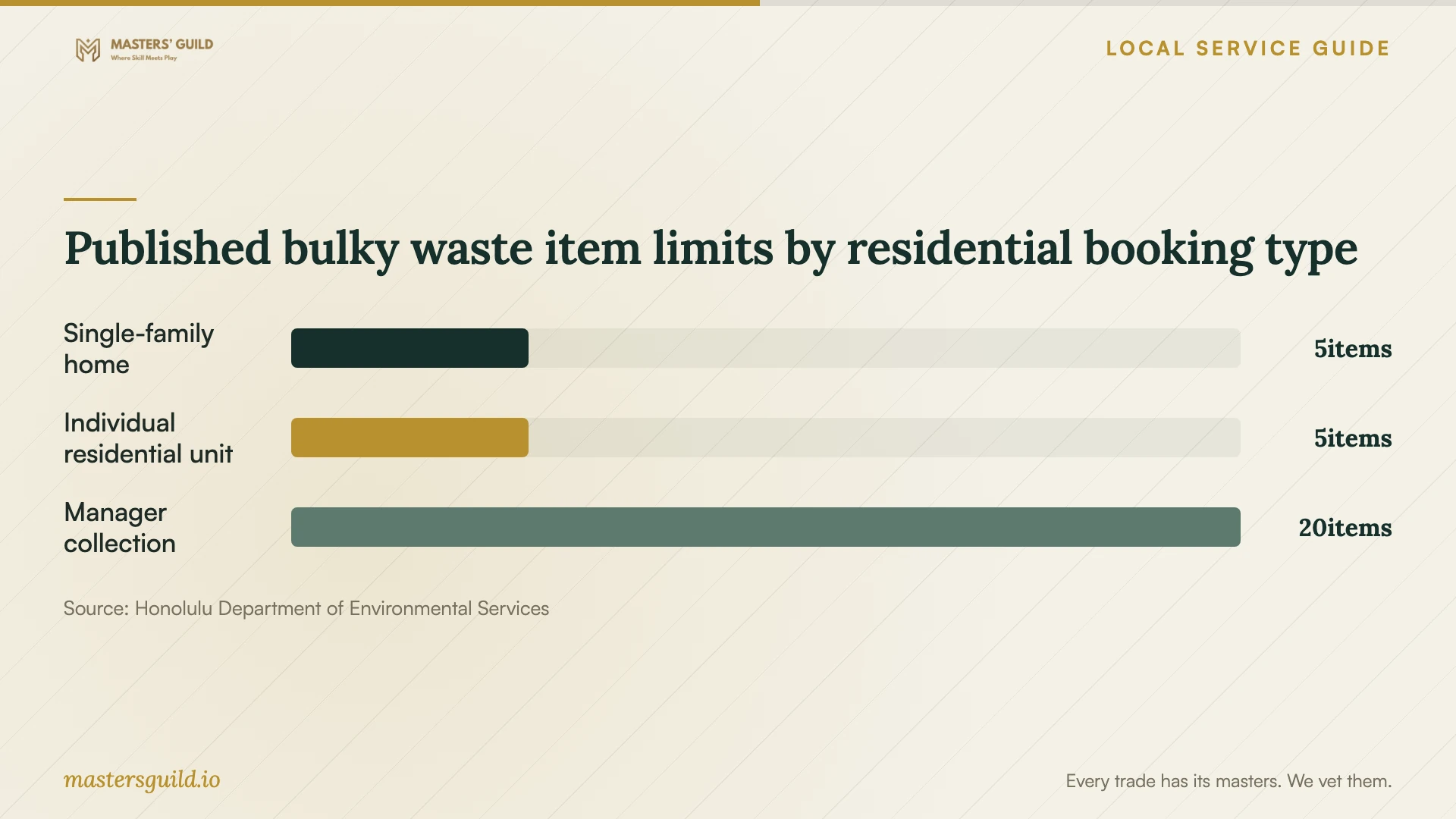
Published bulky waste item limits by residential booking type
Local details that affect your job
Waikiki has a different collection frequency
Honolulu permits weekly bulky appointments in Waikiki, compared with one appointment per address per month elsewhere under the published rules. Check appointment availability before deciding whether to arrange a city-pickup carry or separate removal. [2]
Condo collection needs an agreed location
For multi-family units, the city directs residents to common pickup locations identified by their manager. AOAOs and property or resident managers can arrange the larger collection option by contacting the Refuse Division at 808-768-3200, option 0. Coordinate with management before scheduling an individual carry. [2]
A street container needs advance coordination
DPP identifies DTS as the agency that processes street usage permits for work that may obstruct a city roadway or sidewalk. Confirm container placement and permit arrangements before fixing the loading appointment. [3]
Match the booking to the destination
| Your task | Arrange | Confirm before booking |
|---|---|---|
| Move furniture within the home | Lifting help | Route measurements, equipment, protection, and reassembly |
| Load your rental truck | Loading labor | Who drives, who secures the load, and the agreed finish point |
| Have a provider drive belongings elsewhere | Lifting and transportation | Carrier identity and PUC certificate for compensated public-highway transport |
| Carry unwanted furniture for city pickup | Lifting to the approved collection location | Appointment, scheduled inventory, and set-out window |
| Load a portable storage container | Container placement and lifting | DTS street-use requirements if placement may obstruct the roadway or sidewalk |
Your hiring checklist
- List each item, its starting point, and its final destination.
- Send item photos, dimensions, known weights, and route photos.
- Confirm who supplies the truck, equipment, and protective materials.
- Get the crew size, billing terms, exclusions, and change process in writing.
- Ask building management to confirm access and loading arrangements.
- Match any curbside carry to the confirmed city collection instructions.
- Review insurance evidence and damage claim terms before work starts.
Frequently Asked Questions
Does someone carrying furniture inside my home need a PUC certificate?
The cited PUC requirement covers transporting people or property for compensation or hire over public highways. An indoor carry does not describe that transportation activity. If the booking includes driving your belongings, verify the carrier and certificate; ask the PUC about an unclear arrangement. [1]
Can city crews collect a sofa from inside my home?
No. Honolulu states that city crews will not enter private property to retrieve scheduled bulky items. Arrange the carry to your curbside frontage or, for a multi-unit building, the common pickup location your manager identifies. [2]
Can I put an old appliance out with my furniture appointment?
The city requires a separate metal appliance appointment. Its published allowance for a single-family home or an individual multi-unit residence is up to five bulky waste items and two metal appliances through the separate appliance appointment. Confirm both appointments before arranging help. [2]
Sources and scope
This guide combines the sources below with practical planning guidance. Figures apply to the stated geography and period; request a written quote for your property.