
Local service guide
Event Planning and Setup in Honolulu
For Event Planning and Setup in Honolulu, hire against a written scope: planning, vendor coordination, physical setup and takedown. Choose setup help if you can manage vendors yourself; add a coordinator if you want someone to direct deliveries and the event schedule. Before booking tents or a public park, assign responsibility for checking approvals. Honolulu’s building and fire departments publish separate tent requirements, and HCDA lists a minimum 45-day processing time for its Kakaʻako large or commercial park-event applications. [1] [2] [3]
Choose the help you need
Start with the work you want to hand over. For a shop celebration or client reception, you might retain the budget and vendor bookings while hiring a crew to place furniture, install approved décor and pack it away. For an event with several suppliers, ask a coordinator to manage arrival times, check deliveries and direct the transition from setup to guest entry.
Ask bidders to describe their deliverables instead of relying on package names. Specify who drafts the floor plan, contacts the venue, confirms rental quantities and handles changes. If you need physical setup, list the items and quantities. Ask whether the quoted team includes enough people to complete that list within your venue’s access window.
Keep a named business representative available to approve extra spending. Agree on a spending limit and a way to record changes so the coordinator can resolve a missing item without guessing at your budget.
Resolve tent approvals before ordering rentals
Honolulu DPP requires a temporary permit before someone erects a tent or similar structure for commercial or religious purposes, including the event uses described in its FAQ. DPP says applicants may need plans and approvals from other agencies. It limits these permits to no more than 30 consecutive days unless the fire code regulates them. [2]
The Honolulu Fire Department requires a permit for a tent or canopy exceeding 2,100 square feet and lists a $200 fee. Applicants must submit two plot-plan copies showing distances from property lines, buildings, other tents, parked vehicles or internal combustion engines. HFD lists an exception for private parties on private property. [1]
Give your planner the event purpose, exact address, tent dimensions and proposed layout. Ask them to confirm the applicable requirements with DPP and HFD before you authorize the rental. Put application preparation, fees and approval tracking into the contract, with a named person responsible for each task.
Build a workable Kakaʻako park plan
For Kakaʻako District Parks under HCDA, the large or commercial event application lists a minimum processing time of 45 days. HCDA says payment of applicable fees secures the calendar date. It also requires an event layout map and HFD fire inspection, and says applicants may need an HCDA conditional use permit. [3]
HCDA’s form calls for one toilet per 100 attendees and requires removal and off-site disposal of all trash at the event’s conclusion. It requires security or HPD Special Duty for large events. Ask your coordinator to identify restroom locations, collection points and the people responsible for the final cleanup. [3]
HCDA requires food vendors to provide temporary food establishment permits from the state Department of Health. Its form also calls for the appropriate Honolulu Liquor Commission license to serve alcohol. Insurance requirements depend on event type; the form specifies HCDA and the State of Hawaii as additional insureds and calls for liquor insurance alongside commercial general liability coverage. Confirm the documents applicable to your event before signing supplier contracts. [3]
Compare the complete quote and handover
Request separate amounts for planning, coordination, setup labor, takedown, rentals, delivery, disposal and permit administration. Ask whether the total includes taxes, parking, overtime and a return trip for equipment. For each allowance, record who pays the supplier and who approves an overrun.
For HCDA park events, budget deposits apart from usage charges. The agency lists security deposits of $200 for groups of 50 to 100, $500 for 101 to 200 and $1,000 for groups over 200. Any staking or driving on grass requires a $5,000 deposit regardless of group size. Discuss the installation method before approving the layout. [3]
Finish with a written handover plan. Name who checks rental counts, photographs the cleared space, removes business property and reports damage. Agree on cancellation terms, the deadline for changing quantities and the person who decides whether to move or postpone an outdoor event.
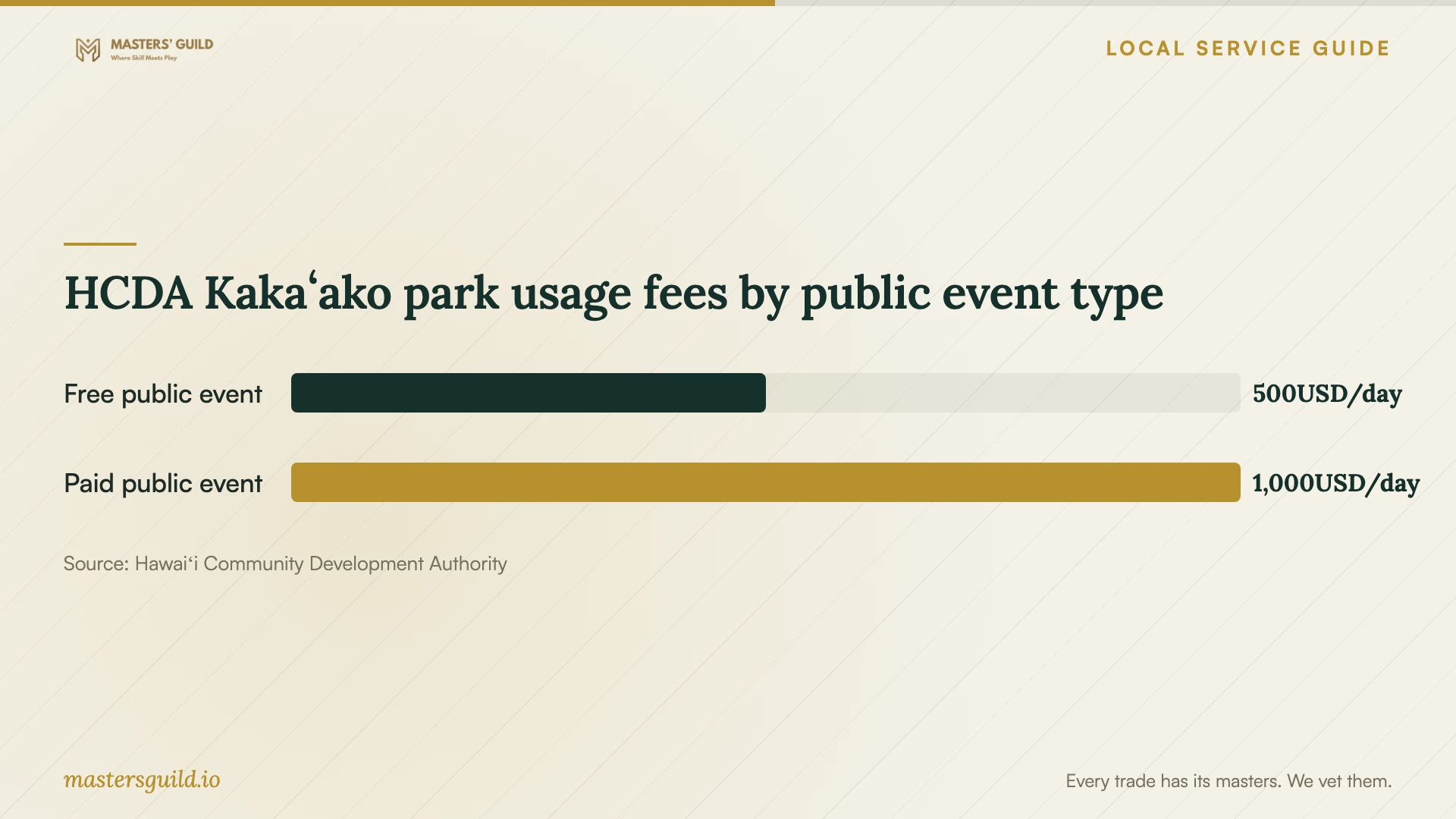
HCDA Kakaʻako park usage fees by public event type
Local details that affect your job
Separate the two tent checks
DPP’s temporary tent requirement addresses commercial or religious use. HFD’s tent permit addresses structures exceeding 2,100 square feet and includes a private-party exception. Give both agencies the intended use and dimensions; do not use the fire threshold alone to decide whether your business event needs approval. DPP lists 808-768-8000 for general questions. [1] [2]
Allow time for HCDA park processing
HCDA publishes a minimum 45-day processing time for its Kakaʻako large or commercial park-event application. Ask your planner to establish the application schedule and confirm calendar status before you pay vendor deposits. The agency says payment of applicable fees secures the event date. [3]
Discuss grass access with the rental company
At HCDA’s Kakaʻako parks, staking or driving on grass triggers a $5,000 deposit regardless of group size. Ask the rental company to describe its installation and delivery method before you approve its quote, and confirm the proposed method with HCDA. [3]
Match the scope to your event
| Your situation | Scope to request | Detail to settle |
|---|---|---|
| You have booked suppliers and can direct them | Setup and takedown crew | Item quantities, crew supervision and removal deadline |
| You want someone to manage supplier arrivals | Event coordination plus any required setup labor | Coordinator authority and who performs physical work |
| You plan a commercial event with a tent | Planning with responsibility for checking DPP and HFD approvals | Intended use, tent dimensions and application owner |
| You plan a large or commercial HCDA Kakaʻako park event | Coordination covering the park application and site logistics | Minimum 45-day processing time, layout, sanitation and cleanup |
Your hiring checklist
- Write down the event purpose, attendance estimate, venue and guest hours.
- Obtain the venue’s delivery, setup and removal windows.
- List furniture, décor and equipment quantities for bidders.
- Assign a named person to confirm approvals and submit applications.
- Request separate service fees, third-party charges and refundable deposits.
- Confirm the crew leader, staffing plan and overtime terms.
- Agree on weather decisions, cleanup duties and rental returns.
Frequently Asked Questions
Does a setup quote include takedown?
Ask the bidder to state this in writing. Specify packing, rental staging, rubbish removal and the time the venue must be clear. Identify who stays after guests leave and who returns equipment.
Does a small tent avoid permit requirements?
Check the event’s use as well as the tent’s size. HFD lists its tent-permit threshold as exceeding 2,100 square feet, with a private-party exception. DPP separately requires temporary permits for tents used for commercial or religious purposes. [1] [2]
How far ahead should I arrange an HCDA park event?
HCDA lists a minimum 45-day processing time for its large or commercial Kakaʻako park-event application. Treat that as an application constraint when choosing your date, and confirm required documents and calendar status with the agency. [3]
How should I compare event-planning prices?
Give bidders the same scope and ask for itemized totals. Compare planning hours, crew duties, rental quantities, delivery, removal and overtime terms. Keep agency fees and refundable deposits visible so you can assess the money needed before the event.
Sources and scope
This guide combines the sources below with practical planning guidance. Figures apply to the stated geography and period; request a written quote for your property.