
Local service guide
Duct and Vent Cleaning in Honolulu: Hiring Guide
Arrange Duct and Vent Cleaning in Honolulu by having a provider inspect for substantial contamination, correct its underlying causes before cleaning or replacement, and give you a written scope and price. For moisture problems, repair leaks or drainage faults first. EPA recommends cleaning as needed, based on findings such as substantial mold, pest infestation, or excessive debris. [1]
Decide whether cleaning addresses your concern
Start with an inspection. EPA identifies substantial visible mold on hard surfaces, vermin infestation, and excessive duct debris or particles escaping supply registers as reasons to consider cleaning. Have the inspector show you the affected areas and explain the underlying cause. Correct that cause before cleaning, retrofitting, or replacing ducts. [1]
Verify a mold finding before choosing treatment. EPA says appearance alone may not establish that a substance is mold; an expert may need laboratory analysis. Describe where you notice odors, dust, or water and when they occur. Discuss unexplained health symptoms with your doctor. EPA says duct cleaning has not been shown to prevent health problems. [1]
Compare the work behind each quote
EPA advises getting written estimates from at least three providers. Give each the same problem description. Compare the system count, duct materials, included components, exclusions, and total price. For a contaminated system, EPA advises cleaning all components; leaving a contaminated component untreated can lead to recontamination. [1]
Check whether the proposed work includes supply and return ducts, registers, coils, drain pans, blower, and air-handler housing where applicable. The crew should use outdoor vacuum exhaust or HEPA vacuum equipment for indoor exhaust, protect furnishings, choose methods suited to the duct material, and seal and reinsulate access holes. [1]
Keep dryer-vent work on a separate line if you want it included. Identify the appliance and outlet involved. Agree on a written approval process for discoveries that would change the price or work.
Plan the budget without a local price guess
This guide does not provide a current Honolulu price estimate. EPA's consumer guide gives a broad reference of $450 to $1,000 per heating and cooling system, depending on scope, size, access, climatic region, and contamination. The guide carries an October 1997 publication identifier, so treat that range as historical background rather than a current local quote. [1]
Have providers account for inspection, access work, cleanup, disposal, and any tax in the total. For hourly work, EPA recommends obtaining an estimate of hours or days and finding out whether the crew expects interruptions. [1]
Repair moisture problems before cleaning
For wet ducts or recurring musty odors, have the technician inspect leaks, the condensate pan and drain, and insulation near cooling coils. EPA identifies condensation around cooling coils as a major factor in moisture contamination. Repair the leak or drainage problem before cleaning or replacement, or contamination may recur. [1]
Have the technician distinguish cleanable hard surfaces from wet or moldy insulation that needs replacement. Review any chemical proposal separately. EPA says no biocides are registered for fiberglass duct board or fiberglass-lined ducts. Before authorizing a treatment, examine the label and the proposed application area, and have the provider explain why physical cleaning and moisture control would be insufficient. [1]
Prepare access and inspect the result
For a condominium, confirm with management who controls the equipment and ducts involved. Settle access permissions, equipment staging, and work hours before booking. Agree on the expected cooling interruption, clear the access route, move fragile items, and arrange a place for pets.
At completion, review the cleaned components with the provider, using photographs for inaccessible areas. EPA recommends a visual inspection that includes clean registers, a clean and draining coil pan, intact fiberglass, sealed access openings, and proper system operation. Have the crew address deficiencies before accepting the work. [1]
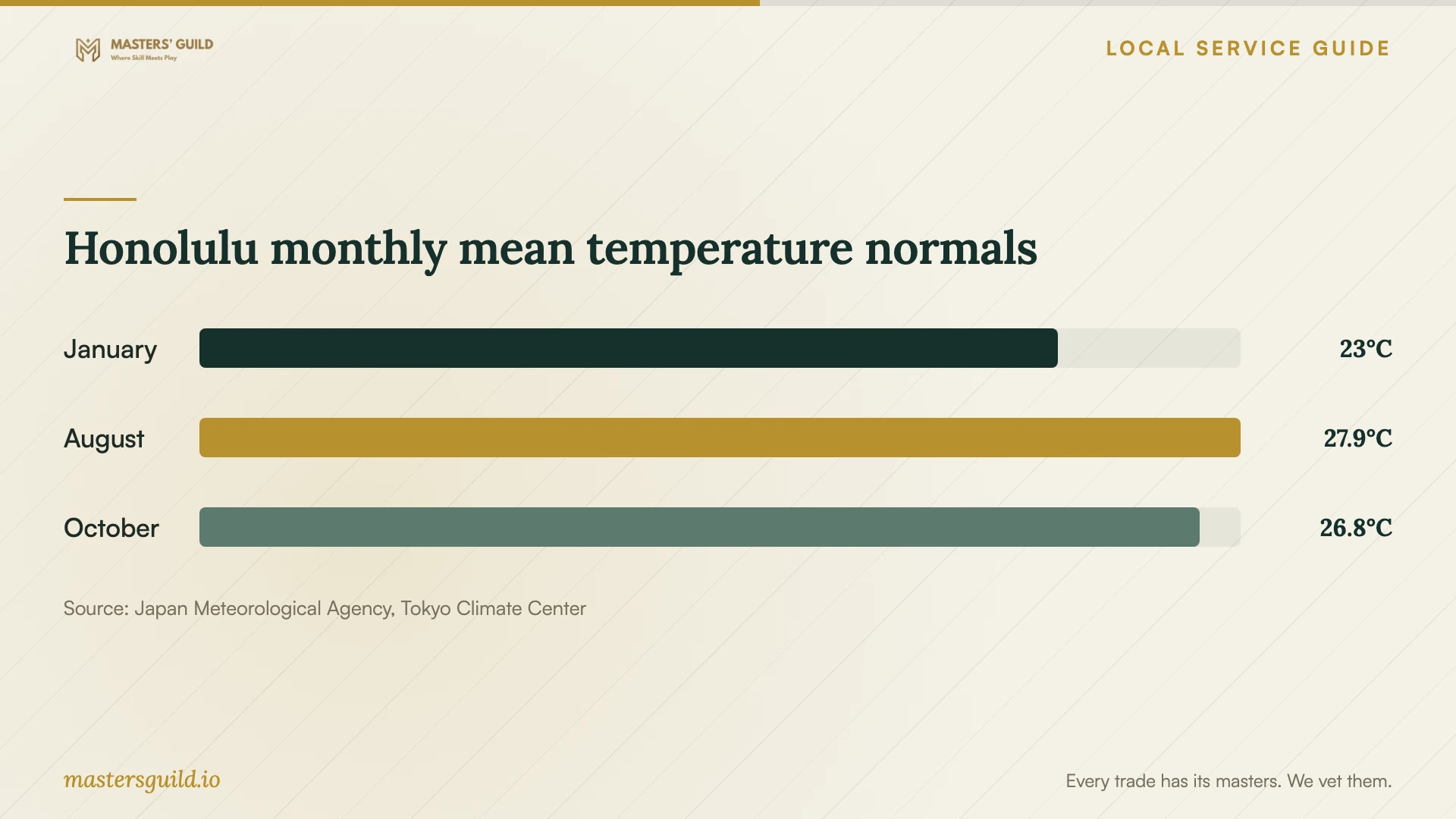
Honolulu monthly mean temperature normals
Local details that affect your job
Hawaii license checks for expanded work
Hawaii DCCA states that a contractor's license is required for projects exceeding $1,500 in labor and materials or requiring a building, electrical, or plumbing permit. Its guidance does not establish that every cleaning-only visit requires an HVAC contractor license. Before approving proposed replacement or alterations, obtain the contractor's name and license number, verify them through DCCA's hiring resources, and clarify the requirements for that scope. [2]
Honolulu GET on the invoice
Honolulu's 0.5% county surcharge applies to activities taxed at the 4.0% GET rate. Businesses may absorb the tax or pass it on. The Department of Taxation lists a maximum combined pass-on of 4.7120% through December 31, 2030. Confirm whether the provider includes any pass-on in its quoted total so you can compare the amount you would pay. [3]
State help with unresolved air-quality complaints
Hawaii Department of Health's Indoor Air Quality Unit investigates public complaints involving inadequate ventilation, inadequate cooling, and ventilation-system emissions. If concerns persist after service, call 808-586-5800 to ask whether your complaint falls within its work. Keep service records and a log of when the problem occurs. Do not assume the unit will provide a residential inspection. [4]
Match the finding to the next step
| Finding | Next step | Before approving |
|---|---|---|
| Dust on a return grille | Clean the grille and inspect before buying whole-system cleaning. | Look for contamination beyond the grille. |
| Excessive debris or particles leaving registers | Correct underlying contamination causes before cleaning. | Confirm the affected components and debris collection method. |
| Suspected mold on hard surfaces | Verify the finding and correct moisture causes before cleaning. | Determine whether expert confirmation is needed. |
| Wet or moldy fiberglass | Correct the moisture source before replacing affected material. | Identify the sections that need replacement. |
| Proposed repairs or alterations | Check Hawaii contractor-license requirements for the expanded project. | Verify the contractor and clarify applicable permit requirements. |
Your hiring checklist
- Write down where and when you notice dust, odors, or water.
- Locate equipment information and accessible service points.
- Confirm condominium permissions and responsibility for the affected equipment.
- Choose someone who can authorize changes during the visit.
- Clear the agreed access route and move fragile belongings.
- Plan around the expected cooling interruption and arrange for pets.
Frequently Asked Questions
Should I book duct cleaning every year?
EPA recommends cleaning as needed rather than on a routine schedule. Use inspection findings to decide. Maintain filters, coils, and drain pans instead of assuming you need an annual duct-cleaning package. [1]
Will duct cleaning lower my cooling bill?
EPA says little evidence supports efficiency gains from cleaning ducts alone. Cleaning dirty coils, fans, and heat exchangers may improve system efficiency. Have a technician identify the cause of poor performance before choosing work. [1]
Does EPA certify duct-cleaning companies?
No. EPA does not certify, endorse, or approve duct-cleaning companies. Evaluate relevant training, experience with your duct materials, references, and applicable state licenses. [1]
Sources and scope
This guide combines the sources below with practical planning guidance. Figures apply to the stated geography and period; request a written quote for your property.