
Local service guide
Door and Window Repair in Honolulu, HI
For Door and Window Repair in Honolulu, have the contractor separate hardware adjustment, glass work, and frame or opening alterations in the quote before you book. Confirm the permit route for the proposed work. Hawaii DCCA requires a contractor’s license for projects exceeding $1,500 in labor and materials, or projects requiring a building, electrical, or plumbing permit. Obtain the contractor’s name and license number and verify their status before signing. [1]
Describe the problem before choosing the repair
Tell the repairer what you experience: a door rubs at one corner, a latch misses the strike, a sliding panel resists movement, glass has cracked, or water appears during rain. Photograph the whole assembly and the affected area. Include any maker’s label and a short video of the operating problem if you can record it without handling damaged glass.
Have the repairer identify the parts they propose to retain and replace. For glass work, request the glass specification and confirm whether the price includes removal, installation, and disposal. For a sticking panel, request a distinction between adjustment, replacement hardware, and frame work. Leave the diagnosis to the inspection.
Keep people away from loose or broken glass and avoid forcing a damaged panel. Tell the contractor if you cannot secure the opening or use an exit. Request a separate description and price for temporary protection, followed by the permanent repair.
Resolve licensing and permits before scheduling
DCCA requires a contractor’s license for any project exceeding $1,500 in labor and materials and for any project requiring a building, electrical, or plumbing permit. Review the whole proposed job against those triggers. Obtain the name and license number of the contractor responsible for your scope and check their status through DCCA’s verification resources. [1]
Give Honolulu DPP the address and an exact description of the proposed repair, including changes to the opening or surrounding framing. Ask whether that scope requires a permit. DPP identifies ROH Chapter 18 as the basis for building permit requirements. [3]
DPP limits instant online permits to qualifying properties and scopes. Its instructions require checks for flood zone, property warnings, and zoning, and cap the estimated work value at $75,000. That ceiling alone does not establish eligibility. Assign responsibility for confirming qualification and preparing plans if DPP requires them. [2]
Compare quotes for the same finished result
Give each bidder the same opening and requested outcome to price. Specify whether you want the panel to operate and lock, damaged glass replaced, or a water-entry problem investigated. Request separate amounts for diagnosis, parts, labor, access equipment, disposal, temporary protection, and finish work where applicable. Check exclusions and any tax or other charge before comparing totals.
For a proposed replacement, obtain the product name, dimensions, finish, glass specification, and hardware details in writing. Have the contractor confirm parts availability and explain what happens if the ordered item does not fit. Agree on how they will document concealed damage and obtain your approval before expanding the work.
Separate the inspection appointment from the installation commitment. Establish what the contractor must measure or order before offering a completion date. For a condominium, check with your building manager about approval, access, work hours, and exterior appearance before authorizing an order.
Plan exterior work and check completion
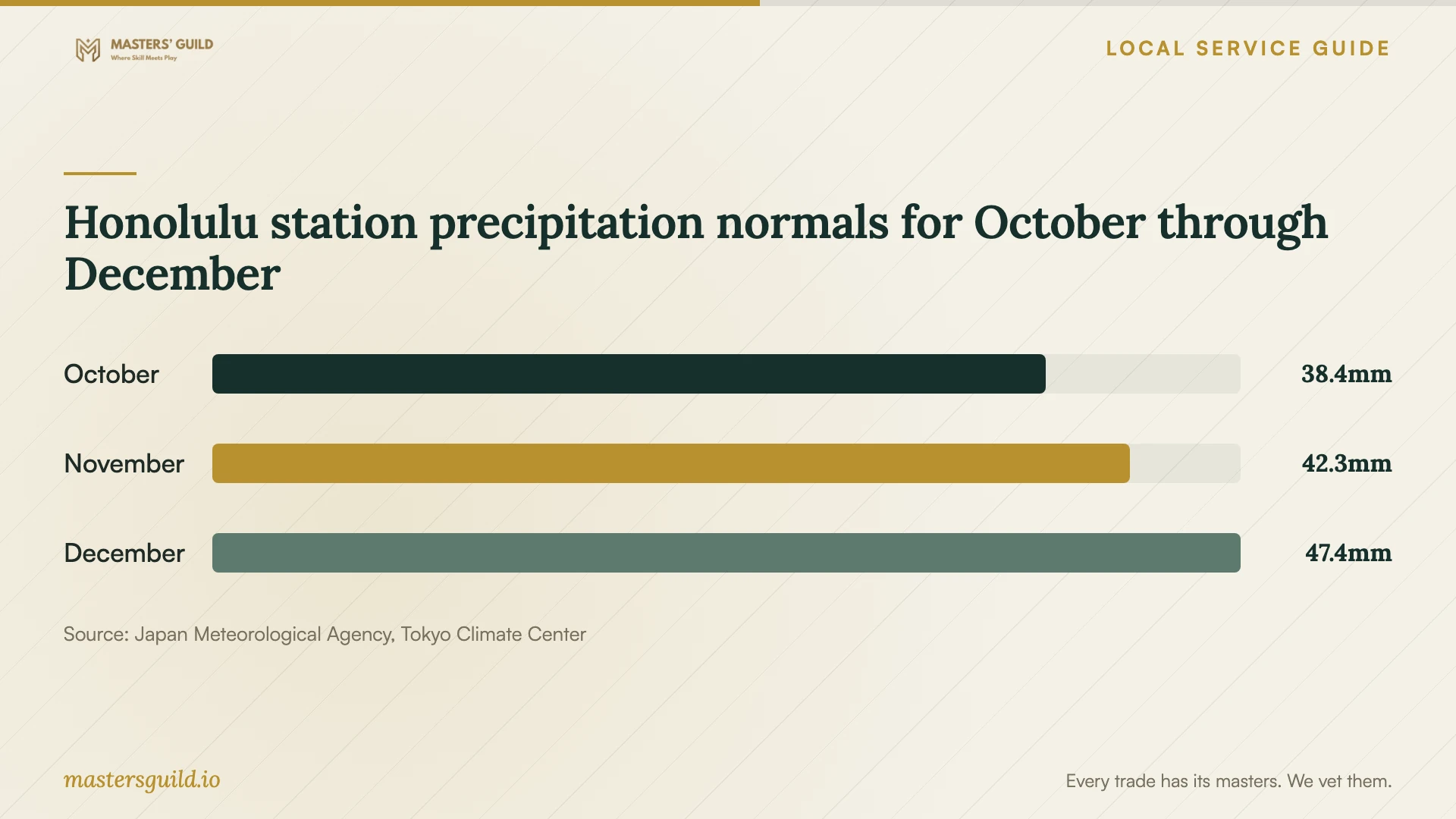
For exterior sealing or frame work, discuss how the contractor will protect the opening if rain interrupts the job. JMA publishes Honolulu station precipitation normals of 38.4 mm for October, 42.3 mm for November, and 47.4 mm for December. These figures provide context for discussing weather protection; they do not predict rain at your address or establish a repair deadline. [4]
Before accepting the work, operate the repaired door or window with the contractor present. Check the agreed locking function and inspect the finish. Request maintenance instructions and warranty terms, then keep photographs, product information, the invoice, and written change approvals.
For work under an instant online permit, DPP instructs applicants to call for required inspections and ensure the inspector closes the permit after completion. Collect confirmation of closure with your project records. [2]
Honolulu station precipitation normals for October through December
Local details that affect your job
Condominium owners should confirm the application route
DPP describes instant online building permits as mostly for single-family dwellings. Its FAQ identifies flood zones, special design districts or clusters, and property warnings or violations as reasons an instant application may fail. Before ordering replacement assemblies for a condominium, obtain an address-specific determination from DPP about the application route. [3]
Emergency work has a next-working-day application rule
DPP states that emergency work may begin without a permit under ROH Section 18-3.3 if the applicant submits the required permit application on the working day immediately following commencement. DPP instructs applicants to identify emergency work in the job description and warns against using this provision for non-emergency work. Assign responsibility for that application before urgent work starts. [3]
Prepare a precise question for Honolulu DPP
DPP lists 808-768-8000 as its general questions line. Have your address, proposed repair description, photographs, and Tax Map Key available when discussing the permit route. Have the contractor distinguish work within the existing assembly from changes to the opening so you can describe the proposal with precision. [3]
Questions to settle before authorizing work
| Your situation | Request | Before proceeding |
|---|---|---|
| Panel sticks or latch misses | An inspection and a defined adjustment or hardware scope | Request the reason for any proposed frame or full assembly replacement |
| Glass has cracked | Glass specifications, installation scope, and temporary protection | Keep people away from damaged glass and confirm disposal arrangements |
| Contractor proposes changing the opening | A scope-specific permit determination from DPP | Resolve the application route and responsibility for plans |
| You expect an instant online permit | Property and scope eligibility checks | Confirm flood zone, warnings, zoning, and the $75,000 work-value ceiling |
| Repair proceeds under a permit | Written responsibility for inspections and closure | Collect confirmation that the inspector closed the permit |
Your hiring checklist
- Photograph the full opening, damage, hardware, and maker’s label.
- Describe operating, locking, and water-entry symptoms.
- Request a written scope identifying retained and replaced components.
- Obtain the contractor’s name and license number for verification.
- Resolve the permit route before committing to installation.
- Confirm building access and association approval before ordering.
- Agree on temporary protection and approval of additional work.
- Check operation and collect warranty and permit records at completion.
Frequently Asked Questions
Does a small repair require a licensed contractor?
DCCA requires a contractor’s license for projects exceeding $1,500 in labor and materials. It also requires a license for projects needing a building, electrical, or plumbing permit. Check both triggers against the proposed scope before hiring. [1]
Can I assume a replacement qualifies for an instant permit?
No. DPP requires both property and scope qualification and describes instant permits as mostly for single-family dwellings. Confirm the route for your address and proposed work before scheduling installation. [2] [3]
How much should I budget?
Request an itemized quote after the contractor identifies the repair scope. Compare parts, labor, access, disposal, temporary protection, and finish work. Request a separate replacement option if you want to compare repairing the existing assembly with replacing it.
Who closes the building permit?
DPP directs applicants to contact the assigned building inspector for closure. Its instant permit instructions require inspections and inspector closure after completion. Put responsibility for arranging these steps in the agreement. [2] [3]
Sources and scope
This guide combines the sources below with practical planning guidance. Figures apply to the stated geography and period; request a written quote for your property.