
Local service guide
Concrete work in Honolulu: Hiring and Permit Guide
Concrete work in Honolulu starts with a measured scope and a contractor license check. Hire a licensed contractor for projects exceeding $1,500 in labor and materials or requiring a building, electrical or plumbing permit. Before accepting a bid, assign responsibility for checking drainage, applicable paving limits, erosion controls and debris hauling. Honolulu DPP requires an erosion and sediment control plan for topping an existing slab over 120 square feet. [1] [2]
Define the problem before choosing the work
Tell bidders how you intend to use the surface: parking vehicles, providing a walking route, replacing damaged steps or creating outdoor seating space. Supply approximate dimensions and photos of cracks, uneven edges, nearby drains and door thresholds. Have each bidder inspect the site before proposing a repair method.
For existing concrete, request an explanation of the suspected cause of damage and the limits of the proposed repair. Ask bidders to distinguish patching, topping, leveling and replacement where those options merit consideration. For moving cracks, exposed reinforcement or a slab connected to the house, ask whether a structural engineer should assess the condition before you authorize work.
Confirm approvals before setting a pour date
Give DPP the property address or Tax Map Key, proposed dimensions and a description of demolition, excavation and new paving. DPP bases building-permit requirements on ROH Chapter 18 and identifies separate stormwater considerations for concrete. Its FAQ states that walls greater than 30 inches require a building permit. Request a scope-specific determination if the job includes a wall, steps or changes beyond a surface slab. [1]
Have the bidder name the person handling applications, erosion-control documents and inspections, and identify those costs in the proposal. DPP says permit review time varies with project complexity, plan completeness, compliance, agency approvals and its backlog. Keep approval time separate from the contractor’s construction schedule. [1]
Discuss where the crew will park trucks, position equipment and store demolished material. DPP says work near a city street that temporarily obstructs a roadway or sidewalk requires a street usage permit through the Department of Transportation Services. Resolve that access question before reserving delivery equipment. [1]
Compare the complete bid
Compare proposals against the same drawing and dimensions. Have each contractor specify demolition, excavation, base preparation, slab thickness, reinforcement, finish, joints and drainage direction. Request separate prices for optional finishes and a written process for approving extra work if the crew encounters unexpected conditions.
Ask how the crew will contain concrete washwater and protect adjacent areas during placement. Include cleanup, hauling and the intended disposal destination in the agreement. Honolulu’s household curbside service does not accept concrete or construction debris, so arrange removal outside household collection. [3]
Build your budget from site-specific written bids. Identify allowances for permits, engineering, equipment access and disposal. Have each bidder explain exclusions and state who pays for changes so you can compare the amount you would pay for the same completed job.
Check credentials and agree on handover
Hawaii DCCA requires a contractor’s license for projects exceeding $1,500 in labor and materials and for projects requiring a building, electrical or plumbing permit. Obtain the contracting business’s name and license number, then use the verification resources on DCCA’s hiring page. Have the contractor confirm that its license covers your proposed scope and provide current insurance documentation. [2]
Agree in writing on payment stages, weather delays, access restrictions and the contractor’s instructions for using the finished surface. Request separate dates for walking, moving furniture and parking vehicles. At handover, review drainage, edges, finish and cleanup against the contract, and collect inspection records where applicable.
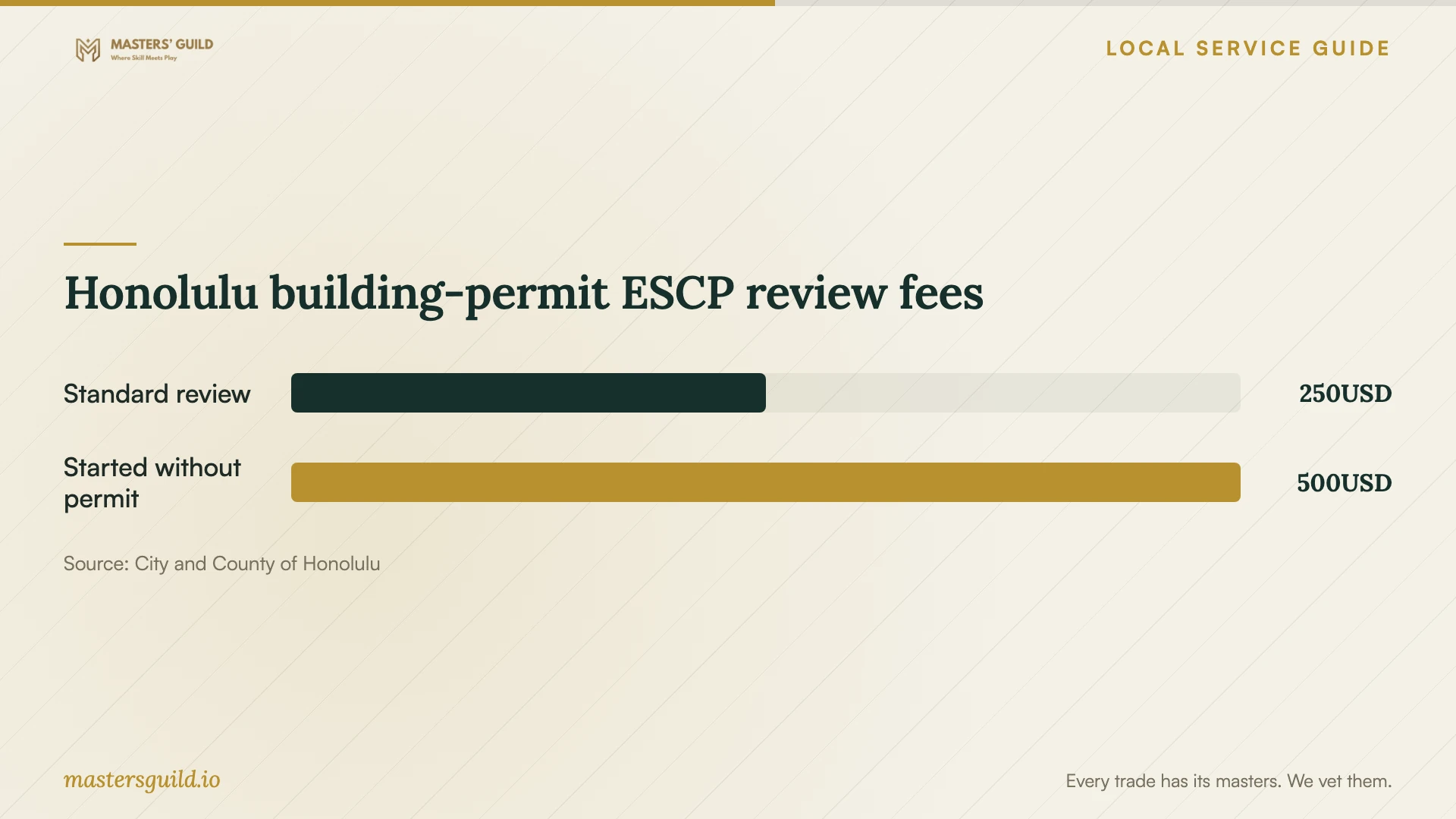
Honolulu building-permit ESCP review fees
Local details that affect your job
Topping an existing slab requires a stormwater check
DPP states that topping existing concrete over 120 square feet requires an erosion and sediment control plan because contaminants can leave the work area. Before choosing an overlay, identify who will prepare the plan and manage the required controls. Keeping the existing slab does not resolve that stormwater question. [1]
Confirm the coverage rule for your property
Confirm the applicable standard with DPP before calculating permitted driveway or patio expansion. DPP describes a 75% impervious-surface limit in residential guidance that excludes townhomes, condos and apartments. Its related residential standards also exclude lots regulated by Cluster, Existing Use or Planned Development–Housing permits. Where the 75% standard applies, DPP counts buildings, driveways, patios, lanais and other impervious surfaces. For existing coverage above that limit, DPP allows redistribution but prohibits increasing the total. Have your bidder document the applicable rule and whole-lot calculation before finalizing dimensions. [1]
Pervious driveway pavers need supporting documentation
DPP allows pervious driveway pavers to reduce impervious coverage but requires documentation addressing subsurface soil suitability and a design that supports vehicle loads without affecting adjacent foundations and structures. Before selecting pavers for that purpose, identify who will supply the documentation and include its cost in the proposal. [1]
Arrange demolition hauling before work starts
Honolulu’s curbside rules exclude concrete, construction debris, soil and rocks. Require the proposal to identify who loads and hauls the material, where the contractor intends to take it and whether disposal charges form part of the agreed price. [3]
Resolve these questions before accepting a concrete bid
| Proposed work | Local requirement or restriction | Next step |
|---|---|---|
| Top an existing slab over 120 square feet | DPP requires an erosion and sediment control plan. | Include plan preparation and site controls in the scope. |
| Enlarge a driveway or patio | DPP’s 75% residential coverage guidance excludes townhomes, condos and apartments; related standards exclude Cluster, Existing Use and Planned Development–Housing lots. Where applicable, owners cannot increase existing coverage above the limit. | Confirm the applicable standard with DPP before calculating permitted expansion. |
| Use pervious driveway pavers | DPP requires documentation of soil suitability and design for vehicle loads without affecting adjacent foundations and structures. | Name the person supplying the supporting documentation. |
| Build a wall greater than 30 inches | DPP requires a building permit. | Confirm design, application and inspection responsibilities. |
| Remove existing concrete | City household curbside collection excludes concrete and construction debris. | Include hauling and disposal arrangements in the price. |
Your hiring checklist
- Photograph the site and mark the proposed work area and dimensions.
- Describe intended loads, finish and drainage direction to each bidder.
- Verify the contractor’s business name and license, and request insurance documentation.
- Get a property-specific determination of paving limits before approving expansion.
- Document responsibility for permits, erosion controls and inspections.
- Confirm truck access, staging space and pedestrian access during work.
- Include demolition, hauling, disposal and cleanup in the written price.
- Agree on extra-work approval, payment stages and surface-use instructions.
Frequently Asked Questions
Does a small concrete repair require a licensed contractor?
DCCA says a license is required when the project exceeds $1,500 in labor and materials or requires a building, electrical or plumbing permit. Check both the total project value and permit requirements before treating a repair as exempt. [2]
Does every concrete slab need a building permit?
DPP’s FAQ mentions concrete slabs that do not require a building permit, but it also identifies stormwater requirements for concrete work. Ask DPP about your exact scope. A building-permit exemption does not settle erosion-control requirements or the paving limits applicable to your property. [1]
Can I enlarge a patio if my lot already has extensive paving?
Confirm the applicable coverage standard with DPP first. Its 75% residential guidance excludes townhomes, condos and apartments, and related standards exclude Cluster, Existing Use and Planned Development–Housing lots. Where the limit applies, DPP says owners with existing coverage above 75% may redistribute impervious surfaces but cannot increase the total. [1]
How soon can the contractor start?
Request separate estimates for approvals, preparation, placement and return to use. DPP says building-permit timing varies with the project, submitted plans, compliance, available records, backlog and external approvals. Have the contractor identify which approvals must precede the proposed start. [1]
Sources and scope
This guide combines the sources below with practical planning guidance. Figures apply to the stated geography and period; request a written quote for your property.