
Local service guide
Commercial Building Cleaning in Honolulu, HI
Arrange Commercial Building Cleaning in Honolulu by having providers walk through your premises and quote the same written task list, visit schedule, and access arrangements. Before signing, assign recycling duties, request coverage evidence, and confirm the final payable total. Choose a proposal that addresses your operating hours, periodic floor care, and a clear process for correcting missed work.
Define the work before requesting quotes
Prepare a room-by-room scope for the walkthrough. List offices, reception areas, restrooms, break rooms, corridors, and shared spaces you control. Ask the property manager to identify landlord responsibilities, then mark the boundary between your cleaner’s work and the building’s service.
For each area, specify tasks and frequency. Separate bin emptying, restroom cleaning, surface wiping, vacuuming, and mopping from periodic carpet extraction, floor finishing, and interior glass cleaning. Request separate prices for the initial cleanup and recurring visits.
Point out sensitive equipment, confidential documents, and surfaces that need particular products or methods. For a medical or dental practice, give bidders your facility’s cleaning protocols and ask them to explain relevant training. Agree on exclusions before accepting a general office-cleaning proposal.
Compare the complete invoice and contract
Request a recurring total with the visit count, supplies, equipment, and agreed tasks. Identify who purchases restroom consumables. Ask how the provider charges for holidays, extra work, missed visits, and changes in occupied space. For floor care, agree on a work window and when staff may return.
The Hawaii Department of Taxation’s page, last updated January 9, 2024, says businesses may choose whether to pass GET and the applicable county surcharge to customers. It lists Honolulu’s maximum pass-on rate as 4.7120% through December 31, 2030. Ask bidders to identify any pass-on amount and state the final payable total. [1]
Review omissions and allowances before choosing a lower quote. Include the contract term, cancellation notice, price-change procedure, and remedy for incomplete work. Ask the provider to explain how you approve extra charges before anyone performs additional work.
Check coverage and control access
Request current liability coverage evidence and identify who will perform the work, including subcontractors. Hawaii’s workers’ compensation FAQ, dated August 31, 2016, states that employers with one or more full-time or part-time employees must provide coverage unless an exclusion applies. It also describes approved self-insurance. Ask the provider to document the arrangement covering your assigned crew. [2]
Agree on keys, alarm codes, entry times, and lockup responsibility. Ask how the supervisor handles replacement staff and reports damage. Confirm parking, equipment delivery, elevator access, water access, and supply storage with your property manager before the first visit.
Plan entrance care and inspect early visits
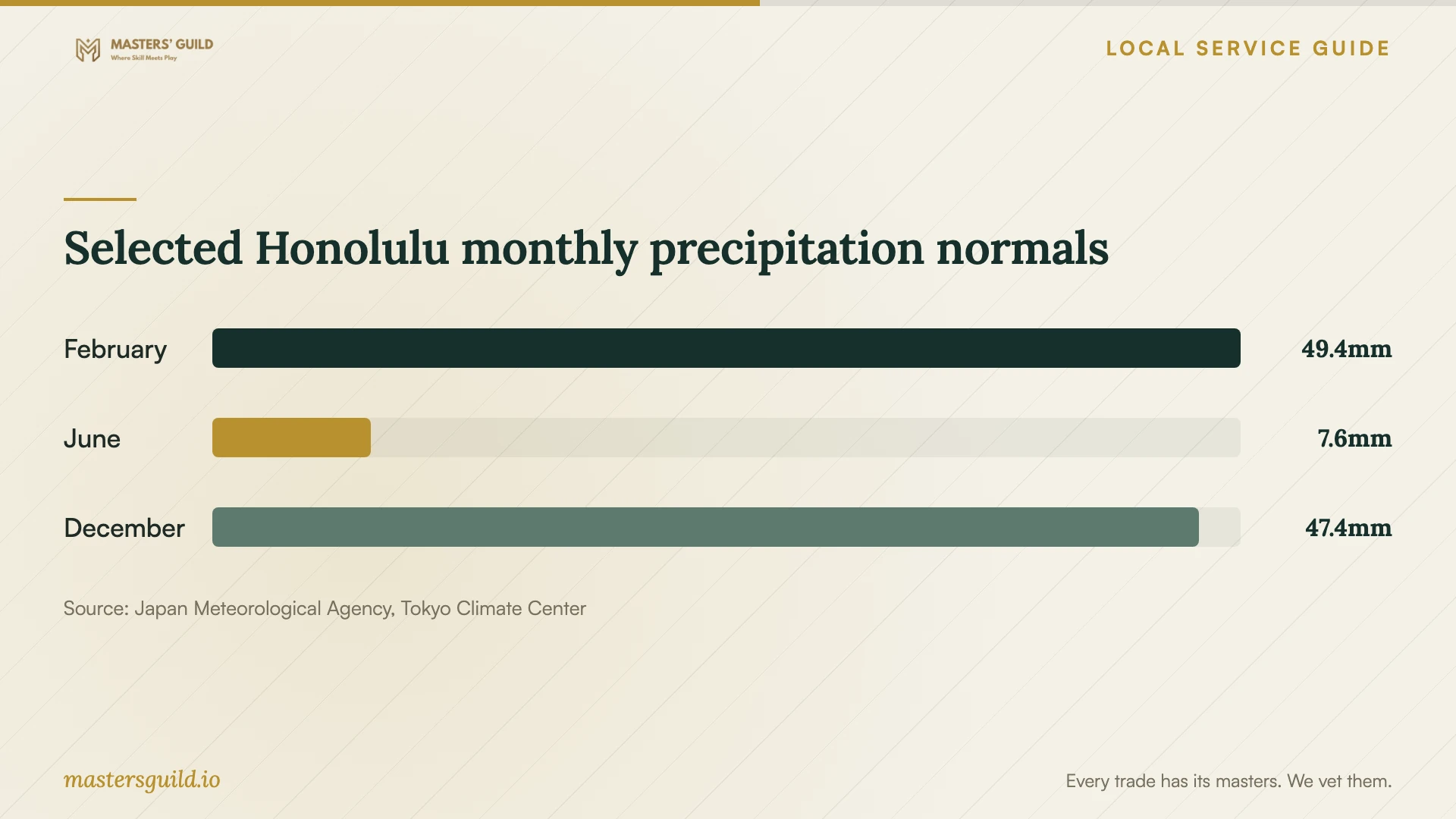
The Japan Meteorological Agency’s Honolulu station table lists monthly normal precipitation of 49.4 mm in February and 7.6 mm in June. Use the chart as a seasonal discussion aid when arranging entrance checks and exterior-work rescheduling. The source does not identify the normal baseline years, and these values do not forecast rain on your service date. [4]
Record existing damage before service starts and agree on an inspection list. After the first visits, check the agreed surfaces, restroom supplies, recycling separation, and lockup procedure. Give the supervisor specific examples of missed work and a correction deadline. Adjust the schedule if your use of the premises differs from the original brief.
Selected Honolulu monthly precipitation normals
Local details that affect your job
Confirm recycling requirements and any suspension
Honolulu’s guidance requires large office buildings to recycle paper, newspaper, and cardboard; it also identifies requirements for liquor-serving establishments and large food establishments. The city says it may suspend recycling requirements when collection and recycling cost more than collection and disposal. Confirm applicability and any suspension with the Recycling Branch rather than treating a higher quote as an automatic exemption. Then assign separation, internal collection, transfer, and hauling duties in the cleaning agreement. [3]
Resolve uncertain waste instructions with the city
The city’s guidance says businesses that ask for assistance will not face penalties and that a recycling specialist will help establish a program. Ask the Recycling Branch for help if your property manager cannot confirm the setup. The city also identifies disposal restrictions affecting cardboard and electronic waste, so give the cleaner explicit instructions for those materials rather than including them in an undefined general-trash task. [3]
Distinguish the surcharge from the customer pass-on
The state’s tax guidance lists Honolulu’s county surcharge as 0.5%, applicable to activities taxed at the 4.0% GET rate. Its maximum optional customer pass-on, including the surcharge, is 4.7120%. These figures describe different parts of the tax treatment. Ask each bidder to show how it calculated the invoice and compare final payable totals. [1]
Match the agreement to your premises
| Your situation | Include in the agreement | Resolve before signing |
|---|---|---|
| Shared office building | A boundary between tenant and common-area cleaning | Ask the property manager to assign responsibility |
| Business recycling applicability unclear | Separate collection and transfer instructions | Confirm requirements and any cost-based suspension with the Recycling Branch |
| After-hours service | Entry, alarm, and lockup procedures | Identify credential holders and the incident contact |
| Periodic floor care | A separate scope, price, and work window | Agree on when staff may return |
| GET pass-on included | The pass-on amount and final payable total | Compare the calculation with the state’s published guidance |
Your hiring checklist
- List rooms, floor materials, sensitive surfaces, and spaces outside your control.
- Set task frequencies and separate initial cleanup from recurring visits.
- Confirm applicable recycling requirements and any suspension with the Recycling Branch.
- Assign bin separation, internal collection, transfer, and hauling responsibilities.
- Request liability and applicable workers’ compensation coverage evidence.
- Agree on access, alarms, parking, storage, and lockup.
- Obtain the final payable total and separate prices for periodic services.
- Set inspection, correction, extra-work approval, and cancellation terms.
Frequently Asked Questions
How much should I budget for commercial cleaning?
Obtain a walkthrough quote for your actual premises. Give bidders the same task list and schedule, then compare recurring totals, visit counts, initial cleanup, periodic services, and consumables. Ask each provider to identify any GET pass-on and give you the final payable amount.
How often should the cleaner visit?
Choose a starting schedule around your opening hours, restroom use, food areas, and customer traffic. Specify which tasks happen each visit and which follow a separate schedule. Review the work with the supervisor after service starts and adjust frequencies where needed.
Does waste removal include recycling?
Ask the provider to define collection, transfer, and off-site hauling as separate duties. Honolulu identifies recycling requirements for certain businesses and allows a possible cost-based suspension. Confirm applicability and any suspension with the Recycling Branch before finalizing instructions; higher collection costs alone do not establish your exemption. [3]
What if a provider says it does not need workers’ compensation?
Ask for an explanation and supporting documentation. Hawaii’s guidance requires coverage for employers with one or more employees, subject to exclusions, and allows approved self-insurance. Check the explanation against who will perform your work, including any subcontracted crew. [2]
Sources and scope
This guide combines the sources below with practical planning guidance. Figures apply to the stated geography and period; request a written quote for your property.