
Local service guide
snow removal in Hialeah, FL: Before You Hire
For snow removal in Hialeah, request a one-time assessment of a confirmed surface hazard before committing to recurring service. NWS documents metropolitan Miami flurries on January 19, 1977, and describes below-freezing nights in South Florida as rare. Base your booking on the forecast for your address and the affected access route. [1] [2]
Start with the affected access route
Describe the problem from a safe position. Identify standing water, frost, loose material or a bonded slippery layer without stepping onto the suspect area. Send an overview photograph and a closer view if you can take one safely. Explain which entrance you need to reach and whether another route remains usable.
Avoid authorizing equipment from a cold-weather headline alone. NWS explains that wind chill speeds an object's cooling but cannot cool it below the actual air temperature. A feels-like reading alone does not establish a frozen driveway. Ask the provider what observed condition warrants the proposed work. [2]
NWS also notes that frost can occur with temperatures in the mid 30s when moisture and calm winds allow it. Use the forecast alongside what you observe; do not assume that an above-freezing air temperature settles the condition of your walkway. [2]
Request a quote for a defined job
Request a written quote for your property. Give the provider approximate dimensions, surface material, steps, gate width and obstacles. Ask them to price the route you need cleared and obtain your approval before expanding the work to other areas.
Separate the callout charge, labor, materials and return visits. Establish what you owe if the crew finds no work necessary, and how cancellation works if conditions change before arrival. For a recurring proposal, ask what triggers attendance, which visits the price includes and what you pay during periods without work.
Compare proposals for the same scope. A useful estimate names the affected area, proposed method, total authorized charge and exclusions. Ask the provider to explain any allowance they cannot price until inspection, then agree on a spending limit before they begin.
Check equipment, materials and responsibility
Confirm that the provider serves your address and can supply the equipment they propose. Request proof of insurance covering the work and ask how they handle damage claims. Identify pavers, decorative concrete, irrigation fixtures and other features that need protection.
If the provider recommends a treatment product, ask for its name, application instructions and intended quantity. Have them explain compatibility with your paving and nearby plants. Keep the product label available for any pet-access or cleanup instructions rather than accepting an unspecified promise that the material is safe.
Agree on a handover that identifies the completed area and any remaining hazard. If you cannot inspect the result, request a completion photograph. Arrange access without leaving children or pets in the work area, and ask the crew to explain when you can use the route.
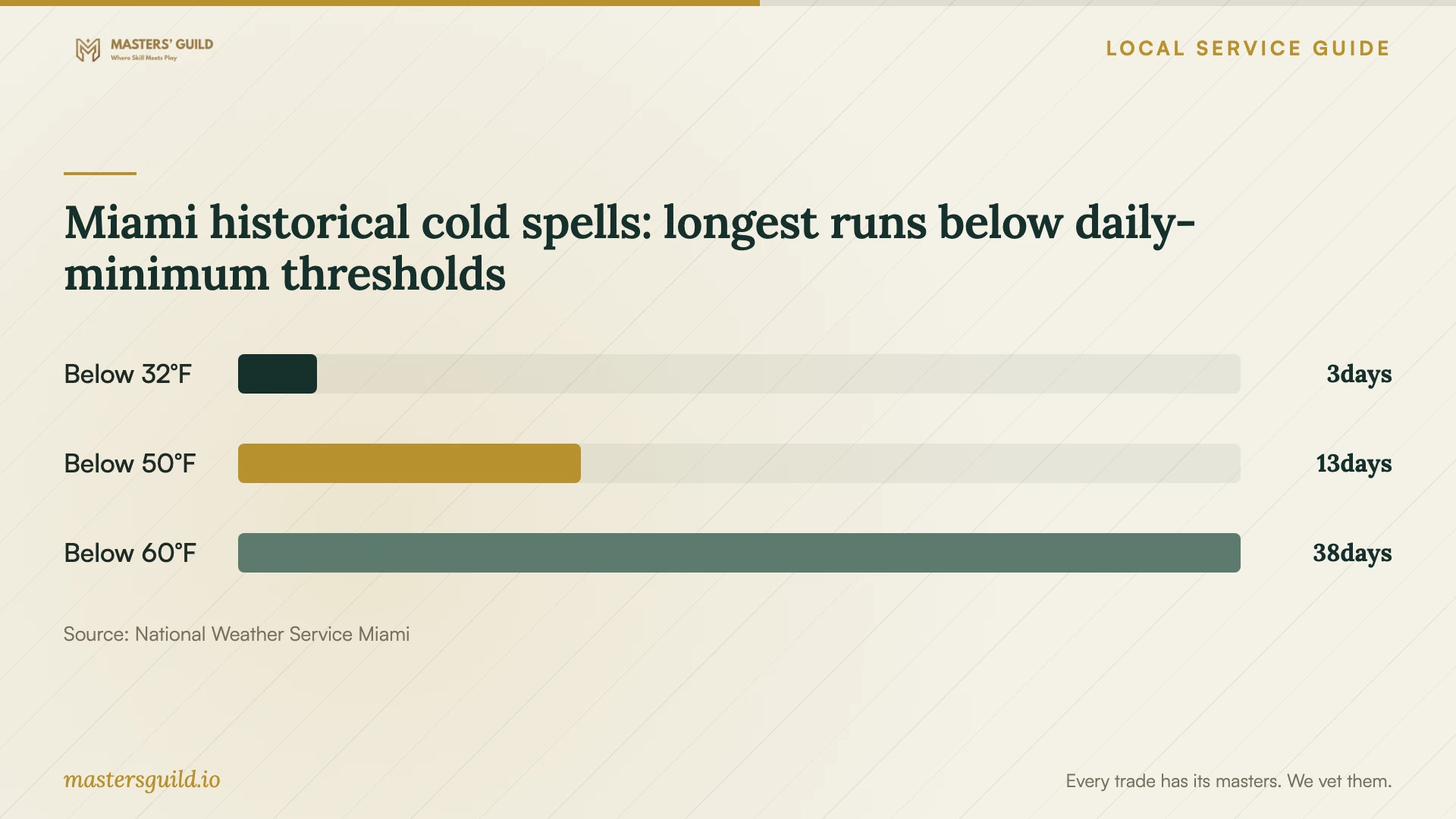
Miami historical cold spells: longest runs below daily-minimum thresholds
Local details that affect your job
Use an address forecast instead of a coastal report
NWS Miami says inland sections of South Florida metropolitan areas are more susceptible to freezing temperatures than coastal sections. For a Hialeah property, check the forecast for the address instead of relying on a beach-area report. Use that regional distinction to decide whether to inspect your access route; it does not establish that the pavement needs treatment. [2]
Preserve the inlet and grass swale
Hialeah asks residents to keep storm inlets free of trash and debris. The city also identifies neighborhood grass swales as drainage features that collect stormwater and allow infiltration. Identify both during the site walkthrough, choose a separate material collection area and ask the crew to remove loose debris without pushing it into either feature. [3]
Match the request to the condition
| Situation | Next step | Question for the provider |
|---|---|---|
| Low feels-like temperature with no observed surface problem | Check actual temperatures and inspect from a safe position | What condition would you assess before recommending treatment? |
| A suspect slippery patch blocks the entrance | Limit the assessment to the required access route | Can you address this area and describe any remaining hazard? |
| A provider proposes a seasonal package | Compare the agreement with a one-time arrangement | What would I pay if no work occurs? |
| Water remains after the immediate cleanup | Request an explanation of the water source before approving repeat treatment | Does this need a separate drainage or leak assessment? |
Your hiring checklist
- Identify the entrance you need and an alternative route if available.
- Estimate the affected area's dimensions and identify its surface material.
- Confirm gate clearance, parked-car access and any equipment restrictions.
- Check the provider's insurance and damage-reporting procedure.
- Approve any additional work before the crew exceeds the agreed scope.
- Inspect the completed route and record any hazard that remains.
Frequently Asked Questions
Does the 1977 snowfall justify a seasonal contract?
NWS records flurries across metropolitan Miami on January 19, 1977. That account does not establish snow accumulation at your property or a recurring service requirement. Ask the provider to justify a contract against the specific work it would cover. [1]
Should I request plowing or manual clearing?
Describe the material and surface first, then ask the provider to recommend a method. Require an explanation of equipment clearance and surface protection before approving a plow or other powered equipment. Keep the initial request focused on the access you need.
Can I leave the method to the contractor?
Ask for the proposed method before work begins. You should understand any treatment product, the area the crew will address and how they will handle remaining material. If the contractor changes the approach after inspection, review the revised scope and price before authorizing it.
Sources and scope
This guide combines the sources below with practical planning guidance. Figures apply to the stated geography and period; request a written quote for your property.