
Local service guide
Lawn mowing in Hialeah: Scheduling and Hiring
Lawn mowing should remove no more than one-third of the grass blade height per visit, according to UF/IFAS. For your Hialeah home, ask providers to identify the grass, propose a cutting height and adjust visits to its growth. Put trimming, edging, pavement cleanup, rain delays and any hauling in the written quote. Confirm disposal before hiring: the city excludes commercial lawn debris from residential bulk collection. [1] [2]
Compare the complete visit before comparing prices
Ask each provider to quote the same lawn areas and tasks. Specify the front, back and side yards, fence-line trimming, edging along paved areas and cleanup afterward. Send photos of the lawn and access points, then ask whether the provider needs an on-site inspection before confirming the price.
Separate the first cut from recurring maintenance if the lawn has grown tall. Ask for the initial work, ongoing visit price and any bagging or hauling charge as separate items. State whether you want a per-visit agreement or a recurring plan, and ask how the provider bills a postponed or skipped cut.
Do not treat a mowing quote as permission for additional treatments. Ask the provider to list fertilizer, weed treatment, shrub work and irrigation repairs as separate proposed services. Request proof of insurance and agree on how to report damage to sprinkler heads, gates or nearby property.
Set the cutting height before the schedule
Have the provider identify your turf before selecting a mower setting. UF/IFAS recommends different cutting heights by species and cultivar. For St. Augustinegrass, its guidance specifies 3.5 to 4 inches for cultivars other than the listed dwarf and semi-dwarf exceptions. Captiva, Delmar and Seville are the exceptions it identifies for a 2.5-inch cut. [2]
Choose weekly or biweekly visits only after discussing growth between cuts. UF/IFAS bases frequency on growth rate, which varies with species, season, weather and management. Its example is a St. Augustinegrass lawn maintained at 4 inches: mow before it exceeds 6 inches. Ask the provider to flag growth that would make your agreed interval unsuitable. [2]
For an overgrown lawn, ask how the provider will avoid removing too much leaf tissue in one visit. UF/IFAS warns that scalping can cause long-term turf damage. Agree on the recovery approach and any extra visits before work begins. [2]
Agree on clippings and pavement cleanup
Consider leaving fine clippings on the lawn. UF/IFAS recommends this for most lawns to return nutrients and organic matter to the soil. If excess clippings form clumps, its guidance recommends distributing them. Ask the provider to describe the finished result rather than leaving the clipping policy unstated. [2]
Include pavement cleanup in the scope. UF/IFAS says grass clippings on driveways, sidewalks and other hard surfaces can carry nutrients into storm drains or water bodies. Ask the crew to return those clippings to the lawn and leave paved areas clear. [2]
If you want bagging or expect substantial debris, settle hauling before the visit. Hialeah collects residential bulk and yard waste once a month but lists commercial lawn debris as unacceptable. Do not assume the crew can leave its waste for city collection; ask where it will take removed material and whether disposal forms part of the quoted price. [1]
Coordinate access, irrigation and rain delays
Choose an arrival window that lets the crew work on dry turf. UF/IFAS advises against mowing wet turf with a rotary mower because clippings can clog the machine. Ask how the provider will assess wet conditions, notify you of a delay and arrange the replacement visit. [2]
Before the visit, clear toys, hoses and pet waste, secure pets and provide gate instructions. Mark sprinkler heads or other features you want the crew to avoid. Tell the provider about narrow passages and ask which equipment will fit before agreeing to the work.
At the first visit, confirm the mower setting and walk through the agreed boundaries. Afterward, inspect the edges, paved areas and any clipping clumps. Use the agreed scope when requesting corrections, and ask the provider to discuss changes in height, frequency or price before the next visit.
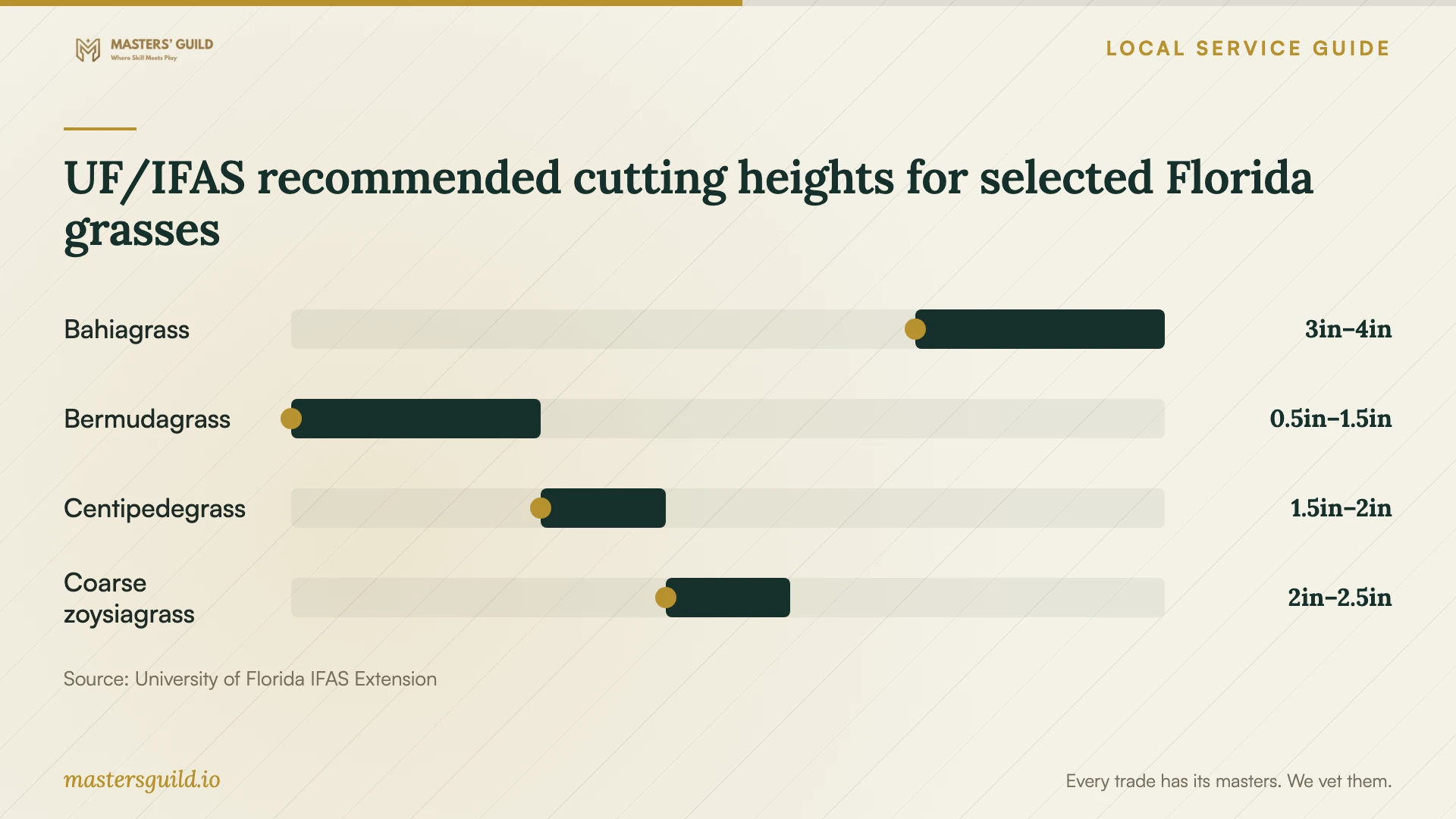
UF/IFAS recommended cutting heights for selected Florida grasses
Local details that affect your job
Hialeah bulk collection does not cover commercial lawn debris
The city provides monthly residential bulk and yard-waste collection and excludes commercial lawn debris. For acceptable material you place out yourself, check the city collection map, set it out the night before or by 6 a.m. on collection day, and keep it at least 5 feet from listed obstacles such as vehicles, fences and utility poles. Ask your mowing provider to include disposal rather than assuming residential pickup covers its debris. [1]
Use Miami-Dade watering windows to plan a dry-turf visit
Miami-Dade County permits lawn irrigation at odd-numbered addresses on Wednesdays and Saturdays and at even-numbered addresses on Thursdays and Sundays, before 10 a.m. or after 4 p.m. The county says to choose the morning or evening window. Its year-round restrictions cover public water, private wells and surface water, with stated exceptions. Coordinate your existing irrigation schedule with the crew, allowing the turf to dry before mowing. [2] [3]
Match the agreement to your lawn
| Situation | Request before hiring | Basis |
|---|---|---|
| Choosing weekly or biweekly visits | A schedule that keeps each cut within the one-third rule | UF/IFAS bases mowing frequency on growth rate. |
| Unknown St. Augustinegrass cultivar | Grass identification before agreeing to a low mower setting | UF/IFAS distinguishes standard cultivars from named dwarf and semi-dwarf exceptions. |
| Bagging or substantial debris removal | A written hauling and disposal arrangement | Hialeah excludes commercial lawn debris from residential bulk collection. |
| Irrigation close to the proposed visit | An arrival window after turf dries | County watering windows apply; UF/IFAS recommends mowing dry turf. |
Your hiring checklist
- Send photos and identify all lawn areas you want included.
- Ask the provider to identify the grass and state the intended cutting height.
- Request separate prices for initial overgrowth work and recurring visits.
- Confirm trimming, edging, clipping handling and pavement cleanup.
- Agree on who removes debris and pays disposal charges.
- Provide gate access, secure pets and mark features to protect.
- Confirm insurance, rain-delay communication and billing for missed visits.
Frequently Asked Questions
Should I choose weekly or biweekly mowing?
Ask the provider to assess growth between visits. UF/IFAS recommends cutting often enough to remove no more than one-third of blade height. Use that limit to review the proposed interval, and agree on how to change frequency when growth changes. [2]
Does the crew need to bag the clippings?
UF/IFAS recommends leaving clippings on most lawns. Ask the crew to distribute clumps and clear paved surfaces. If you request bagging, confirm hauling and disposal in writing because Hialeah excludes commercial lawn debris from residential bulk collection. [1] [2]
Can the crew mow after the sprinklers run?
Wait until the turf dries. UF/IFAS advises mowing dry turf and warns that wet clippings can clog rotary mowers. Coordinate the appointment with your permitted county watering days and agree on a replacement visit if the lawn remains wet. [2] [3]
How can I compare quotes without a published local price range?
Give each provider the same photos, lawn boundaries, access details and task list. Ask for the recurring visit charge, initial cleanup, bagging, hauling and optional work as separate items. Compare the total for the same scope and billing terms.
Sources and scope
This guide combines the sources below with practical planning guidance. Figures apply to the stated geography and period; request a written quote for your property.