
Local service guide
Event Planning and Setup in Henderson, NV
For Event Planning and Setup in Henderson, hire against a written scope covering planning, vendor coordination, installation, and cleanup. Before booking food service for a business opening or customer gathering, ask each operator to identify their permit coverage and service format. SNHD distinguishes vendor permits from event coordinator permits and provides exceptions for particular food operations. [1] [2]
Choose the help you need before comparing quotes
Describe your event in a short brief: purpose, venue, date, expected attendance, food arrangements, and opening and closing times. State whether you need someone to design the event or carry out a plan you have approved. Give each candidate the same brief.
For setup work, list physical tasks such as receiving rentals, positioning tables, placing signs, installing agreed décor, and packing items after guests leave. For coordination, add vendor confirmations, a shared schedule, an on-site contact, and authority to approve changes within your budget.
Ask candidates how they would handle a late caterer or a delivery arriving before the venue opens. Request a sample schedule and references for a similar event format. Confirm who will attend and who covers that person’s absence.
Check food permits by operator and service format
SNHD defines a special event as a temporary public gathering with at least one temporary food establishment or food vendor, a defined start and stop date, and a duration of no more than 14 calendar days. Discuss that definition with your planner when arranging a public opening or customer event. [1]
For traditional special events, SNHD requires participating food operators to obtain temporary food establishment permits unless they already hold Annual Itinerant or Mobile Vendor permits. Its catering FAQ also identifies an exception for contracted banquet or similar service without food sales to individual customers. Confirm which provision applies to each operator rather than assuming all vendors need the same permit. [1] [2]
The catering FAQ says an invitation-only temporary event without individual food sales does not require a temporary permit in the catering circumstances it describes. This guidance addresses catering permit holders; it does not establish permission for any invitation-only food operation. Ask SNHD to confirm requirements for your operator and service format. [2]
Record whether guests buy food from vendors, receive refreshments without charge, or pay an entrance fee that includes food. Ask each food operator for their permit details. Have the planner name who checks coverage, submits any required applications, and keeps documentation available.
Include setup access and teardown in the agreement
Walk the venue with the setup lead. Agree on the delivery entrance, unloading location, storage area, table positions, and guest routes. Obtain written access times and restrictions from the venue before approving the crew schedule.
Request separate quote lines for planning, crew hours, rentals, delivery, installation, removal, and waste handling. Ask how the provider charges for overtime, extra trips, missing rental items, or layout changes. Set a spending limit above which the provider needs your approval.
Name the person who counts rentals on arrival and before collection. Define whether cleanup includes food waste, décor removal, floor cleaning, and returning furniture to its original position. Agree on a final walkthrough and identify who can sign off after you leave.
Approve an outdoor backup before ordering rentals
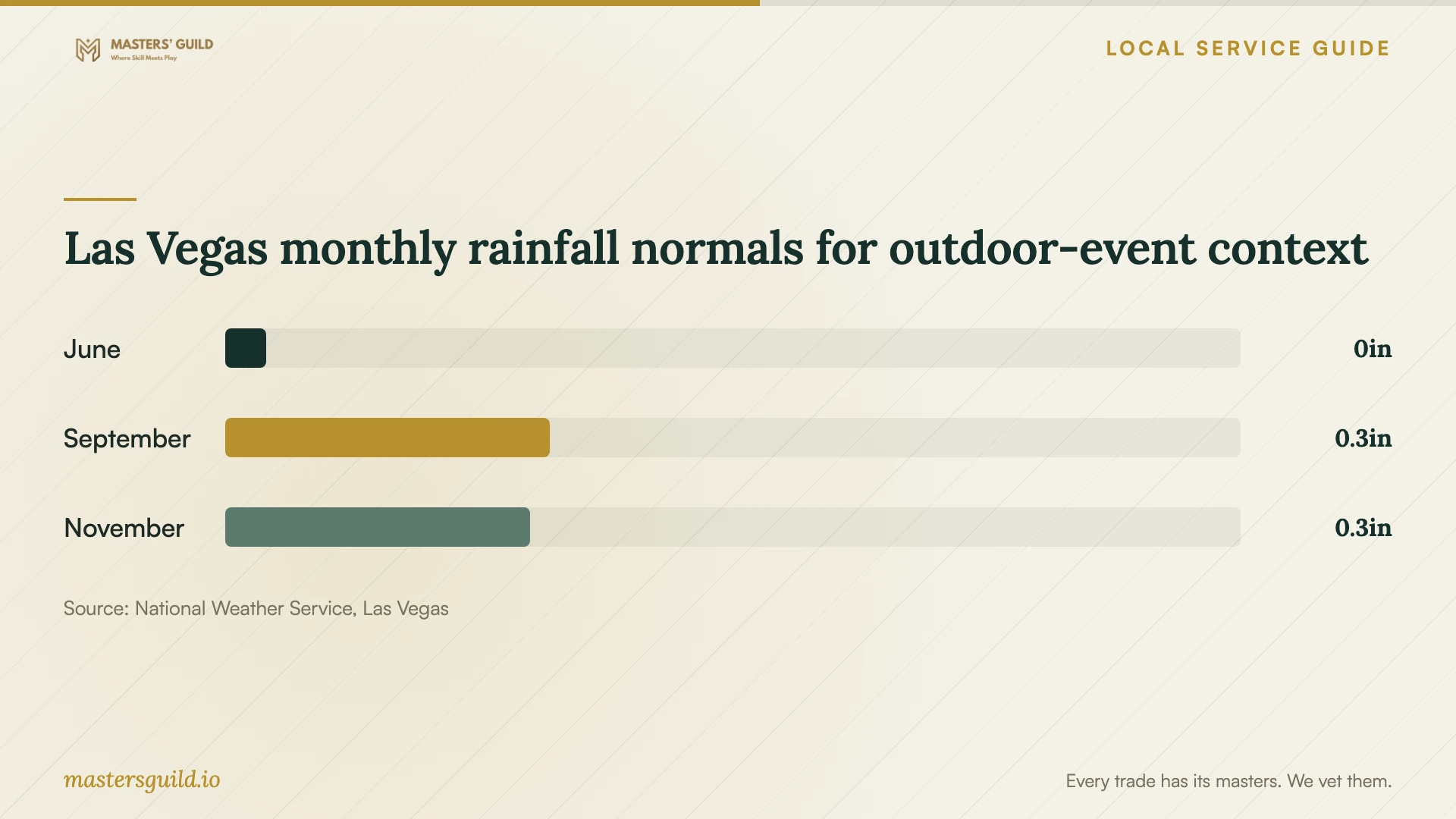
The National Weather Service publishes Las Vegas precipitation normals for 1991–2020. The selected monthly figures in the chart provide regional historical context, rather than Henderson venue measurements or forecasts for your event date. [3]
Ask your planner to write a contingency covering shade, drinking water, guest shelter, and protection for décor and equipment. Identify an indoor alternative or a cancellation arrangement. Choose who checks the forecast, who decides to move the event, and the latest time vendors can change their setup.
Review the backup layout before ordering rentals. Confirm where guests, catering staff, and equipment would go if you move inside. Have vendors explain the added charges and access arrangements for that change in their proposals.
Las Vegas monthly rainfall normals for outdoor-event context
Local details that affect your job
Assign the event coordinator permit as a separate responsibility
SNHD requires an event coordinator permit for traditional special events with five or more permitted food vendors. It also requires one for tasting events, where an entrance fee entitles patrons to food service. These coordinator requirements differ from individual food-vendor permit requirements. Name the applicant in your agreement and request confirmation of the application status; a provider’s job title does not establish that they have handled the permit. [1]
Schedule applications and event-day inspection coverage
SNHD requires temporary permit applications no later than seven calendar days before the event starts to avoid late fees. It may deny permits if applicants have not submitted complete applications and required documentation at least one business day before the start. Applicants use its online Environmental Health portal, and SNHD inspects temporary permits on the event day. Set an earlier internal deadline and assign someone to address inspection issues. [1]
Match your arrangement to the responsibility
| Your arrangement | Help to request | Point to settle |
|---|---|---|
| You have booked vendors and approved the layout | Setup and teardown crew | List installation tasks, access times, and removal duties. |
| You want someone to direct vendors during the event | Event coordination | Name the on-site lead and their spending authority. |
| Traditional special event with five or more permitted food vendors | Coordination with a named permit applicant | SNHD requires an event coordinator permit. |
| Tasting event where the entrance fee includes food service | Planning that includes tasting-event permit coordination | SNHD requires an event coordinator permit. |
Your hiring checklist
- Give candidates one brief covering attendance, food arrangements, venue, and schedule.
- Separate planning, coordination, setup, and teardown responsibilities.
- Obtain venue confirmation of delivery access, storage, and collection times.
- Name who confirms each food operator’s permit coverage and handles applications.
- Request itemized charges and written approval rules for extra spending.
- Approve the main layout, vendor schedule, and outdoor contingency.
- Assign rental counts, cleanup supervision, and the final walkthrough.
Frequently Asked Questions
Does a caterer’s permit cover my public event?
Confirm the service arrangement with SNHD. Its catering FAQ identifies an exception for contracted banquet or similar service without sales to individual customers. Its special-events guidance exempts already-permitted Annual Itinerant or Mobile Vendors from obtaining temporary food establishment permits. Other participating food operators at traditional special events need temporary food establishment permits. Check event coordinator requirements as a separate step. [1] [2]
Does an invitation-only event avoid food permits?
SNHD’s catering FAQ describes a temporary-permit exemption for invitation-only events without individual food sales in the catering context. Do not treat this as an exemption from all food permits or as permission for any food operator. Confirm your caterer’s existing permit coverage and proposed service with SNHD. [2]
How should I compare event planning prices?
Compare quotes against the same task list and attendance assumptions. Ask providers to separate their fee from crew labor, rentals, catering, delivery, and cleanup. Check included hours, cancellation terms, and the approval process for additional spending.
Does submitting a food permit application guarantee approval?
No. SNHD inspects temporary permits on the event day and can deny them if operations do not comply with its food regulations. Ask who will attend the inspection and who can authorize changes the inspector requires. [1]
Sources and scope
This guide combines the sources below with practical planning guidance. Figures apply to the stated geography and period; request a written quote for your property.