
Local service guide
Website Design in Hartford, CT: Plan Your Project
Arrange Website Design in Hartford by giving designers the same written brief: your customer’s main task, required pages, content responsibilities, integrations, budget and launch deadline. Compare build and recurring charges, account ownership and acceptance tests. Request itemized tax treatment and assess privacy requirements before approving forms, analytics or advertising tools.
Define the customer task and project scope
Start with the action you want a customer to complete. For an appointment business, describe how someone chooses a service, finds availability and receives confirmation. For a shop, describe product selection, payment and fulfillment. Ask each designer to explain how they would build and test that path.
List the pages, forms and outside systems you want included. Assign responsibility for writing, photographs, product information and approvals. For a redesign, identify content to retain and existing page addresses to preserve. Request separate prices for optional work, and name the person who can approve additions.
Compare costs and Connecticut tax treatment
Request a build price and a separate schedule of recurring charges. Include hosting, domain renewal, paid software, maintenance and support. Ask what triggers extra charges, how many revision rounds the proposal includes and what happens if you change the scope. Compare proposals using the same deliverables and support period.
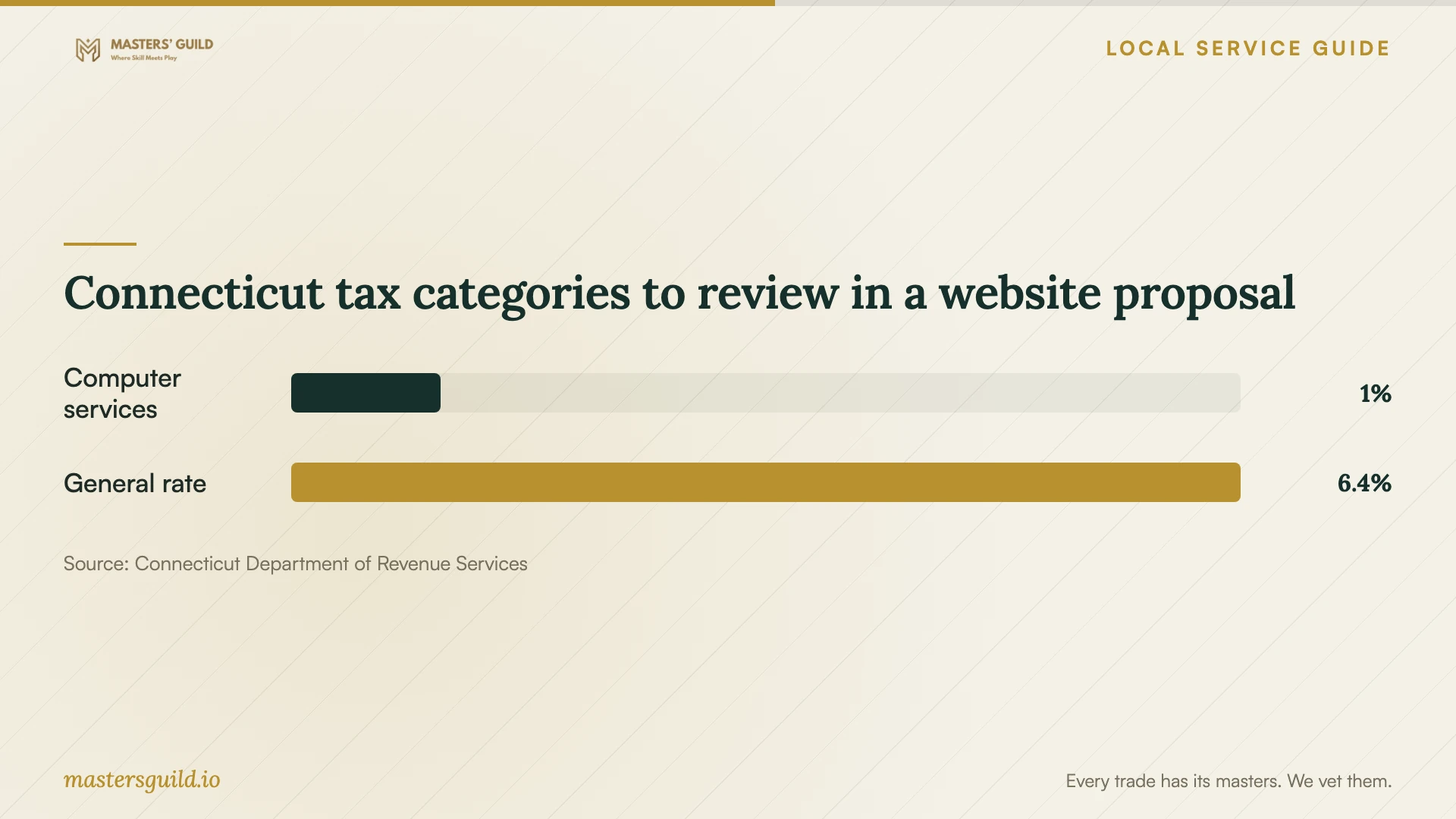
The Connecticut Department of Revenue Services lists website creation, development, hosting and maintenance under computer and data processing services in its Services Subject to Sales and Use Taxes guidance. Its companion Sales and Use Tax Information page publishes a 1% rate for that category and a general 6.35% rate for most taxable goods and services. These pages explain classification and rates together; they come from the same regulator. [1] [2]
DRS states that Connecticut jurisdictions impose no additional local sales taxes. Ask the provider to identify the classification, taxable amount and rate for each component of a mixed proposal. Keep the provider’s explanation with the agreement rather than choosing a rate yourself. [2]
Assess privacy before approving integrations
The Connecticut Attorney General’s Connecticut Data Privacy Act guidance describes coverage for businesses operating in Connecticut or targeting residents. Criteria include processing at least 35,000 consumers’ personal data, processing sensitive data, or offering consumers’ personal data for sale, subject to exclusions and exemptions. The guidance excludes payment-only processing from the first two criteria and describes consumer health data controller coverage without a size threshold. [3]
Prepare an inventory of proposed form fields, booking tools, analytics and advertising integrations. Record what you intend to collect, why you need it and which vendors receive it. Ask a qualified adviser to assess coverage and exemptions, then give the designer written requirements before approving those tools.
For covered controllers, the Attorney General identifies privacy notices, consent before processing sensitive data and recognition of qualifying opt-out preference signals among the obligations. Ask the designer to explain how the implementation will follow your adviser’s requirements and how you will test it before launch. [3]
Choose through demonstrations and written milestones
Ask candidates to walk through a relevant project and explain their contribution. Review the customer journey on a phone and a computer. Have them demonstrate how your staff would edit a page, replace an image and review an inquiry. Use that demonstration to decide whether you want the proposed editing setup.
Put milestones and acceptance criteria in the agreement. Define who approves the design, when you supply content and how both parties approve changes. Tie payments to work you can review. Include a process for revising the schedule if content, integration access or approvals arrive late.
Prepare the handover and launch approval
Request business-controlled accounts for the domain, hosting and key services, with appropriate access for the designer. Document ownership or usage rights for code, design files, photographs and copy. Include an account inventory, renewal schedule, backup and restoration instructions, and a staff editing session in the handover.
Complete the main customer task before approving launch. Send a test inquiry and confirm delivery. Check menus, keyboard navigation, form labels and error messages. For online sales, agree on checkout and refund tests. For a redesign, review old-to-new page addresses. Name the people responsible for launch approval, rollback decisions and post-launch fixes.
Connecticut tax categories to review in a website proposal
Local details that affect your job
Statewide tax rules affect Hartford proposals
Connecticut DRS classifies website creation, development, hosting and maintenance as computer and data processing services and publishes a 1% rate for that category. Ask designers to separate those charges from other deliverables. DRS also states that a business purchasing taxable services for Connecticut use without paying Connecticut sales tax must pay use tax. Include tax treatment when comparing an out-of-state provider’s proposal. [1] [2]
Connecticut opt-out rules affect acceptance testing
The Connecticut Attorney General states that controllers subject to the CTDPA must honor qualifying consumer opt-out preference signals beginning January 1, 2025, and identifies Global Privacy Control as an example. If your business falls within coverage, request a demonstration of how the selected analytics and advertising setup honors those signals. Include that behavior in acceptance testing alongside the privacy notice. [3]
Choose what to request in the proposal
| Your project | Request | Review before approval |
|---|---|---|
| A focused inquiry page | Page content, contact form and delivery setup | Submit an inquiry and confirm who receives it |
| A site your staff will update | Editing access, page templates and training | Have a staff member change sample content |
| Online sales or appointment booking | Named integrations and transaction tests | Complete the purchase or booking journey |
| Replacement of an existing site | Content inventory, address mapping and launch plan | Review retained content and old-to-new addresses |
Your hiring checklist
- Write down the main customer task, required pages and integrations.
- Assign content, photography and approval responsibilities.
- Request separate build, recurring, optional and tax charges.
- Inventory proposed data collection and obtain a privacy applicability review.
- Agree on milestones, revisions and acceptance tests.
- Confirm account control, usage rights and renewal responsibilities.
- Test the customer journey and review the handover before final payment.
Frequently Asked Questions
How much should I budget for website design?
Request itemized quotes for your scope from several designers. Separate design and development from content, integrations, recurring subscriptions and tax. Ask for optional items as separate amounts and require written approval for additions. Decide what you can defer before signing.
Should the designer charge 6.35% Connecticut tax?
Ask for the classification of each component. Connecticut DRS lists website creation, development, hosting and maintenance under computer and data processing services, with a published 1% rate. DRS lists 6.35% as the general rate for most taxable goods and services. Request itemized treatment for a mixed proposal. [1] [2]
Does a small business need Connecticut privacy controls?
Have an adviser assess your processing activities and exemptions. The Connecticut Attorney General identifies sensitive-data processing and personal-data sales among coverage criteria, alongside a consumer-volume threshold. Its guidance also describes consumer health data controller coverage without a size threshold. Give the designer the resulting implementation requirements. [3]
How should I set a launch date?
Ask the designer to schedule content delivery, design approval, development, testing and handover as separate milestones. Identify who approves each stage and reserve time to fix problems found during testing. Agree on how both parties will change the launch date if a dependency arrives late.
Sources and scope
This guide combines the sources below with practical planning guidance. Figures apply to the stated geography and period; request a written quote for your property.