
Local service guide
Tree Cutting and Arborist Services in Hartford, CT
To arrange Tree Cutting and Arborist Services in Hartford, start with an on-site assessment, identify who controls the tree, and request a written scope for pruning, treatment or removal. For paid pruning and tree treatments, check the responsible arborist’s Connecticut license and business registration. Connecticut DEEP includes those activities in its arboriculture licensing guidance; ask DEEP about the requirements for a removal-only proposal rather than assuming the same scope applies. [1]
Choose the work before comparing offers
Ask the assessor to identify each tree and explain the proposed work in plain language. For a tree you want to keep, request a diagnosis, the reason for pruning or treatment, and a plan for reviewing its condition. For a removal proposal, ask why preservation would not meet your goals and whether you need a second assessment before deciding.
Give each bidder the same instructions. Mark the trees on photographs and distinguish removal, selective pruning, treatment, stump grinding and hauling. Ask the contractor to describe the intended pruning cuts or objective. Avoid approving a proposal that says only tree trimming without explaining what the crew will do.
Check Connecticut credentials for the proposed work
Connecticut DEEP requires an arborist license for people advertising, soliciting or contracting to perform arboriculture. Its definition includes paid pruning, trimming, bracing, fertilizing and protecting trees against insects or diseases. DEEP also states that arborists must register their businesses. Request the responsible person’s name and license number alongside the business’s registered name. [1]
Use the licensed-arborist and registered-business lookup resources identified on DEEP’s tree-law page. Ask who will supervise your work and request proof of liability insurance and applicable workers’ compensation coverage. Match the names on the proposal, credential records and insurance documents, and resolve differences before signing. [2]
Check treatment credentials against the actual plants and service. DEEP limits the arborist license’s pesticide authorization to specified treatments of fruit, shade and ornamental trees. It requires additional certification for other sites, including ornamental shrubs and turf. If a proposal combines tree treatment with lawn or tick applications, ask the contractor to identify the certification covering each task. [1]
Resolve roadside and boundary questions
Before approving work beside a street, ask Hartford’s municipal tree warden to clarify whether the tree falls under public control and what authorization applies. DEEP’s statewide reference identifies tree-warden powers, public-tree removals, roadside-tree permits and utility responsibilities as separate legal subjects. That reference does not establish a Hartford permit process or confirm permission for your tree. [2]
For a tree near a property boundary, establish ownership and agree on access before the crew arrives. Ask the contractor to document any permission needed for equipment on neighboring land. For work near wires, ask who will coordinate with the utility. Keep people away from a fallen tree touching wires and contact the utility before arranging cutting.
Get a diagnosis for a declining beech
DEEP reports that beech leaf disease is widespread in Connecticut and affects native and ornamental beeches. Signs include dark bands between leaf veins, crinkled leaves and canopy thinning. Photograph the leaves and whole canopy, then ask an arborist to assess the tree before you accept a removal or treatment recommendation. [3]
DEEP states that there is no known cure, but describes phosphite-based treatments that can protect individual trees on a small scale. Ask for the treatment objective, proposed follow-up and total scope before authorizing a course of treatment. DEEP advises against moving beech material such as firewood and saplings, so discuss handling and disposal in the written proposal. [3]
Set the price, access and cleanup terms
Request a site-specific written total after the contractor inspects access and the trees. Ask for separate amounts for the main work, stump grinding, hauling and any optional treatment. Record whether the crew will leave logs, chips or grindings, and who will fill the stump area. Use those details to compare offers rather than choosing on the headline total alone.
Walk the proposed equipment route with the contractor. Point out gates, planted areas, irrigation and surfaces you want protected. Agree on where vehicles and branches may go, how the crew will protect access to your home, and how you will approve extra work. Include a weather rescheduling plan and ask who decides whether ground conditions permit equipment access.
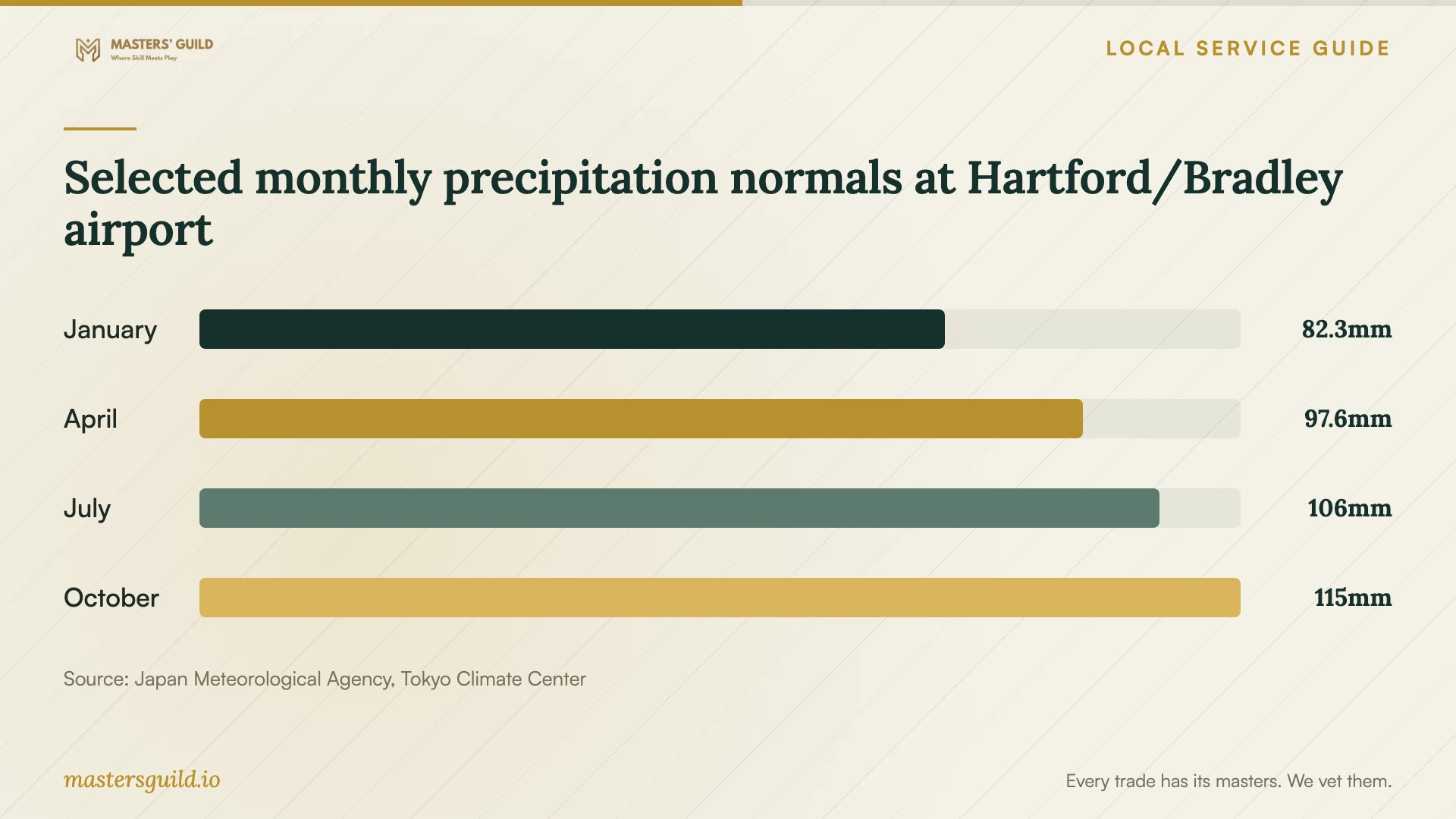
Use the regional precipitation chart as context for that weather discussion. JMA’s Hartford/Bradley airport table lists precipitation normals across the year, including the selected months below. Ask the contractor to assess your actual ground conditions and forecast before bringing equipment onto the property. [4]
Selected monthly precipitation normals at Hartford/Bradley airport
Local details that affect your job
Connecticut checks both the arborist and the business
For pruning or treatment at your home, request the individual license and the arborist business registration. DEEP treats these as separate requirements. Its Pesticide Management Program lists 860-424-3369 for questions, which gives you a state contact if the contractor’s proposed work or credentials need clarification. [1]
A beech assessment needs a treatment and disposal discussion
Connecticut DEEP’s August 2026 guidance describes beech leaf disease as widespread and no longer requests reports of infected trees. For a symptomatic yard beech, prioritize an arborist’s assessment and discuss treatment suitability and material handling. DEEP advises residents to avoid moving beech firewood and saplings. [3]
Choose your next step
| Situation | Next step | Ask before approving |
|---|---|---|
| You want pruning or bracing | Check the Connecticut arborist license and business registration. | Who is responsible for the work, and what is the pruning objective? |
| The tree stands beside a street | Clarify control and authorization with the municipal tree warden. | Does public-tree or roadside-tree authority affect this job? |
| A beech has banded leaves or a thinning canopy | Request a diagnosis and preservation assessment. | Could individual-tree treatment help, and how will you handle removed material? |
| The proposal includes tree and lawn treatments | Check certification for each treatment site. | Which credentials cover the trees, shrubs or turf included? |
Your hiring checklist
- Photograph each tree and mark the work you want assessed.
- Ask the assessor to explain preservation and removal options.
- Request the responsible arborist’s credential details and business name.
- Resolve tree ownership, access permission and any public-authority questions.
- Compare proposals with matching pruning, hauling and stump specifications.
- Review insurance documents and the planned equipment route.
- Agree on weather delays, cleanup and written approval for extra work.
Frequently Asked Questions
Does a Connecticut arborist license cover removal-only work?
DEEP’s guidance defines licensed arboriculture around improving tree condition, including pruning and treatment. It does not give a clear removal-only ruling in its explanatory text. Ask DEEP to clarify the requirements for that scope before treating a removal proposal as a licensed arboriculture service. [1]
Do I need permission to cut a roadside tree?
Resolve that before booking. DEEP identifies laws covering public-tree removals, roadside-tree permits and tree-warden authority. Ask the municipal tree warden which requirements apply to the particular tree; the statewide reference does not confirm authorization for your property. [2]
Should I remove a beech with leaf disease?
Ask for a tree-specific assessment before deciding. DEEP describes a serious disease with no known cure, alongside treatment options for individual trees. Request an explanation of the tree’s condition, treatment goals and reasons for any removal recommendation. [3]
What should the removal quote include?
Ask for identified trees, the work method, access arrangements, hauling, stump work, cleanup and a written total. Specify whether you want to keep logs or chips. Agree on how the contractor will price and obtain approval for any added work.
Sources and scope
This guide combines the sources below with practical planning guidance. Figures apply to the stated geography and period; request a written quote for your property.