
Local service guide
Hartford, CT social media management
Hire social media management in Hartford by comparing written proposals against the same business goal, content workload, and response coverage. Ask each provider to separate management fees, content production, and advertising spend. Before signing, agree on account ownership, approval deadlines, customer-data access, and how you will measure inquiries or bookings. Include Connecticut privacy and merchandise-promotion checks when those activities enter the scope. [1] [2]
Define the work before requesting quotes
Choose a business outcome you can track, such as appointment requests, store inquiries, or purchases through a campaign link. Give candidates your current accounts, intended customers, service area, available photographs, and upcoming offers. Ask them to explain what they would keep, change, and measure.
Separate content planning, writing, design, publishing, comment moderation, and direct-message handling in the proposal. Specify the number of original pieces and platform adaptations. Define who supplies photographs, who approves offers, how many revisions you receive, and which questions the manager must refer to your staff.
For an on-site content session, agree on the location, staff contact, customer permissions, and usable deliverables before booking. If you supply all images, ask the provider to price that scope separately. Request examples of relevant work and ask what the provider contributed to each example.
Choose platforms around your customers
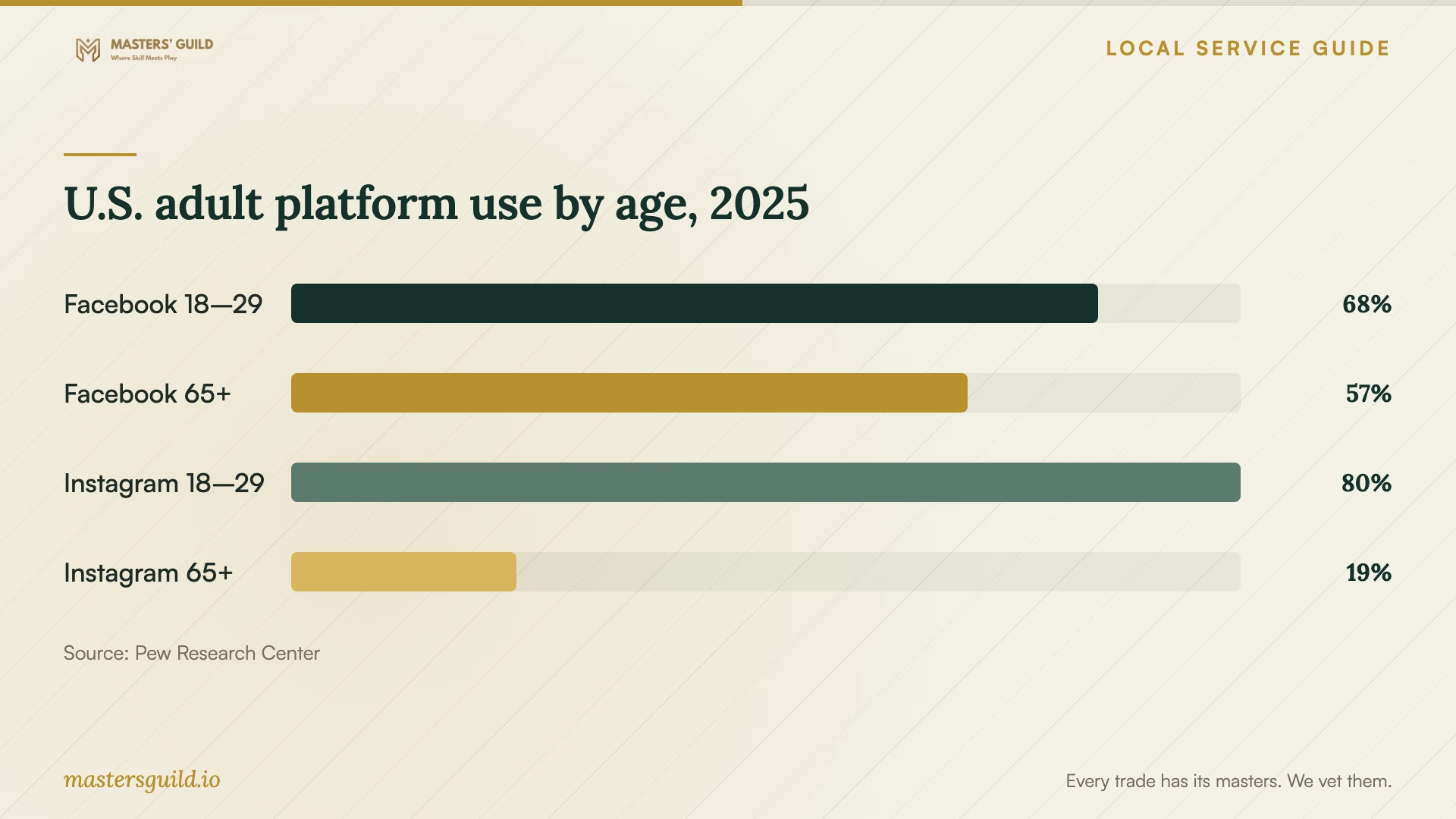
Pew Research Center's 2025 national survey found that 71% of U.S. adults said they ever used Facebook and 50% said they ever used Instagram. Among adults ages 18–29, 80% reported Instagram use, compared with 19% of adults ages 65 and older. These findings describe national usage, not the audience or buying behavior of your business. [3]
Ask a candidate to connect each proposed platform to your customer age range, content resources, and business goal. Compare that recommendation with your own inquiries and account analytics. Start with a scope you can support, then review whether another platform deserves production time and budget.
Use the chart as a prompt for platform-selection questions. It cannot establish which channel will generate sales in Hartford, how often customers use a platform, or what you should spend. [3]
Compare the full cost and contract
Request an itemized quote showing setup work, recurring management, content sessions, software charges, and paid-ad management. Put advertising spend on its own line. Ask whether the provider charges a fixed ad-management fee, a percentage of spend, or both, and identify any minimum commitment.
Compare proposals using the same deliverables and response hours. Ask what happens when you need an extra promotion, an urgent correction, or additional design work. Record cancellation notice, renewal terms, and the process for retrieving assets and reports when the relationship ends.
Ask the provider to identify any tax charged on the service and its basis. Connecticut DRS publishes a general 6.35% rate for taxable services and separate rates for certain categories. Confirm the classification of your proposed contract with your accountant or DRS before comparing tax-inclusive totals. [2]
Control account access and campaign approvals
Keep a business-controlled account administrator and recovery contact. Agree on the access each worker needs, who may change billing, and who may authorize advertising spend. Set a written approval process for prices, stock availability, customer images, and responses to complaints. Include an access-removal and asset-handover checklist in the agreement.
Before a provider uploads customer lists or works with tracking data, assess whether your business falls under the Connecticut Data Privacy Act. The Attorney General's guidance describes coverage based on data-processing activities and lists exemptions. It also applies to processors handling personal data for covered businesses. Ask a qualified adviser to resolve applicability and document the provider's permitted uses. [1]
For covered controllers, Connecticut requires honoring universal opt-out preference signals from residents, including signals concerning targeted advertising. Ask who will handle opt-outs and consumer requests, and how the manager will coordinate with whoever maintains your website. Do this before approving the relevant campaign. [1]
Set reporting and response expectations
Ask for a sample report before hiring. Require separate reporting for paid and unpaid activity, a record of spending, and an explanation of how the provider identifies inquiries or sales. Agree on a starting baseline and a review date. Avoid treating follower totals as the only measure of work.
Write down staffed response hours and the route for urgent messages. Your staff should decide who handles refund requests, confidential customer information, and disputes. At each review, compare completed work with the contract, discuss customer questions, and approve changes to the next content plan.
U.S. adult platform use by age, 2025
Local details that affect your job
Connecticut privacy checks before audience uploads
Statewide rules apply to covered businesses operating in Hartford. The Attorney General lists coverage triggers including processing at least 35,000 consumers' personal data, with an exclusion for payment-only processing, processing sensitive data, or offering personal data for sale. The guidance also lists exemptions and separate consumer-health-data rules. Ask an adviser to check your activities before authorizing customer-list uploads or tracking. For covered work, document the provider's instructions and responsibility for opt-outs. [1]
Approve retail offers against state tax-advertising rules
Connecticut DRS says retailers may not advertise that they will pay or absorb merchandise sales tax, omit it from the sales price, or refund it. This statewide restriction affects retail promotional copy for Hartford businesses. Include a check for those claims in the manager's approval process, and ask DRS or your accountant to review a proposed tax-related offer before publication. [2]
Match the scope to the work you need
| Your situation | Scope to request | Question before signing |
|---|---|---|
| You supply approved photos and copy | Scheduling and publishing | Which platforms, revisions, and reports does the fee include? |
| You need original material | Planning, writing, design, and content sessions | Who supplies assets and approves customer images? |
| You need customer-message coverage | Defined moderation and response hours | Which messages go to your staff, and how? |
| You want customer-list advertising | Campaign work with a privacy applicability review | Who documents permitted data use and handles applicable opt-outs? |
| You promote retail merchandise offers | Publishing with a Connecticut tax-claim approval check | Who checks the offer for prohibited tax-absorption or refund claims? |
Your hiring checklist
- Write one measurable business goal and describe your intended customers.
- Give each candidate the same accounts, content inventory, and deliverables brief.
- Separate management, production, software, and advertising spend in each quote.
- Agree on revisions, approval deadlines, response hours, and complaint escalation.
- Keep a business-controlled administrator, recovery contact, and billing authority.
- Assess privacy-law coverage before authorizing customer-data use.
- Add a merchandise sales-tax claim check to retail promotion approvals.
- Record reporting expectations, cancellation terms, and the handover process.
Frequently Asked Questions
How much should I budget for management?
Ask candidates for itemized quotes for the same workload before setting your budget. Separate setup, recurring work, content production, and advertising spend, then compare exclusions and minimum commitments. Choose a scope you can fund through the agreed review date.
Do I need a manager based in Hartford?
Choose based on the work you need. If you require on-site photography or staff coordination, ask about travel, scheduling, and who attends. For remote work, agree on file delivery, approvals, response coverage, and handover.
Does Connecticut privacy law apply to every small business?
Coverage depends on processing activities, exemptions, and special rules, including those for consumer health data. Ask an adviser to assess your business before the manager uses customer lists or sensitive data. [1]
Can we advertise that we will cover merchandise sales tax?
Connecticut DRS prohibits retailers from advertising that they will pay or absorb merchandise sales tax, omit it, or refund it. Have your accountant or DRS review tax-related promotional wording before you approve it. [2]
Sources and scope
This guide combines the sources below with practical planning guidance. Figures apply to the stated geography and period; request a written quote for your property.