
Local service guide
Senior Care in Hartford, CT: Choosing Home Support
To arrange Senior Care in Hartford, list the help your relative needs, separate medical tasks from everyday assistance, and compare written plans for the same schedule. Connecticut requires homemaker-companion agencies to register with the Department of Consumer Protection. Their companions cannot administer medications, assess blood pressure or provide physical therapy. Verify registration and match the provider to the tasks before signing. [1] [4]
Match the caregiver to the daily tasks
Start with a normal day: preparing meals, bathing, dressing, errands, appointments and time alone. Include your relative in the discussion. Describe the assistance they want, the tasks they want to keep doing and the times when someone should be present.
Connecticut allows homemaker companions to provide nonmedical help with cooking, laundry, light cleaning, shopping and personal hygiene. DCP excludes medication administration, wound care, blood-pressure assessment, physical therapy direction and creation of special diets from this service category. [4]
For a hospital discharge, ask the care team to identify who will perform each medical task. Give prospective companion providers the remaining task list and ask them to confirm their duties in writing. Describe any help needed with moving between a bed, chair or bathroom and ask the care team to assess the arrangement.
Clarify the employment arrangement
DCP distinguishes agencies that place their employees in homes from registries that match consumers with companions. Under the registry model, companions receive at least part of their compensation from the consumer or work as independent contractors. Connecticut requires the service agreement to explain the employee, provider and client employment relationship. [1] [4]
Have the provider name the person responsible for paying and supervising the caregiver. Ask who handles employment responsibilities and who supplies cover after an absence. Discuss a missed visit, a poor caregiver match and an urgent change in needs as separate situations.
DCP requires homemaker-companion agencies to conduct comprehensive background checks before hiring employees who will provide these services. Ask how the agency completes its screening and how you can report concerns about a caregiver. [4]
Compare the full written cost
Connecticut requires the agency and client to sign a written contract or service plan. The agreement must cover anticipated services, the term and cost, job duties, employment relationships, personal-information safeguards, gifts and gratuities, and a complaint process. [4]
Request quotes for the same duties and schedule. Ask providers to specify visit minimums, weekend and holiday charges, transportation expenses, cancellation terms and any replacement-caregiver charge. For overnight care, explain whether you need someone awake and working or available to respond.
Ask for the total charge for your proposed week and the terms for changing it. Review temporary discharge coverage and ongoing care as separate commitments. Before signing, resolve any difference between the duties discussed, the quoted price and the written plan.
Prepare for the first visits
Prepare a short care brief with preferred routines, communication needs, emergency contacts, appointment details and agreed duties. Discuss keys, shopping money, receipts and access to private records. Ask your relative what they want to share before handing over personal information.
Arrange a first-visit handover and walk through the tasks together. Agree on how the caregiver should report concerns and whom to contact after a missed visit. Set a review date to discuss reliability, comfort with the caregiver and changes to the requested help.
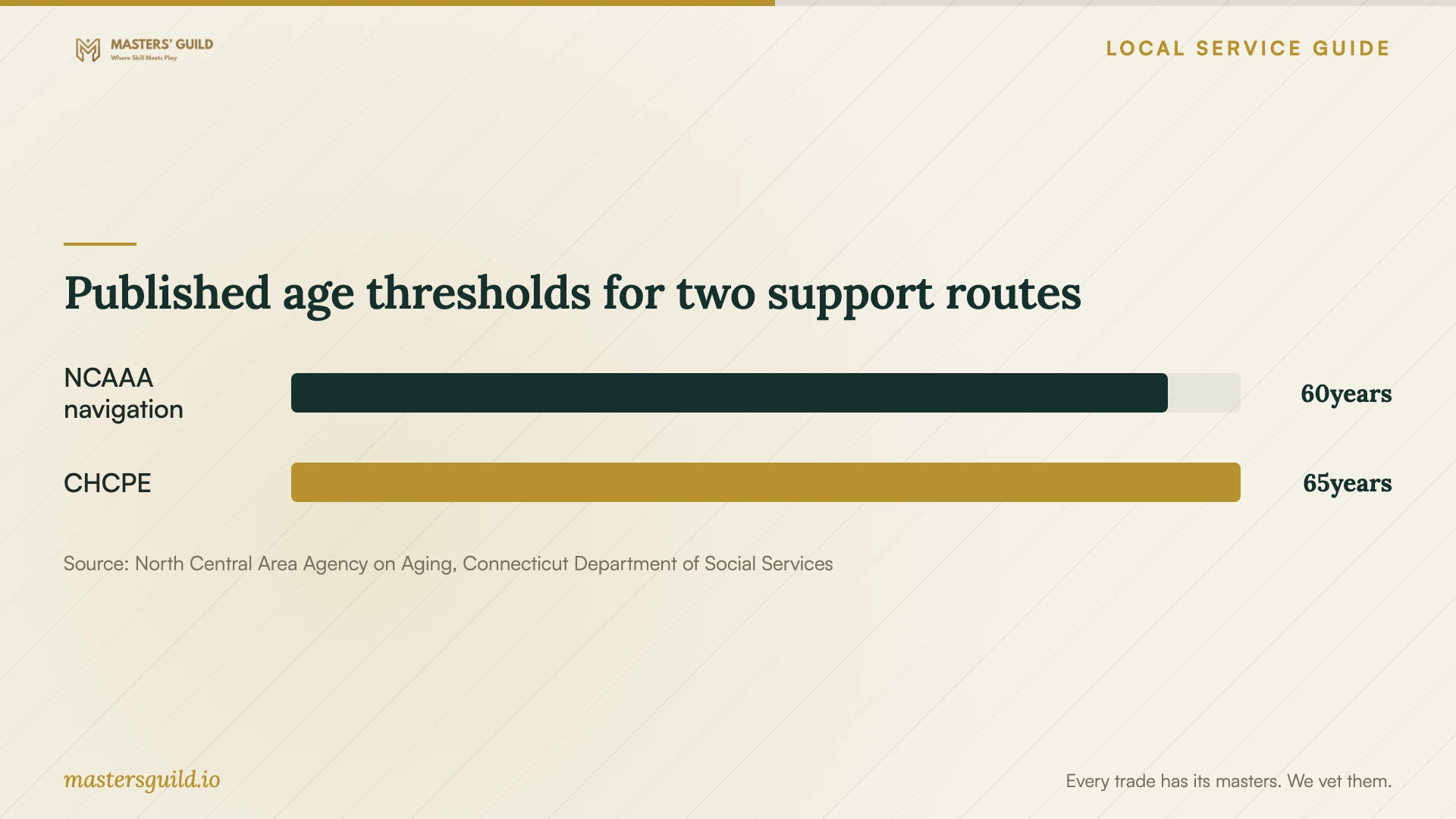
Published age thresholds for two support routes
Local details that affect your job
Connecticut registration checks before care begins
DCP directs consumers to Connecticut eLicense to verify a homemaker-companion agency or registry. Agencies must register before conducting business in Connecticut. Check the legal name on the proposed agreement against the registration, then ask the provider to explain any difference. Registration covers nonmedical homemaker-companion services; DCP prohibits these providers from delivering medical services. [1] [4]
State support for eligible residents living at home
The Connecticut Home Care Program for Elders requires applicants to be Connecticut residents aged 65 or older, face a risk of nursing home placement and meet financial criteria. DSS reviews individual needs to determine whether someone can remain at home with support. Services may include care management, adult day health, companions, homemakers and delivered meals. Explore eligibility before committing to an ongoing private payment arrangement. [3]
Confirm coverage before using regional navigation
North Central Area Agency on Aging describes no-cost service navigation for adults aged 60 or with a disability, including help with homecare, transportation, caregiver support and benefit applications. Its service-navigation page does not identify the municipalities it serves. Before relying on this route for a Hartford address, ask the agency at 860-724-6443 to confirm coverage. The agency warns that benefit processes and applications can take weeks; plan immediate care separately while exploring assistance. [2]
Choose a route by the help needed
| Your situation | Route to consider | Point to confirm |
|---|---|---|
| Help with meals, laundry, errands or personal hygiene | Registered homemaker-companion agency or registry | Nonmedical duties and the employment arrangement |
| Medication administration, wound care or blood-pressure assessment | Ask the care team to arrange medical services | Homemaker companions cannot perform these medical tasks |
| Help finding services or applying for benefits | Consider NCAAA navigation after confirming address coverage | Its page describes no-cost navigation for adults aged 60 or with a disability |
| Age 65 or older with critical daily-care needs | Explore Connecticut Home Care Program for Elders | Connecticut residency, nursing-home-placement risk and financial eligibility |
Your hiring checklist
- List requested tasks, visit times and your relative's preferences.
- Identify medical tasks with the care team and assign responsibility for them.
- Verify the agency or registry through Connecticut eLicense.
- Confirm who employs, pays, supervises and replaces the caregiver.
- Compare written quotes for identical duties and schedules.
- Review cancellation terms, privacy safeguards and the complaint process.
- Prepare emergency contacts, access instructions and a first-visit handover.
- Explore state program eligibility and confirm regional service coverage before relying on it.
Frequently Asked Questions
Can a homemaker companion administer medication?
Connecticut prohibits homemaker companions from administering medications. Ask the care team to identify who will administer them and record that responsibility in the care arrangements. [1] [4]
Can a family member receive payment through CHCPE?
DSS states that family members cannot receive payment for caring for relatives through the program's personal care attendant services, with very rare exceptions. Ask the program about your circumstances before budgeting for family caregiver pay. [3]
Does Connecticut require paid training for companion-agency employees?
DCP announces an eight-hour paid employee-training requirement starting January 1, 2027. That start date follows October 15, 2026. Ask about current training and how the agency will implement the requirement if care continues into 2027. [1]
Sources and scope
This guide combines the sources below with practical planning guidance. Figures apply to the stated geography and period; request a written quote for your property.