
Local service guide
Pressure washing in Hartford, CT: Hiring Guide
Arrange Pressure washing in Hartford with a written surface-by-surface quote, an agreed cleaning method, and a wash-water collection and disposal plan. Confirm whose water the crew will use, applicable tax, and weather terms before accepting an offer. Resolve proposed drainage routes first: Connecticut DEEP describes separate regulatory programs for surface-water, groundwater, and sewer discharges. [1]
Get a quote you can compare
Send each contractor the same photos and description. Identify the driveway, siding, steps, patio, or other surfaces you want cleaned. Mark exclusions and include close views of stains or damage alongside a wider view showing access. Ask whether the provider needs a site visit before committing to a price.
Request separate descriptions for general washing, targeted stain treatment, and additional work. Have the contractor explain the method and products proposed for each material. Agree on a test area where appearance concerns you, and record which marks the provider expects to remove or leave.
Request a total, payment schedule, cancellation terms, and conditions that could change the price. Include collection, disposal, furniture moving, and cleanup in that discussion. Ask for proof of liability insurance, who will perform the work, and how you would report damage.
Resolve wash-water disposal before scheduling
Walk the work area with the contractor and identify drains, low spots, and property boundaries. Ask where wash water will travel, how the crew will collect it, and where they intend to dispose of it. Include cleaning products and material removed from the surface in that discussion.
Connecticut DEEP describes separate programs for discharges to surface water, groundwater, and sewage treatment plants. Its surface-water program includes municipal storm drainage; its pretreatment program covers sanitary and combined sewer routes. Ask the contractor to establish the receiving system before proposing disposal. [1]
DEEP lists Water Permitting and Enforcement staff at 860-424-3018 in its fact sheet. The document carries a June 2013 content date and warns readers against relying on it to determine whether a permit is required. Use that published contact to seek guidance about an unresolved proposal and confirm the requirements for the actual activity. [1]
Check your water account and the quoted total
Confirm whether the contractor brings water or connects to your outdoor tap. For use of your supply, request an expected volume and identify the connection point. Keep the cleaning quote, disposal scope, and household water expense separate when comparing offers.
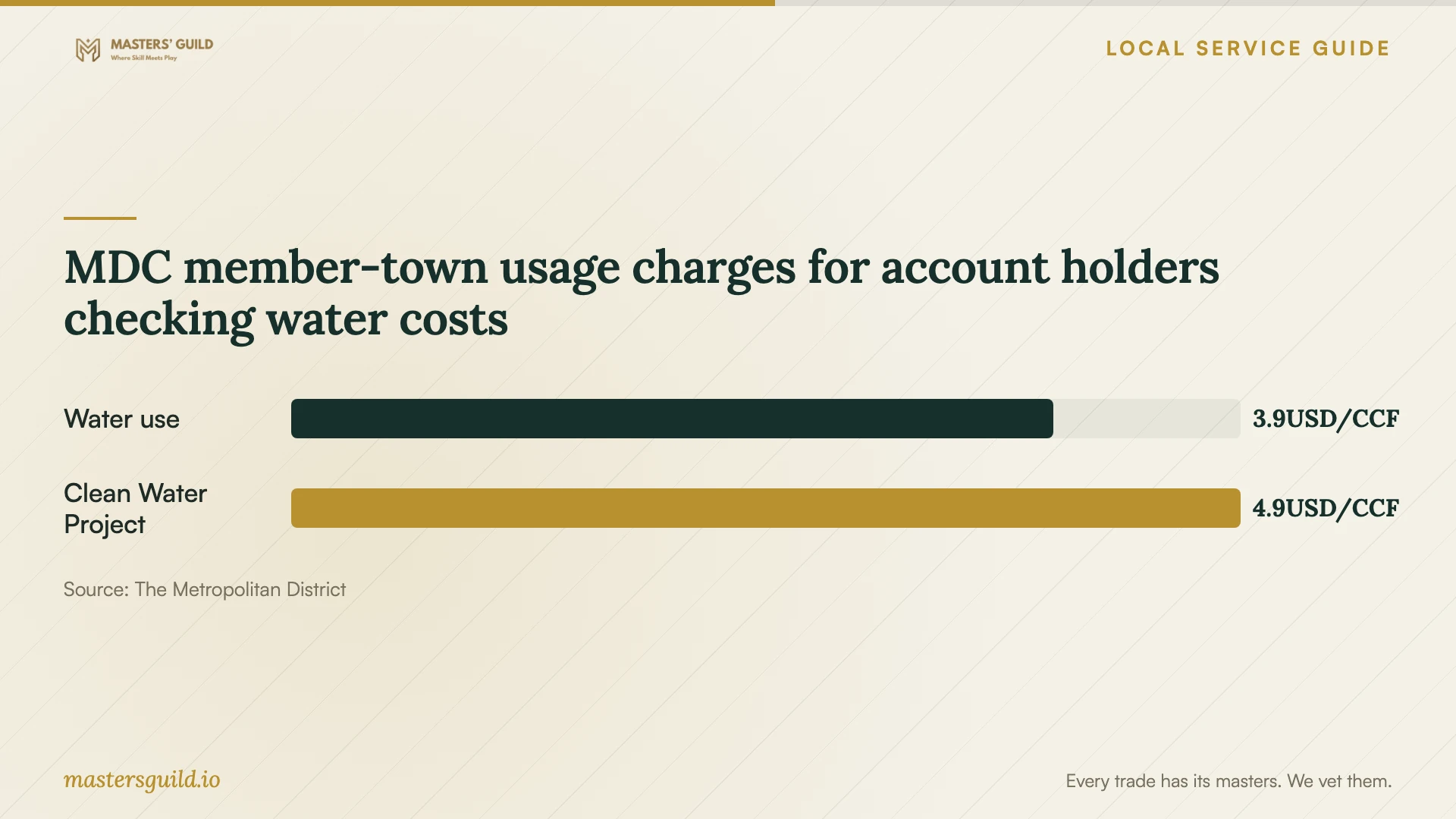
Before applying the chart rates, check your latest bill for the utility name and charge labels. If you have an MDC account, compare its usage charges with the published schedule and ask MDC at 860-278-7850 whether the member-town schedule and Clean Water Project charge apply to your account. Do not choose a schedule from the property address alone. [2]
For accounts subject to MDC’s 2026 member-town schedule, MDC lists a Water Used Charge of $3.91 per CCF and a Clean Water Project Charge of $4.87 per CCF. MDC defines one CCF as 100 cubic feet, roughly 748 gallons. These utility rates do not establish a contractor price or a job’s water consumption. [2]
Ask the provider whether its total includes applicable Connecticut sales tax and how it classifies the work. DRS lists janitorial services, maintenance services, and certain contractor services among taxable categories. Its published list does not resolve the classification of your exact cleaning scope; request clarification before accepting the total. [3]
Agree on access, weather, and completion
Discuss weather limits and rescheduling terms before choosing an appointment. Agree on how the contractor will handle interrupted work and arrange a return visit. If painting or sealing will follow, coordinate the washing date and drying requirements with the person doing that work.
Assign responsibility for moving vehicles, planters, and outdoor furniture. Point out loose finishes, existing leaks, damaged joints, and areas to leave untouched. Arrange access to the agreed water supply, and keep children and pets away from the work area.
Photograph existing conditions and inspect the same areas with the contractor afterward. Compare remaining stains with the agreed expectations, check adjacent areas, and confirm completion of water collection and cleanup. Record unresolved items and the promised follow-up before closing out the job.
MDC member-town usage charges for account holders checking water costs
Local details that affect your job
Identify the receiving drainage system
For work at your Hartford property, ask the provider to identify where collected water would go before agreeing to disposal. Connecticut DEEP distinguishes municipal storm-drain routes from sanitary or combined sewer routes and describes a separate groundwater program. Its June 2013 fact sheet cannot settle current requirements for your job. Seek activity-specific guidance if the provider cannot explain the proposed route and authorization. [1]
Verify the MDC schedule against your account
If you receive an MDC bill, locate the Water Used Charge and any Clean Water Project charge, then confirm your account’s schedule with MDC if the labels or rates differ. Under its 2026 member-town schedule, MDC publishes $3.91 per CCF for water use and $4.87 per CCF for the Clean Water Project. Ask the contractor for expected volume after establishing which charges apply. MDC describes its water customer service charge as fixed monthly; keep that separate from added consumption. [2]
Resolve these points before accepting an offer
| Proposal or concern | Your next step |
|---|---|
| The contractor proposes a drain for disposal | Identify the receiving system and clarify applicable authorization; DEEP describes distinct discharge programs. |
| The crew plans to use your tap | Request expected volume. For an MDC account, verify whether the member-town usage charges apply before using the chart. |
| An offer leaves tax unclear | Request an inclusive total and the provider’s classification; DRS lists taxable cleaning and maintenance categories. |
| You have concerns about a surface or stain | Agree on a test area and written expectations before authorizing treatment. |
Your hiring checklist
- Send matching photos and scope descriptions to each provider.
- Agree on methods, products, test areas, and excluded surfaces.
- Identify drains and obtain a collection and disposal plan.
- Confirm the water source and request expected consumption.
- Check your utility account before applying published usage rates.
- Request a total identifying applicable tax, extras, and payment terms.
- Confirm insurance, access, weather terms, and cleanup responsibilities.
- Photograph existing damage and arrange a completion walkthrough.
Frequently Asked Questions
How should I set a washing budget?
Obtain written quotes for your surfaces, access, and disposal arrangements. Ask providers to separate optional stain treatments and other extras. Compare inclusive totals with the same scope, then keep any household water expense separate from the service price.
Can the contractor rinse wash water into the street?
Resolve the receiving drainage system and applicable requirements before approving that plan. DEEP includes municipal storm drainage within its surface-water discharge program. Its older fact sheet does not determine permit requirements for a particular residential job, so seek guidance on the proposed activity. [1]
How do I know whether the chart rates apply?
Check your bill’s utility name and usage-charge labels. For an MDC account, ask MDC at 860-278-7850 to confirm whether the 2026 member-town schedule and Clean Water Project charge apply. Use the contractor’s expected volume for planning after confirming your account details. [2]
Should a residential cleaning quote include sales tax?
Ask the provider to identify applicable tax in its total and explain the service classification. DRS lists janitorial and maintenance services among taxable categories, but its published list does not classify a specific residential pressure-washing job. [3]
Sources and scope
This guide combines the sources below with practical planning guidance. Figures apply to the stated geography and period; request a written quote for your property.