
Local service guide
Plumbing Services in Hartford, CT: Hiring and Planning
For Plumbing Services in Hartford, choose a contractor whose Connecticut license covers your job and request a written scope before approving repairs. For a disrupted sewer connection or wet-weather basement flooding, contact the Metropolitan District, known as MDC, before arranging private work: its inspection, reimbursement and renewal programs may change how you proceed. [1] [2] [3]
Describe the problem before booking
Tell the plumber which fixtures you cannot use, where you see water and when the problem started. Note whether you see trouble at one fixture or several, and whether rain coincided with the backup. Send photographs of accessible piping and the affected area. Ask what the initial visit includes and what you will owe if you decline the proposed repair.
For active leakage, close the fixture shutoff or main water valve if you can reach and operate it safely. Stop using fixtures that discharge into a backed-up drain. Keep people away from sewage and water near electrical equipment. Explain any access hazards when arranging attendance.
Separate the immediate request from the proposed permanent repair. Ask the contractor to describe how they will contain the problem, establish its cause and obtain your approval for additional work. Avoid authorizing excavation or extensive pipe replacement from a description of symptoms alone.
Choose a contractor with the right license scope
Connecticut’s Department of Consumer Protection identifies P-1 as the unlimited plumbing contractor license. A P-2 journeyperson may perform plumbing and piping work while employed by a contractor licensed for that work. Ask for the responsible contractor’s name and license number, along with the name of the person attending. [3]
For exterior service-line work, check the proposed scope against the license category. A P-7 contractor’s authority covers water, sewer and storm piping from the point of utility responsibility to a point immediately inside a structure. That limited scope matters when a proposal combines outside piping with interior plumbing repairs. [3]
Ask for proof of insurance and identify who will perform each part of the job. Have the contractor state who will confirm permit requirements, obtain applicable approvals and arrange inspections. Keep those responsibilities in the written proposal, especially when a plumber and a separate excavation contractor will share the work.
Coordinate sewer work with MDC before committing
MDC states that property owners must maintain the entire sewer house connection, the pipe carrying wastewater from the home to the sanitary sewer main. During a sewer-service disruption, MDC offers a qualified registered contractor for rodding and/or camera inspection at no cost to the owner. Owners who hire their own contractor can seek capped reimbursement, subject to the program’s coordination requirements. [1]
For eligible renewal work, MDC offers one-time funding of up to $10,000 per property. The program covers full-length renewal through lining, pipe bursting or replacement; it excludes repairs to only a damaged section. MDC requires participation in its Sewer Backup Prevention Program and review of contractor proposals before acceptance into the renewal program. [1]
Before signing, ask MDC to confirm your property’s eligibility and the required sequence. Ask the contractor for the inspection report, the proposed repair limits and an explanation of any alternative to full renewal. Keep written approval of scope and cost changes: MDC requires advance written approval of increases caused by unforeseen circumstances before funding them. [1]
Compare the full repair scope and your share of the cost
Request separate amounts for diagnosis, labor, materials, equipment and restoration. For a fixture replacement, identify the model and who supplies it. For concealed piping, ask whether the price includes opening and repairing walls. For sewer work, ask about excavation, surface restoration and disposal. Compare proposals that address the same repair limits.
For an MDC-funded renewal, distinguish the contractor’s total price from the amount MDC agrees to pay. The owner signs the contractor agreement and must pay any required deposit. MDC pays the contractor up to the program limit after completion and acceptance, provided the owner meets the program requirements. Do not treat a funding application as approval. [1]
Before final payment, request an itemized invoice, any camera footage or diagnostic report, warranty terms and records of applicable inspections. Ask the contractor to show you the repaired area and explain any remaining work. Record who will handle callbacks and what the warranty excludes.
MDC reimbursement caps when owners hire their own sewer contractor
Local details that affect your job
Private sewer rodding requires advance MDC coordination
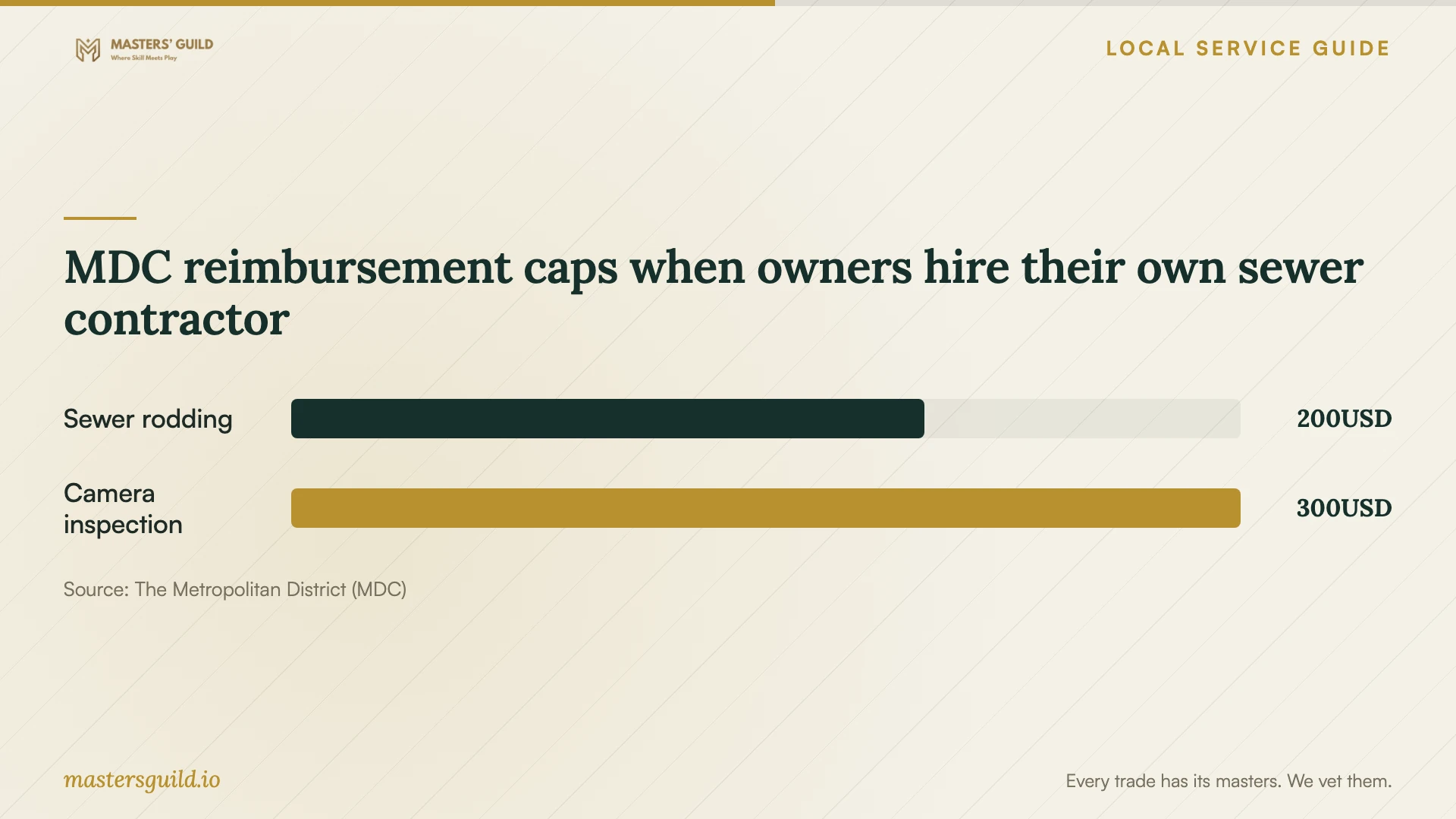
If you choose your own contractor during a sewer-service disruption, MDC lists reimbursement caps of $200 for rodding and $300 for a camera inspection. The contractor must contact Utility Services to arrange a Rodding Permit and an MDC inspector to witness the work. Arrange that coordination before the visit rather than relying on an invoice afterward. [1]
Rain-related basement flooding has a separate assessment route
MDC offers a free assessment through Utility Services at 860-278-7850, extension 3123, for potential Backwater Valve Program participation. Its team surveys basement drain piping to determine qualification. The program addresses foundation drains and roof leaders connected to sanitary sewers, and qualifying properties may receive work at no cost under program guidelines. Ask for this assessment before approving a valve or sump-pump proposal for recurring wet-weather flooding. [2]
Choose the next step for your plumbing problem
| Situation | Next step | Before approving work |
|---|---|---|
| Leaking fixture or interior pipe repair | Ask for a contractor whose license covers the interior work. | Identify the repair limits, access work and restoration. |
| Disrupted sewer house connection | Ask MDC about its arranged rodding and camera inspection service. | If hiring privately, coordinate the permit and witnessed work for reimbursement. |
| Proposed sewer connection renewal | Request MDC review of the proposal and property eligibility. | Confirm full-length renewal, program participation and your payment obligations. |
| Basement flooding during wet weather | Request MDC’s free Backwater Valve Program assessment. | Have MDC assess qualification before committing to a drainage modification. |
Your hiring checklist
- Photograph the problem and record affected fixtures, timing and any connection with rainfall.
- Ask for the responsible contractor’s license number and confirm that its scope matches the proposed work.
- Request proof of insurance and identify any subcontractors.
- Agree on the diagnostic charge and an authorization limit for additional work.
- Ask MDC about program eligibility and coordination before arranging private sewer work.
- Put access, restoration, disposal and approval responsibilities in the quote.
- Keep reports, written change approvals, invoices and warranty terms.
Frequently Asked Questions
Does MDC maintain my sewer house connection?
MDC states that owners must maintain the entire connection. Its inspection and rodding assistance does not transfer responsibility to MDC. Ask for the condition report and any recommended maintenance plan after the inspection. [1]
Will MDC fund a repair to one damaged sewer section?
Its Sewer House Connection Program excludes point repairs. Renewal funding applies to the full length of the connection, subject to eligibility, proposal review and the other program requirements. [1]
Does wet-weather basement flooding qualify for free work?
Qualification requires an MDC assessment. The utility surveys basement piping and reviews the sewer serving the drainage area. It says qualifying properties may receive work at no cost under program guidelines; an assessment does not promise approval. [2]
Can a limited sewer contractor handle interior plumbing too?
Check the exact license held. Connecticut limits a P-7 contractor’s scope to water, sewer and storm piping from utility responsibility to immediately inside the structure. Ask who will take responsibility for interior work beyond that scope. [3]
Sources and scope
This guide combines the sources below with practical planning guidance. Figures apply to the stated geography and period; request a written quote for your property.