
Local service guide
Kitchen Remodeling in Hartford, CT: Hiring Guide
For Kitchen Remodeling in Hartford, choose your scope before requesting bids, check the contracting business against Connecticut's home-improvement registration requirements, and agree on permit responsibility before demolition. Connecticut requires registration for businesses contracting with consumers for residential improvements, with exceptions including work covered by a trade license. Give bidders the same cabinet, appliance and layout specifications so you can compare their proposals. [1] [2]
Define the kitchen you want bidders to price
Write a scope that separates the work you need from optional upgrades. Decide whether you want to retain cabinet boxes, replace cabinets within the existing footprint, or rearrange the room. Mark the sink, range and refrigerator positions on a sketch. Ask each bidder to identify the work needed for your proposed layout rather than quoting from photographs alone.
List cabinet dimensions, door finish, countertop material, backsplash extent, flooring area and appliance models. Ask who will measure for cabinets and countertops, order materials, receive deliveries and resolve damaged or incorrect items. If you have not selected a product, request a named allowance and an explanation of how the contractor will charge for your eventual selection.
Compare written project quotes rather than relying on an unsupported Hartford price range. Ask bidders to separate installation work, materials, appliances, demolition, disposal and permit-related charges. Request an explanation of exclusions and the procedure for pricing concealed conditions before approving additional work.
Check the contracting business and permit plan
Connecticut's Department of Consumer Protection requires an individual or business contracting with a consumer for residential improvement work to register, subject to the listed exceptions. Work covered by a trade license and subcontracted work fall outside that home-improvement registration category. Ask the lead contractor to explain which business will contract with you and which firms will perform specialized work. [1]
Use DCP's registration page and its Lookup/Verify a License option to check the business you intend to hire. Match its identity to the name and registration number in your contract. Ask for insurance documentation and references for projects with a similar scope, then ask those homeowners how the contractor handled changes and unfinished items. [1] [2]
DCP says many projects require building permits and places ultimate responsibility for obtaining them on the homeowner. You can assign the application work to the contractor in your contract. For this property, confirm the proposed scope with Hartford's municipal permitting staff and verify any required approval before work starts. The supplied state guidance does not establish Hartford's specific application steps, fees or turnaround times. [2]
Resolve demolition questions before scheduling
For a pre-1978 house, Connecticut DEEP describes EPA renovation requirements when contractors disturb more than 6 square feet of interior painted surface per room. These include an EPA RRP-certified firm, certified renovators, lead-safe practices and distribution of the Renovate Right brochure with written receipt confirmation. Ask the bidder to explain how these requirements apply to the painted surfaces in your kitchen. [3]
DEEP identifies flooring, plaster and wallboard among materials that may contain asbestos. Its guidance requires an asbestos consultant's inspection before renovation in residential structures with five or more units. For a kitchen in such a building, raise that inspection requirement with the owner or building manager before setting a demolition date. [3]
Ask who will evaluate suspect materials, who will handle any required abatement, and how the contractor will price that work. DEEP states that asbestos waste cannot go into regular trash and that uncontaminated construction debris must go to a facility permitted to accept it, or be recycled or reused. Include disposal responsibility in your scope rather than leaving it as an informal arrangement. [3]
Put specifications, payments and changes in writing
Connecticut requires a written, signed and dated home-improvement contract. DCP lists the contractor's name, address and registration number, both signatures, cancellation information, start and completion dates, and the full work-and-price agreement among its required contents. Its guidance also calls for written contract changes and a copy for the homeowner. [2]
DCP recommends progress-based payments in three or four parts and says an upfront payment generally should not exceed one-third of the project total. Treat that deposit amount as agency guidance, rather than a stated statutory cap. Ask the contractor to connect each payment to a defined milestone and document any material purchase that requires an advance. [2]
Before signing, resolve cabinet hardware, countertop edges, backsplash termination, appliance installation and cleanup. Agree on how you will approve substitutions. Ask for a schedule showing deliveries, demolition, installation and any required inspections. Plan where you will prepare meals, store food and wash dishes while the contractor works.
Select appliances before final cabinet measurements
Choose appliance models before approving the cabinet order. Give the installer the manufacturer's dimensions and installation instructions, then ask them to confirm door clearance, connections and service access. Include responsibility for delivery, installation and removal of existing appliances in the proposal.
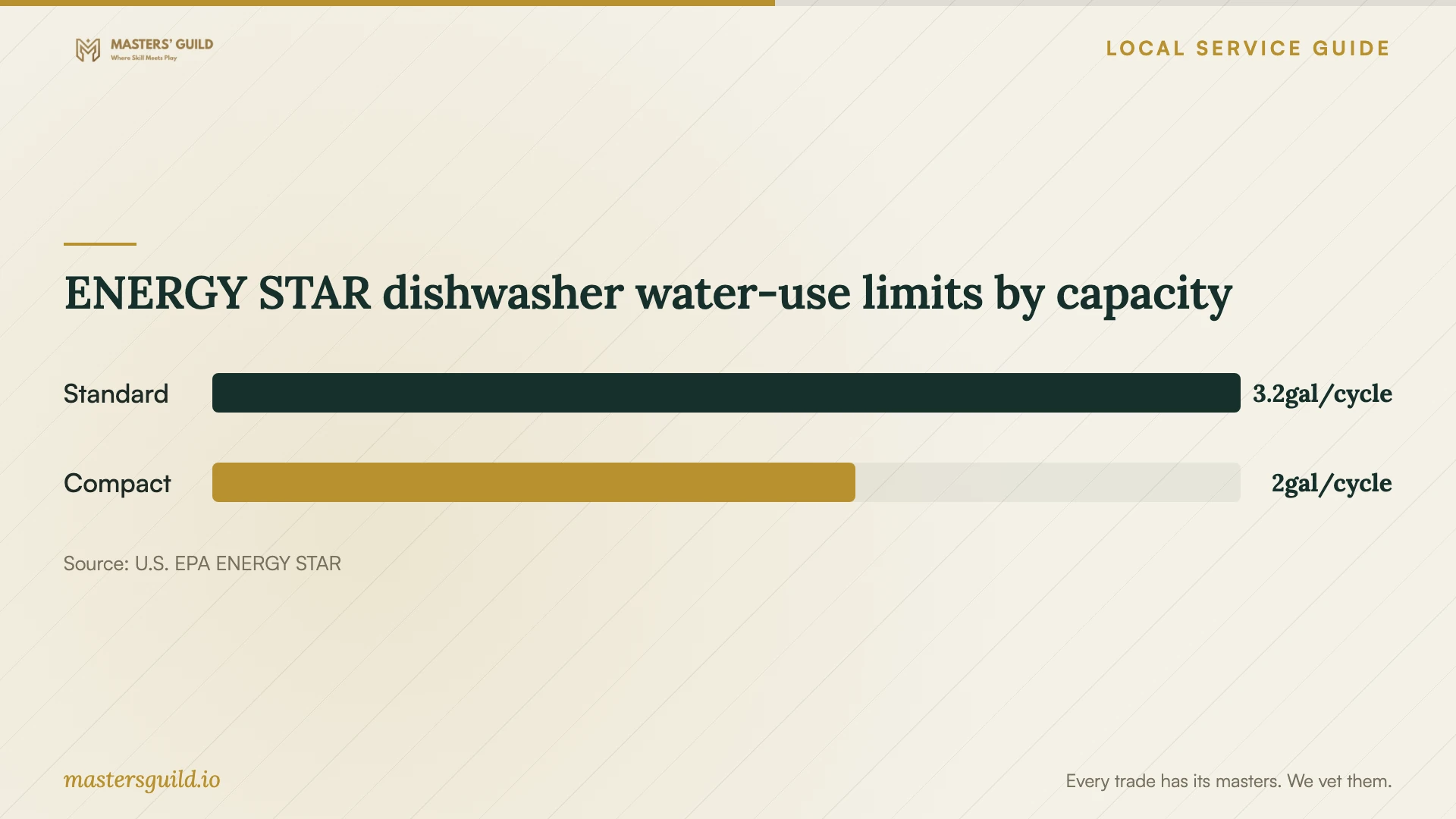
ENERGY STAR's published dishwasher criteria distinguish standard machines, with capacity of at least 8 place settings plus 6 serving pieces, from compact machines below that capacity. The respective maximum water-use criteria are 3.2 and 2.0 gallons per cycle. Use the chart as an efficiency reference while deciding which capacity suits your household; it does not establish a remodel price or your future utility bill. [4]
ENERGY STAR dishwasher water-use limits by capacity
Local details that affect your job
Connecticut contract cancellation rights
For your Hartford residential project, check the cancellation date before signing. DCP says the contract must state your right to cancel before midnight on the third business day after entering the agreement, place the notice near your signature, and include a separate cancellation notice. Saturday counts as a legal business day in Connecticut. Keep your signed copy and review the stated deadline. [2]
Connecticut rules for larger residential buildings
If your kitchen sits in a residential building with five or more units, DEEP says an asbestos consultant must inspect before renovation or demolition starts. Confirm building size with the owner or manager and ask for the inspection arrangement before authorizing tear-out. This statewide requirement applies to qualifying buildings here; the source does not impose that same blanket inspection requirement on smaller residential buildings. [3]
Choose the next step for your project
| Your situation | Next step | Ask before committing |
|---|---|---|
| You want to retain the layout | Request a defined cabinet and finish scope | Which existing components will you keep, and who checks their condition? |
| You want to move fixtures or remove a wall | Have the contractor detail the proposed work and confirm permit requirements with the municipality | Who obtains approvals, and which work does the quote include? |
| Your pre-1978 kitchen has painted surfaces to disturb | Discuss DEEP's lead-safe renovation guidance and whether it applies to the scope | Which firm and renovator credentials will you provide? |
| Your residential building has five or more units | Arrange the asbestos consultant inspection DEEP requires before renovation | Who coordinates the inspection and any resulting work? |
| The proposal leaves products undecided | Request named allowances and a written selection procedure | How will you calculate and approve a price change? |
Your hiring checklist
- Prepare one scope and product list for all bidders.
- Match the contracting business to its registration record and proposed contract.
- Ask who will perform specialized work and request their credentials.
- Confirm permit requirements for your scope with municipal staff before authorizing work.
- Discuss painted surfaces and suspect materials before agreeing to demolition.
- Review allowances, exclusions, payment milestones and the written change procedure.
- Confirm appliance models, delivery responsibilities and cabinet measurements.
- Agree on cleanup, final walkthrough and resolution of unfinished items.
Frequently Asked Questions
Does my remodeler need Connecticut registration?
DCP requires registration for individuals or businesses contracting with consumers for residential improvements, subject to exceptions. Work covered by a trade license falls outside that registration category. Check the business signing your contract and ask it to identify the firms responsible for specialized work. [1]
Who should obtain the permits?
You can require the contractor to obtain needed permits in the contract. DCP says ultimate responsibility rests with the homeowner, so confirm requirements for your scope and verify approval with the municipality before work begins. [2]
How much should I pay upfront?
DCP says an advance payment generally should not exceed one-third of the total and recommends a three- or four-part progress payment schedule. This is agency guidance. Ask for defined milestones, payment receipts and an explanation of any requested material advance. [2]
How should I handle unexpected work after demolition?
Ask the contractor to describe the condition, proposed repair, price and schedule effect before you approve it. Connecticut DCP says contract changes must be in writing and the homeowner should receive a copy. Agree on that process before work starts. [2]
Sources and scope
This guide combines the sources below with practical planning guidance. Figures apply to the stated geography and period; request a written quote for your property.