
Local service guide
Heavy Lifting in Hartford, CT: Hiring and Access
Arrange Heavy Lifting in Hartford by defining the items, the route through your home, and who will provide transportation before you request a written quote. For an in-state household move that includes transport, check the carrier’s Connecticut credentials. Plan legal truck access before confirming the crew’s arrival; Hartford offers parking reservations and requires payment at least three days before the reservation date. [1] [4]
Define the lifting assignment
Write an item list with dimensions, approximate weights if known, and starting and finishing locations. Identify unusually delicate parts, detachable shelves, loose drawers, and anything you want the crew to disassemble. Send photographs of the items and the full carrying route, including stair turns and doorways. Ask the provider to assess the route before accepting the assignment.
For a sofa going upstairs, measure the narrowest doorway and stair landing. For an appliance, state whether someone will disconnect it before the crew arrives. Ask who supplies lifting equipment, floor protection, straps, and furniture blankets. Keep disconnection, installation, disposal, and transportation as explicit questions so neither side assumes the lifting price includes them.
Check credentials for the transport portion
Connecticut’s Department of Consumer Protection says in-state movers must hold a Household Goods Carrier Certificate or Motor Contract Carrier permit from CTDOT, with a corresponding registration number. CTDOT publishes a searchable 2026 household-goods certificate roster. Match the business name and certificate details when choosing a carrier for a move within the state. [3] [4]
The supplied state guidance addresses movers transporting household goods. It does not establish a licensing rule for a crew hired only to reposition furniture inside your home. For that assignment, ask for proof of applicable insurance, the crew’s plan for your particular item, and written damage terms. If you supply a rental truck, identify who loads, who drives, and which provider accepts responsibility for each part. [4]
For a move across Connecticut’s borders, DCP identifies the U.S. Department of Transportation as the regulator. Tell prospective providers about the state-line crossing when requesting quotes. DCP also says movers must provide a bill of lading after loading belongings onto the truck; keep your copy with the contract and item inventory. [4]
Compare written scope and damage terms
Request a written quote that names the items, crew size, included time, and both endpoints of the work. Ask how the provider handles extra time, additional stairs, waiting for an elevator, or an item that will not fit. Have the provider explain the minimum charge, travel charges, equipment charges, and cancellation terms before you compare totals.
CTDOT warns that moving estimates can increase based on volume, staffing, time, weight, and equipment, and recommends requesting a binding quote. For a transport job, ask the mover to base that quote on the disclosed inventory and access conditions. Ask which changes would require a revised agreement. [3]
CTDOT says contracts usually cover damage by weight at 60 cents per pound. Its example gives a possible maximum recovery of $120 for a damaged 200-pound hutch worth $1,000. Ask about additional insurance and make sure any purchased coverage appears on the contract before signing. For lifting-only work, ask the provider to explain its own damage coverage rather than assuming those carrier terms apply. [3]
Prepare the carrying route and arrival plan
Clear the agreed route before arrival and choose a final position for each item. Arrange building access with your landlord or property manager, including elevator booking and any insurance paperwork they request. Keep children and pets away from the carrying route. Ask the crew to review tight turns before anyone starts lifting.
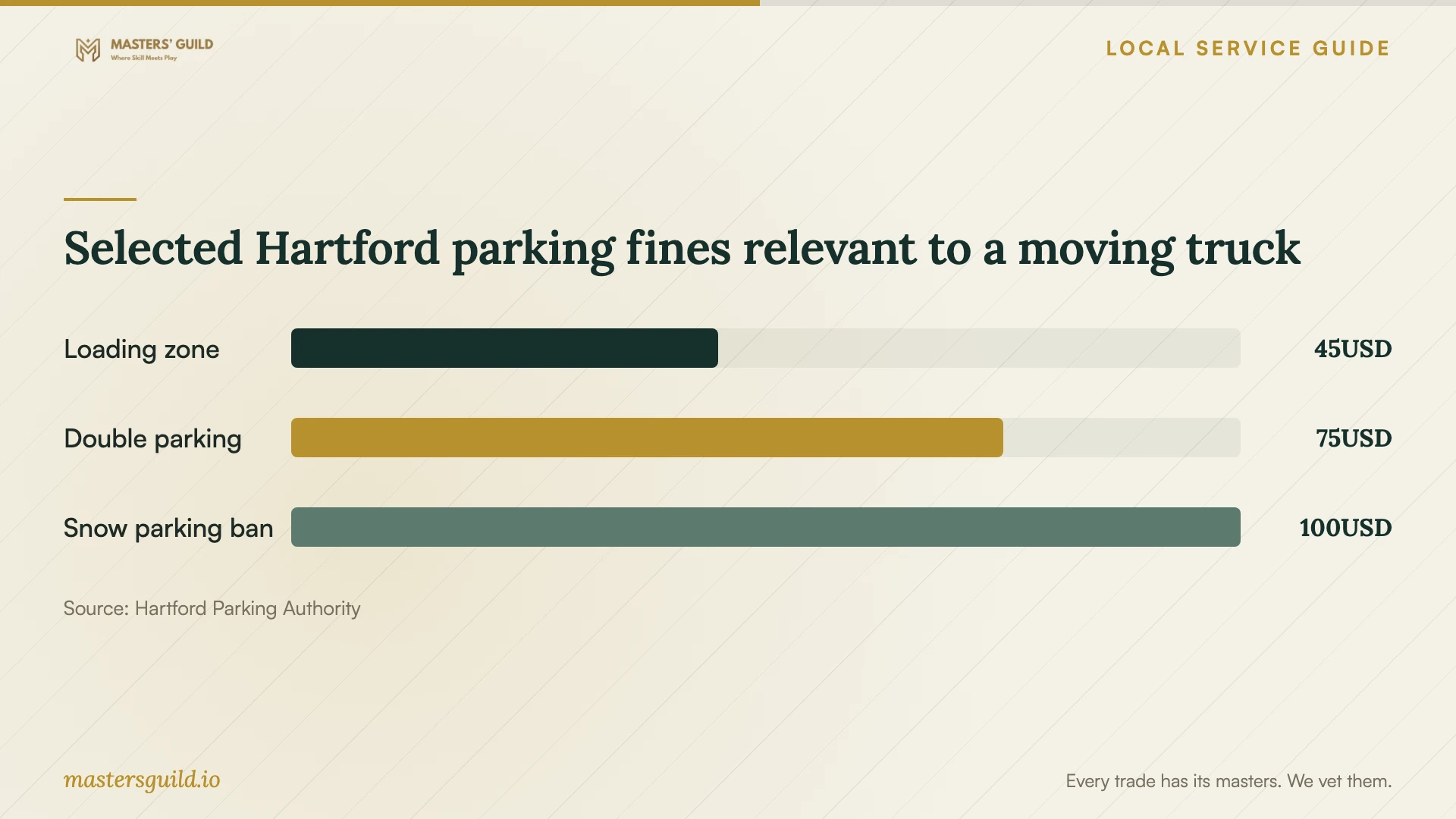
Agree on a fallback if the crew cannot use the intended entrance or parking location. Send the provider a photograph of the curb and signs, then confirm the actual unloading point. Hartford prohibits merchandise loading in no-standing areas and restricts loading-zone use by vehicle type and time. Do not treat the closest open curb as an approved unloading location. [2]
Selected Hartford parking fines relevant to a moving truck
Local details that affect your job
Reserve moving-truck space through Hartford Parking Authority
Submit HPA’s parking reservation request with the street address, requested date, and number of spaces; the form also accepts a location image. HPA generally considers requests first come, first served, subject to approval, and may revise or cancel a reservation. Pay at least three days before the reservation date. Ask for the charge before finalizing your access budget because HPA prices reservations by location, duration, and spaces requested. [1]
Check loading-zone eligibility before scheduling a long unload
Hartford’s loading-zone rule requires a commercial or combination vehicle and limits active loading or unloading to 30 minutes. Its no-standing rule does not allow merchandise loading. If your planned unload needs longer, ask HPA about a suitable reservation instead of assuming a loading zone will cover the appointment. [2]
Keep documentation and a snow-ban fallback
HPA requires documentation to verify active delivery, unloading, or service for box trucks parked on city streets. Ask the mover what documentation it will carry. A parking reservation remains subject to city parking rules, including snow bans, so agree on an alternative arrival or parking plan if a ban affects your appointment. [1] [2]
Match the arrangement to the job
| Your assignment | What to arrange | What to confirm |
|---|---|---|
| Move furniture within the home | A crew that accepts the specific items and route | Equipment, protection, disassembly, and damage terms |
| Load your rental truck | A written loading-only scope | Who drives and who accepts responsibility for loading |
| Transport household goods within Connecticut | A mover with the required CTDOT carrier credentials | Credential details, binding quote, and bill of lading |
| Unload from a Hartford street | An approved reservation or another legal unloading location | Loading-zone vehicle requirements and the 30-minute limit |
Your hiring checklist
- Send item dimensions, photographs, and weights where known.
- Photograph doorways, stair turns, elevator access, and the curb.
- Name who supplies the truck, equipment, protection, and disassembly.
- Ask for applicable insurance documents and written damage terms.
- Get a written price and the conditions for additional charges.
- Confirm building access and the legal unloading location.
- Record existing item damage and clear the carrying route.
Frequently Asked Questions
How much should I budget for the lifting crew?
Request a quote for your inventory and access route. The supplied official sources do not publish Hartford lifting-labor rates. Ask providers to itemize minimum time, travel, equipment, stairs, and waiting charges so you can compare the same assignment.
Does a parking reservation override a snow ban?
No. HPA states that reserved parking remains subject to city parking regulations, including snow bans. Agree on a fallback with the crew before the appointment. [1]
How do I check a Connecticut household-goods mover?
Consult CTDOT’s 2026 certificate roster, which supports searches by town, business name, and certificate number. CTDOT says the list is current as of publication and gives 860-594-2865 for further questions. [3]
Does a mover’s damage coverage pay replacement value?
Do not assume it does. CTDOT says most contracts cover damage by weight and describes a usual rate of 60 cents per pound. Read your contract, ask about additional insurance, and confirm purchased coverage appears before signing. [3]
Sources and scope
This guide combines the sources below with practical planning guidance. Figures apply to the stated geography and period; request a written quote for your property.