
Local service guide
Bricklaying and Masonry in Hartford, CT
For Bricklaying and Masonry in Hartford, choose a contractor after agreeing on the repair boundaries, materials, access, and weather protection. Verify Connecticut home-improvement registration for the business signing your residential agreement, allowing for the state's listed exemptions. For historic brickwork, have the mason explain how they will identify compatible replacement mortar before you approve repointing. [1] [2]
Define the repair before collecting final quotes
Photograph the whole structure and take close views of damaged joints or bricks. Describe water entry you have observed, previous repairs you know about, and when you first noticed the problem. Give each bidder the same information and arrange a site assessment before accepting a final repair scope.
Have the contractor distinguish repointing, brick replacement, rebuilding, and investigation in the proposal. For new steps or walls, include dimensions and the proposed base and support. Keep people away from leaning masonry or loose material overhead while you arrange an assessment of its stability.
Verify the business responsible for your agreement
Connecticut's Department of Consumer Protection requires individuals or businesses contracting with consumers for residential home-improvement work to register, subject to exemptions. The department includes permanent residential changes within home improvement. Its exclusions include subcontracted work, work covered by a trade license, commercial property work, and contracts below $200. [1]
Use the department's license lookup option with the name of the individual or business on your proposal. Resolve any difference between that name and the business providing registration information. If the contractor claims an exemption, have it identify the applicable category. Obtain insurance documentation and references for work comparable to your project as separate hiring checks. [1]
Set material requirements for historic masonry
For historic brickwork, require an explanation of the existing mortar and the replacement mix. NPS explains that historic mortar joints divert moisture through masonry. Its preservation researchers warn that harder, less permeable modern replacements can cause historic masonry units to absorb moisture and fail. [2]
Discuss whether mortar analysis would help establish a compatible recipe. NPS researchers select sampling locations with care because sampling removes original material. Their analysis examines the binder and aggregate; the aggregate contributes to texture and color, while the binder affects hardness and breathability. [2]
Agree on a small sample area before approving the full visible repair. Review color, texture, joint finish, and replacement-brick appearance. Have the mason describe the removal method and how they will protect surrounding units. Record your approval so both parties have the same reference for the finished work.
Plan protection around the actual work dates
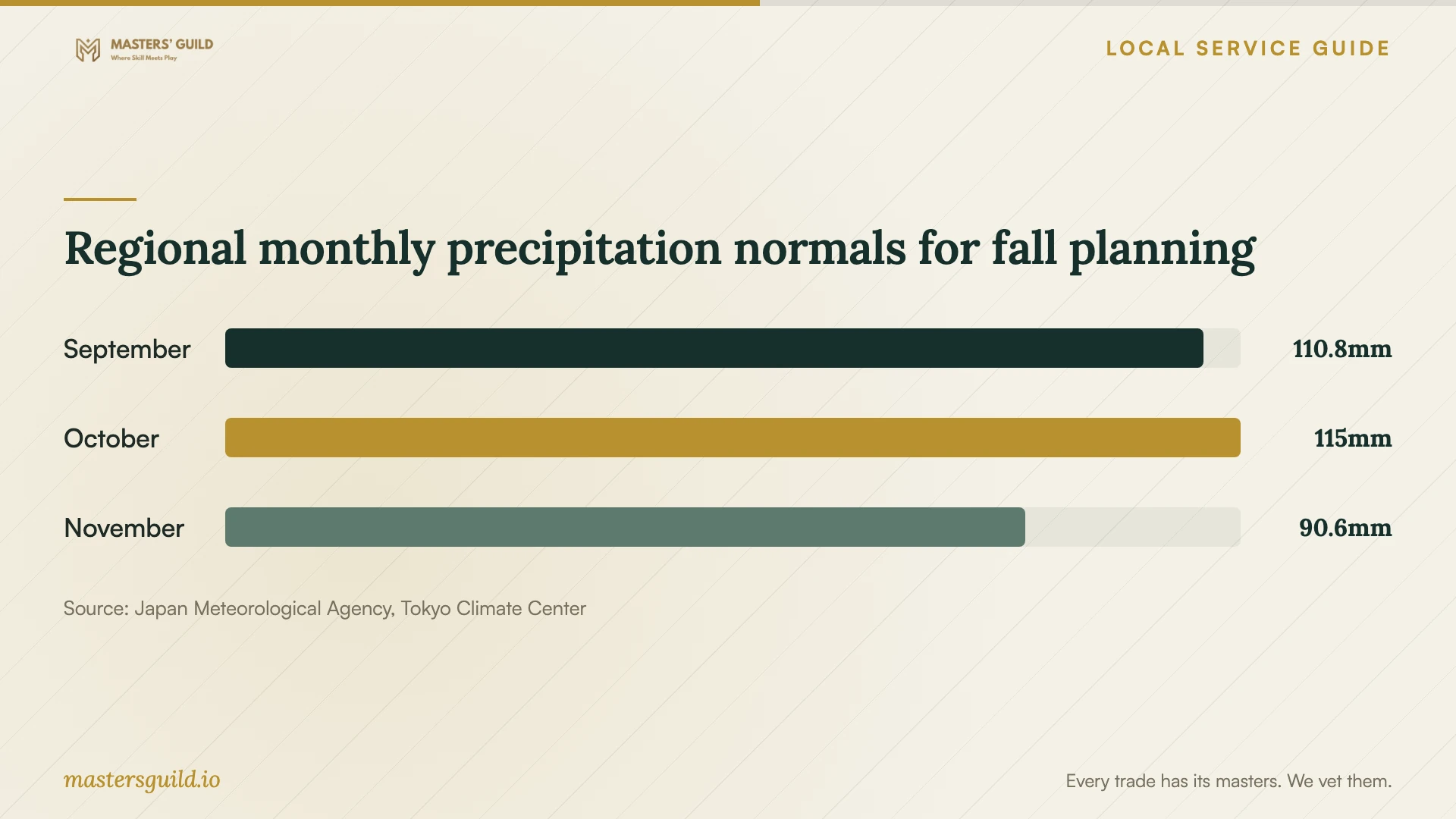
The Japan Meteorological Agency publishes monthly normals for Hartford/Bradley International airport, a regional station rather than your property. Its table reports October mean temperature of 11.6 degrees Celsius and November mean temperature of 5.7 degrees Celsius, with precipitation of 115.0 and 90.6 millimeters respectively. Use this seasonal context to discuss the contractor's plan for a job that extends into November. [3]
Put responsibility for coverings, forecast checks, postponements, and any protection charges in the agreement. Have the mason specify the selected materials' temperature and curing requirements. Set space for equipment and material storage, identify an entrance you can keep usable, and assign responsibility for checking permit requirements before work begins.
Compare complete scopes and agree on completion
Read each total alongside its repair boundaries and exclusions. Separate preparation, joint work, replacement units, access equipment, protection, and debris removal. If bidders propose different methods, have them explain the condition they intend to address and what investigation they need before committing.
Record payment stages and a written process for approving additional work. Set completion terms that cover the approved appearance, finished repair areas, cleanup, and any photographs of concealed work you want. Include warranty terms and exclusions, plus the person responsible for resolving unfinished items.
Regional monthly precipitation normals for fall planning
Local details that affect your job
Check your direct contractor under Connecticut rules
DCP excludes subcontracted work from home improvement on its registration page. For your residential masonry agreement, identify the individual or business contracting with you before checking registration. If that business hires other workers, keep its responsibility for your agreement clear; do not substitute a worker's credentials for checking the contracting party. [1]
Resolve protection costs before a fall job extends
At Hartford/Bradley International, JMA lists normal mean temperatures of 11.6 degrees Celsius in October and 5.7 degrees Celsius in November. These regional monthly averages cannot establish suitable conditions at your house on a workday. Before accepting a fall start date, settle who decides on postponement and whether a delay or added protection changes your price. [3]
Choose the next step for your project
| Situation | Next step | Resolve before approval |
|---|---|---|
| Historic brickwork with deteriorated joints | Arrange a mortar-compatibility assessment | Whether analysis is needed and how the mason will select replacement materials |
| A business will sign your residential improvement agreement | Check Connecticut registration requirements and exemptions | The identity of your direct contracting party |
| Exterior work may extend from October into November | Review the weather-protection and postponement plan | Who decides on delays and who pays for added protection |
| Bids cover different areas or methods | Give bidders a common marked scope | Repair boundaries, exclusions, and additional-work approval |
Your hiring checklist
- Prepare photographs and notes on damage, water entry, and previous repairs.
- Confirm the contracting party's name and registration or applicable exemption.
- Obtain insurance documentation and comparable-work references.
- Approve repair boundaries, material specifications, and a visible sample area.
- Set equipment access, storage, entrance protection, and cleanup responsibilities.
- Assign permit checks and decisions about weather postponements.
- Record payment stages, additional-work approval, and completion terms.
Frequently Asked Questions
Does registration cover every masonry contracting arrangement?
Connecticut DCP lists exemptions from home improvement, including subcontracted work, work covered by a trade license, commercial property work, and contracts below $200. Determine which category applies to the individual or business signing your residential agreement rather than assuming the same requirement applies to everyone on site. [1]
Should I specify lime mortar for old brick?
Have the contractor identify a compatible replacement from the existing materials. NPS explains that mortar composition has changed over time and that incompatible replacements can damage historic masonry. Discuss analysis before prescribing a recipe based on age or appearance alone. [2]
Can a climate chart tell me whether an October job can proceed?
Use monthly normals as background for the scheduling discussion. JMA's Bradley airport table describes regional monthly mean temperature and precipitation, not conditions at your house on a particular day. Have the contractor assess the forecast, selected materials, and protection arrangements before confirming work dates. [3]
What should I do if a contractor finds more damage?
Require photographs or an explanation of the newly exposed condition, a proposed repair, and its price and schedule effect. Authorize the change in writing before the contractor proceeds. Establish that process in the original agreement.
Sources and scope
This guide combines the sources below with practical planning guidance. Figures apply to the stated geography and period; request a written quote for your property.