
Local service guide
Home office setup in Halifax: planning and hiring
For home office setup in Halifax, hire for an itemized scope covering furniture assembly, mounting and equipment adjustment. Arrange a qualified construction electrician for electrical installation, as Nova Scotia Power requires. Measure the layout before booking, and have providers distinguish connecting existing devices from installing permanent wiring. [1]
Define the work before comparing quotes
List the tasks you want completed: assemble furniture, attach monitor arms, connect existing equipment, arrange cables and remove packaging. Have each provider identify which tasks they accept and which require another worker. Specify whether you want help with displays, a docking station, network connectivity or software.
For a wall-mounted monitor, send the screen and mount models, intended position and wall photos. Have the installer assess the wall construction and proposed fixings before drilling. For a desk-mounted arm, request a check of the desktop and manufacturer's mounting instructions.
Request written quotes for your equipment and scope. Have providers separate labour, hardware, cable accessories, delivery or access charges, packaging removal and applicable tax. Agree on how you will approve extra work, including a return visit for missing parts.
Test the layout before ordering furniture
Mark the desk position on the floor and try your chair there. Check drawer clearance, equipment access and your route through the room. CCOHS advises considering movement, storage, privacy, maintenance access and work tasks when allocating office space. [4]
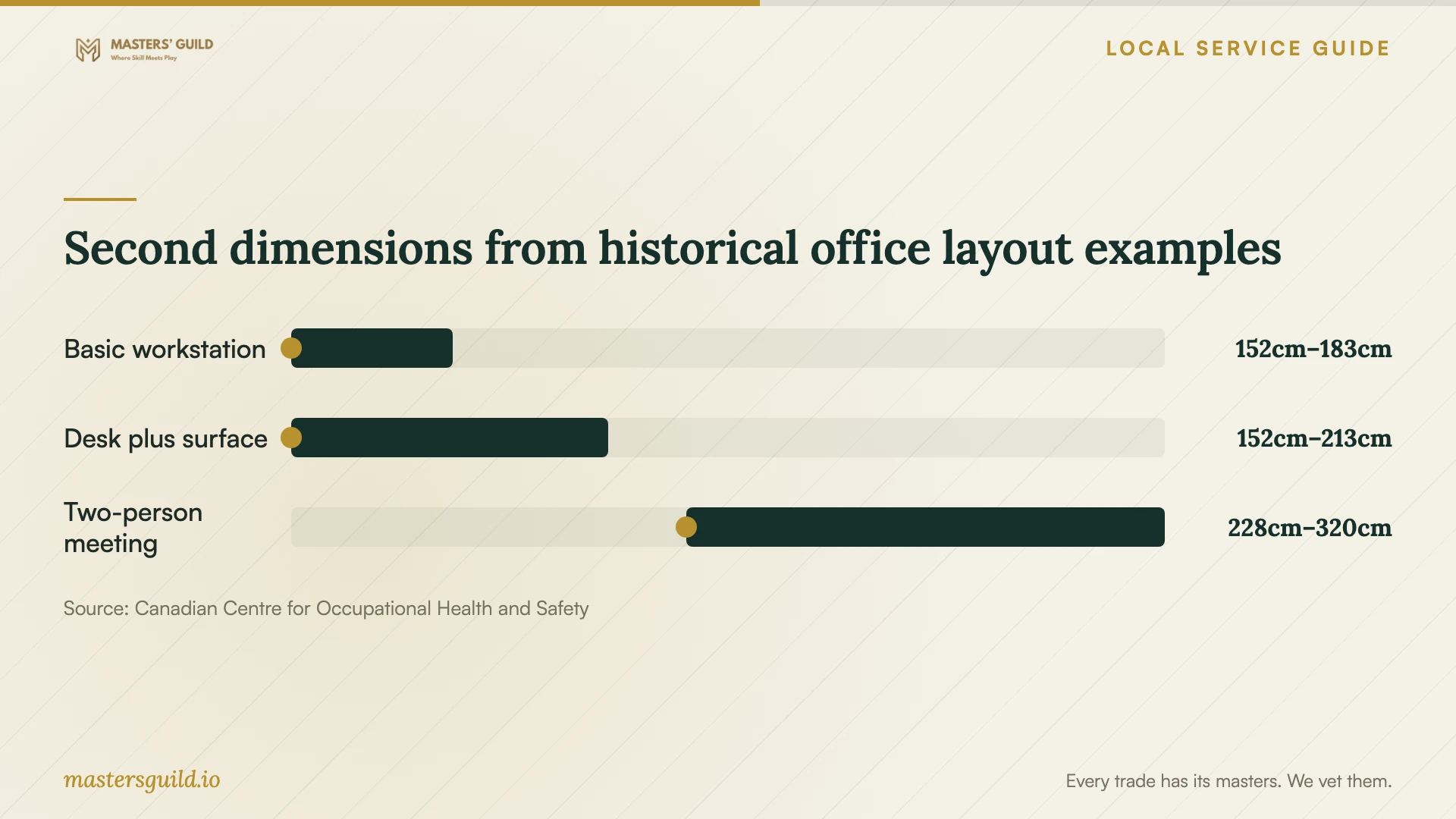
Use the chart as a reference for comparing arrangements. CCOHS reproduces historical paired dimensions and explains that no single space allowance fits all office work. The chart selects the second dimension from each pair without assigning a width or depth orientation. Check both dimensions in the accompanying explanation before applying an example to your room. [4]
Tell the provider about stairs, narrow doorways and building access arrangements. Clear an assembly area and keep instructions and hardware packs together. If you rent or live in a condominium, check the applicable permissions before authorizing wall attachments or alterations.
Include adjustment and testing in the appointment
Have the installer adjust the workstation with you present. CCOHS recommends relaxed shoulders, straight wrists and forearms, elbows close to the body at about 90 degrees, and a monitor at eye level or slightly below. For standing work, it recommends a platform near standing elbow height. [3]
Try a sit/stand desk in both positions with your equipment connected. CCOHS advises keeping cables, electrical access, storage and the surrounding layout from obstructing adjustment. Have the installer allow cable slack through the desk's movement and check for snags. [3]
Before handover, try the controls, inspect the mounting attachments and test the agreed devices. Run through a normal work task, such as joining a call with the camera, microphone and displays connected. Request a demonstration of how to adjust the equipment after the appointment.
Arrange wiring and renovation work before finishing
Have a qualified construction electrician assess new outlets, fixed lighting or circuit work. Nova Scotia Power states that electrical installations require a certificate of qualification in the Electrical Construction trade. Ask the electrician to identify any permit exemption and explain its conditions. [1]
Describe network work precisely. Tell the provider whether you want existing devices connected or permanent communications cabling installed. Nova Scotia Power specifies certification requirements for communications wiring and lists permit exemptions, including communications and cable TV installations in a single dwelling. Have the provider confirm how those rules apply to your installation. [1]
Before altering rooms or introducing a different property use, check the approval route with Halifax Planning & Development. The municipality assesses development against property-specific land-use by-laws and distinguishes development approval from permission to begin construction. [2]
Second dimensions from historical office layout examples
Local details that affect your job
Nova Scotia inspection timing affects wall repairs
Nova Scotia Power makes specified electrical permit exemptions conditional on a construction electrician performing the work and keeping a record for inspection. When wiring requires inspection, arrange the rough-in inspection before anyone conceals it with boarding, insulation or other coverings. Coordinate that step before booking wall finishing. For questions, contact the Wiring Permit Contact Centre at 1-800-464-1520. [1]
Halifax routes approvals by property and proposed use
Before a conversion or changed business use, identify your property's zone through Halifax's Interactive Property Information map and discuss the relevant land-use by-law with Planning & Development. A development permit confirms land-use permission but does not authorize construction. Halifax issues development approval as part of a building or occupancy permit in many cases, so confirm the application route before submitting separate applications. [2]
Match the work to the person you hire
| Planned work | Who to consider | Confirm before booking |
|---|---|---|
| Desk and chair assembly | Furniture assembler | Models, missing parts, cleanup and adjustment |
| Monitor arm or wall mount | Installer who accepts the mounting scope | Compatibility, wall or desktop assessment and fixings |
| New outlet or circuit work | Qualified construction electrician | Permit or exemption conditions and inspection sequence |
| Permanent communications wiring | Certified communications cabling specialist | Installation scope and applicable permit exemptions |
| Room alteration or changed property use | Halifax Planning & Development, then relevant contractors | Property zoning and development, building or occupancy application route |
Your hiring checklist
- Measure the room, delivery route and space for chair movement.
- Send furniture, monitor and mount model numbers with photos.
- Separate assembly, mounting, device connections and cleanup in the scope.
- Identify outlet changes and permanent network cabling before requesting quotes.
- Ask the relevant trade to confirm qualifications, permit treatment and inspection timing.
- Agree on hardware costs and approval of extra work.
- Test desk movement, cable clearance and equipment before handover.
Frequently Asked Questions
Does adding an outlet require a wiring permit?
Ask your electrician to assess the proposed work. Nova Scotia Power lists conditional exemptions, including certain branch-circuit installations. Those exemption conditions still require a construction electrician to perform the work and maintain a record. [1]
Can I close the wall after the electrician installs wiring?
For work requiring inspection, Nova Scotia Power requires a rough-in inspection before anyone conceals wiring with boarding, insulation or other coverings. Agree on that sequence with your electrician before scheduling wall finishing. [1]
Do the chart dimensions establish a minimum home-office size?
No. CCOHS reproduces general office examples from a historical reference, not Halifax residential requirements. It explains that space needs vary. Measure for your equipment, movement, storage and access rather than treating an example as a room-size rule. [4]
What should I check before accepting a standing desk setup?
Try sitting and standing with your equipment connected. Check posture and cable clearance through the adjustment range. CCOHS advises setting up the desk to meet your needs in both positions and keeping the layout from obstructing adjustment. [3]
Sources and scope
This guide combines the sources below with practical planning guidance. Figures apply to the stated geography and period; request a written quote for your property.