
Local service guide
Heavy lifting in Halifax: Plan Your Move
Heavy lifting in Halifax starts with choosing the right scope: help moving an item within your home, labour to load your vehicle, or a crew that also supplies transport and disposal. Send item photos, dimensions and access details before accepting a written quote. For curbside removal, check collection eligibility first: Halifax limits bulky items and excludes buildings with more than six units from municipal curbside collection. [2]
Choose labour, transport or specialist handling
Describe the start and finish of the job in plain terms: move a sofa upstairs, unload a rental truck into specified rooms, or take an appliance away. Ask whether the provider supplies a truck and whether the crew will carry the item to its final position. For a move within your home, make clear that you need labour without transport.
Flag pianos, safes, stone furniture and other items that need a handling assessment. Provide the model or manufacturer weight where available, rather than guessing. Ask the provider to confirm experience with that item, the proposed equipment and any access inspection needed before accepting the job.
Separate lifting from appliance disconnection and reconnection. Ask who will prepare the appliance, secure loose parts and check it after placement. If anyone proposes removing a railing, door frame or building component, pause and agree on a separate scope with the property owner or building manager.
Get a quote you can compare
Request a written total or a clear hourly calculation. Ask for the crew size, minimum booking, billing increments, travel charges, equipment charges and applicable taxes. Confirm when paid time starts and ends, how the provider charges for waiting, and who must approve extra work.
Send the same information to each provider: item list, dimensions, known weights, stair photos, tight turns, elevator access and the distance from the proposed truck position to the door. Ask each provider to identify exclusions. Compare the complete scope before comparing totals.
Ask for evidence of insurance and an explanation of damage coverage, exclusions and the claim process. Confirm who is responsible for floors, walls, the item itself and any vehicle you supply. Record existing damage with photos before the crew starts.
Walk the route before moving day
Measure the item and the narrowest parts of its route, including door openings, stair landings and elevator doors. Photograph turns from both directions. Ask the crew to review uncertain clearances before arrival; agree on what happens if the item cannot pass through the planned route.
For a condo or apartment, ask management about elevator reservations, loading access, move hours and required protection. Include those arrangements in the booking. Keep hallways and exits clear, secure pets, and decide where each item should finish before lifting begins.
Arrange a lawful backup truck position if the nearest space is unavailable. Halifax prohibits stopping in a No Stopping zone, even with an occupied vehicle. The municipality permits active loading or unloading in a No Parking zone. Read the signs at the planned location rather than treating these restrictions as interchangeable. [1]
Agree on weather preparation and disposal
Assign responsibility for clearing outdoor steps, treating ice and protecting the indoor route. Ask the provider how rain, snow or unsafe footing will affect the booking and cancellation terms. Use the forecast and conditions at your property when deciding whether to proceed.
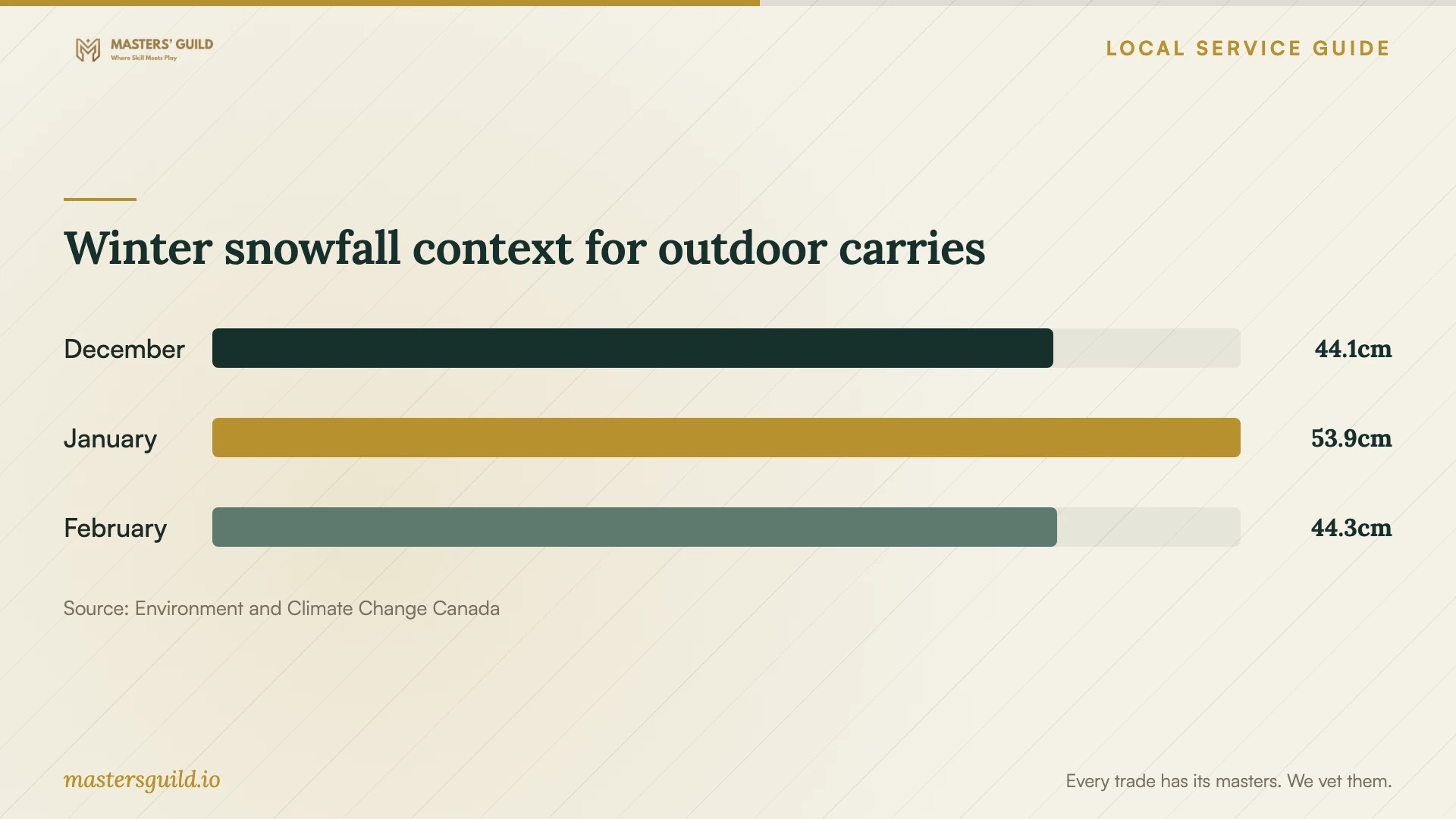
The snowfall chart uses historical observations at Halifax Stanfield Airport. Environment and Climate Change Canada reports average snowfall of 44.1 cm in December, 53.9 cm in January and 44.3 cm in February for the 1991 to 2020 normal period. Use that context to discuss winter access, without treating airport averages as a forecast for your doorstep. [3]
For disposal, name the destination in the quote and ask who pays facility charges. Halifax's garbage collection page displays conflicting Otter Lake fee schedules, so confirm the applicable charge before authorizing a disposal allowance. The municipality requires securely tarped loads for delivery to a waste facility. [2]
Winter snowfall context for outdoor carries
Local details that affect your job
A loading zone may not cover the whole booking
Halifax allows a maximum of 30 minutes in a loading zone while loading or unloading. Loading zones operate from 6 a.m. to 6 p.m., Monday to Friday, unless the sign specifies otherwise; 24-hour zones apply on weekends and holidays too. For a longer move, agree on another lawful parking arrangement. In winter, the municipality can ticket or tow vehicles that interfere with snow clearing regardless of the overnight parking ban's status. [1]
Curbside labour may be enough for eligible furniture
Halifax permits one bulky item per garbage collection for single-unit homes and two per building for dwellings with two to six units. Its residential limits cap those items at 200 kg and eight feet in length. Buildings with more than six units receive no municipal curbside bulky collection; contact management about removal. Check the item and address before booking a crew to carry furniture to the curb. [2]
Schedule fridge preparation before the final carry
Halifax requires a qualified technician to remove refrigerant before collecting a fridge or freezer for recycling. Properties eligible for curbside collection can request free municipal refrigerant removal through 311 or the online request service. Allow up to 10 business days for the technician's visit. After the technician attaches the completion sticker, arrange the carry for the regular garbage collection day. [2]
Choose the scope before requesting quotes
| Your job | Scope to request | Confirm before booking |
|---|---|---|
| Move furniture within your home | Lifting labour and final placement | Route measurements, protection and any disassembly |
| Load or unload your rental vehicle | Labour with agreed loading equipment | Responsibility for load securing and vehicle damage |
| Take eligible furniture to the curb | Carry-only removal | Halifax collection eligibility, item allowance and size limits |
| Remove an item from a building with more than six units | Management-approved hauling | The building's disposal arrangement; municipal curbside collection does not apply |
| Dispose of a fridge or freezer | Refrigerant preparation followed by lifting | Technician completion before municipal recycling collection |
Your hiring checklist
- Photograph the item, stairs, landings, entrances and proposed truck position.
- Provide dimensions and manufacturer weight information where available.
- Confirm labour, truck, equipment, disassembly and final placement in writing.
- Reserve building access and agree on a lawful parking plan.
- Review insurance, damage reporting, waiting charges and cancellation terms.
- Assign route clearing and floor protection before arrival.
- For removal, confirm collection eligibility or the disposal destination before booking.
Frequently Asked Questions
How much should I budget for lifting help?
Get a job-specific written quote. Ask for the crew size, minimum charge, hourly billing rules, travel, equipment, taxes and any hauling fees. Supply photos and route measurements so providers can quote the same work. Ask for a revised total before approving additions.
Can the truck stay in a loading zone throughout the move?
Halifax limits loading-zone parking to 30 minutes while loading or unloading. Check the posted hours and arrange another lawful position if the job needs longer. Waiting in the zone after loading stops can result in a ticket. [1]
Can I hire someone to put an old sofa out for collection?
Check eligibility first. Halifax allows one bulky item per collection for single-unit homes and two per building for dwellings with two to six units, within its weight and length limits. For buildings with more than six units, ask management to arrange disposal. [2]
What should I send the crew about a difficult staircase?
Send photos of the full flight, landings, handrails and turns, plus measurements of the narrowest openings. Include item dimensions and known weight. Ask the provider to confirm the route, equipment and crew after reviewing those details.
Sources and scope
This guide combines the sources below with practical planning guidance. Figures apply to the stated geography and period; request a written quote for your property.