
Local service guide
Concrete work in Halifax: Plan and Compare Quotes
For concrete work in Halifax, choose a contractor who explains the proposed repair or replacement, drainage outlet, site access and permit responsibilities in writing. Before booking a driveway pour, check whether the work affects the municipal right-of-way and arrange Halifax Water’s service-box inspection. The utility asks customers to contact it 2–3 weeks before driveway paving. [1] [3]
Define the concrete job before requesting quotes
Tell each contractor whether you need a driveway, patio, steps, slab repair or retaining wall. Send photographs and approximate dimensions, then request a site visit before accepting the final scope. Point out puddles, uneven edges, cracks and the route workers would use to bring equipment onto the property.
For existing concrete, ask the contractor to explain the cause of the visible problem and compare a repair proposal with replacement. Request a description of what each option would address and what would remain. For steps or concrete attached to a building, ask whether the proposed work needs a structural assessment or permit review.
Check the driveway boundary and permit route
HRM distinguishes driveway work associated with an open building permit from changes without one. Its driveway-access guidance directs owners with an open building permit to a Development-Right-of-Way permit. Without an open building permit, it directs owners modifying an existing driveway to a TPW-Right-of-Way permit, including changes to a curb or culvert and moving or widening the driveway. [3]
These permits apply to municipally owned roads. HRM requires an approved right-of-way contractor on the application and requires that contractor’s insurance to name the municipality as an additional insured, with at least $2 million in general commercial liability coverage. Ask who will submit the application and arrange inspections before agreeing to a start date. [3]
Ask HRM to confirm the requirements for your address and drawing rather than assuming every private slab needs the same approval. The municipality notes that some land-use bylaws limit the percentage of a lot covered by hard surfaces. Include the proposed driveway dimensions when checking whether you can widen it. [3]
Agree on drainage before the pour
Ask the contractor to show the finished elevations and runoff destination on a sketch. Halifax Water advises owners to direct stormwater away from foundations, avoid flooding neighbouring properties and avoid creating icing on roads or sidewalks. Walk through the proposed drainage route together, including any downspouts beside the new concrete. [2]
Halifax Water says driveway drains must not connect to the wastewater system. It recommends allowing stormwater to soak into the property where practical, with a dedicated stormwater sewer or ditch as possible alternatives where available. If the proposal includes a new drain connection, confirm the outlet with the utility before accepting that part of the quote. [2]
HRM requires a Water Permit when installing, altering or relocating water or sewer equipment, including storm or sanitary sewers. Ask the contractor to separate drain installation and connection approvals from the concrete portion of the job so you can see who handles each task. [3]
Compare the full scope and upfront costs
Request separate descriptions for removal, excavation, base preparation, concrete placement, reinforcement, joints, finish and disposal. Ask contractors to state the proposed slab thickness and concrete specification for your intended use. Include site restoration, protection of nearby property, payment stages and written warranty terms in the comparison.
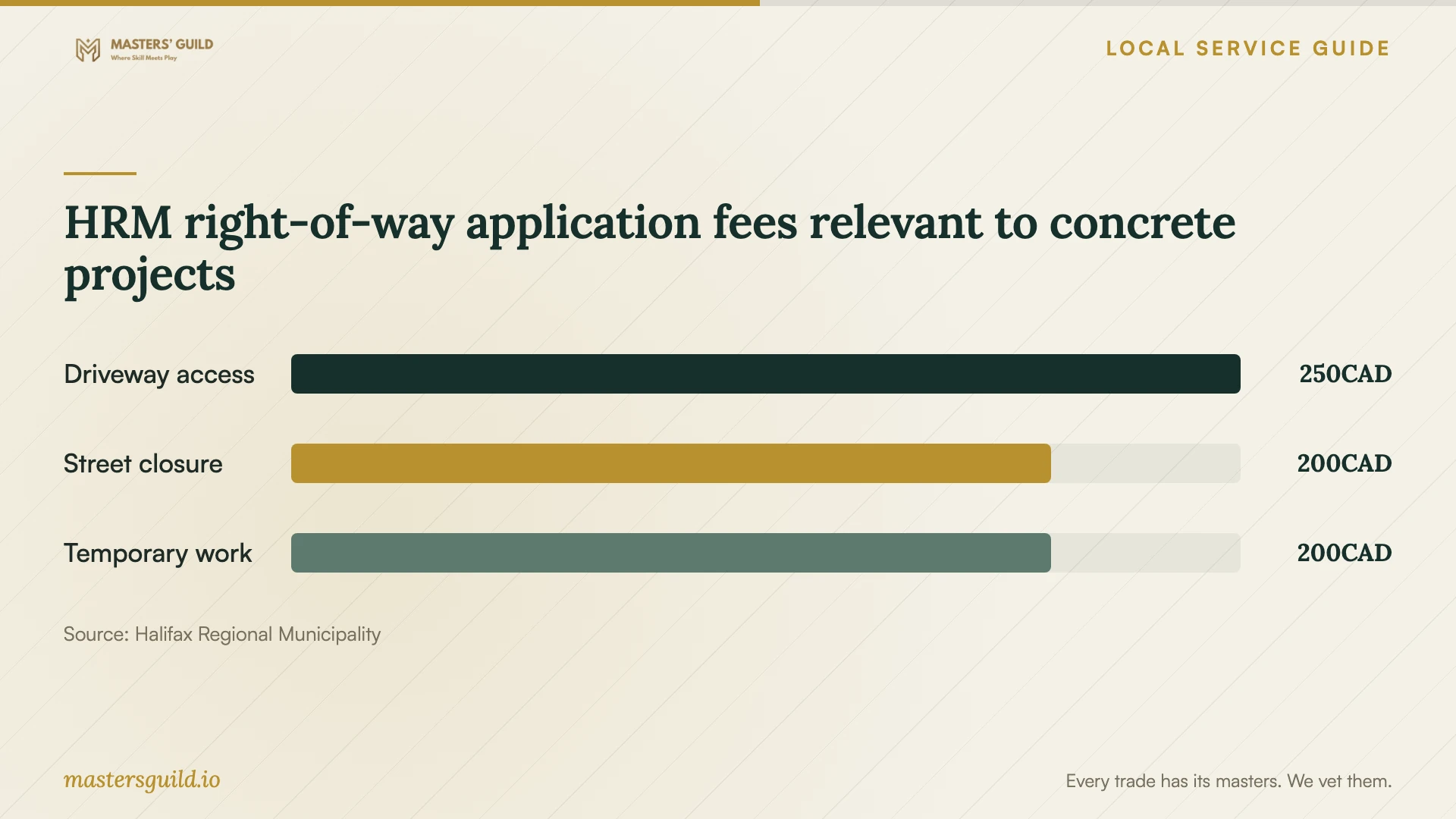
The municipal application fees in the chart cover specific right-of-way work categories, not the contractor’s concrete price. HRM also lists performance security deposits and notes that a $1,000 deposit may apply when the approved contractor lacks a letter of credit or bond on file. Confirm the deposit treatment for your application and record who pays it and receives any refund. [3]
Ask for a written process for unexpected conditions after excavation: who authorizes extra work, how the contractor prices it and whether it changes the schedule. Before signing, request proof of insurance and examples of completed jobs with a similar scope. Arrange alternative parking and access around the work area.
Confirm placement dates and reopening instructions
For work under HRM’s Streets and Services guidance, the municipality allows concrete sidewalk placement from May 1 to October 15 and concrete curb placement from May 1 to October 31, unless the inspector approves another date in advance under the Quality Management Plan. These rules concern sidewalk and curb work; they do not establish a universal deadline for private patios or slabs. [3]
For a project planned on October 12, 2026, confirm any sidewalk or curb placement date with the contractor before booking. Ask for the weather protection plan, postponement terms and written instructions for walking, parking and other loads on the new concrete. Have the contractor distinguish the work-completion date from the date you can resume each use. [3]
HRM right-of-way application fees relevant to concrete projects
Local details that affect your job
Book the water service-box visit before driveway work
Call Halifax Water at 902-420-9287 about 2–3 weeks before driveway paving. Its staff can inspect and maintain the water service box at no charge to customers. Arrange this visit before the new surface goes in so utility work does not disturb the finished driveway. [1]
Check retaining-wall grading approval
HRM requires a Lot Grading Permit for a retaining wall over 1 metre high on a residential serviced lot. Its related-permits guidance identifies lot grading plans prepared by a professional engineer or registered surveyor. Before accepting a wall quote, confirm the permit and design requirements for the property and include those responsibilities in the contract. [4]
Plan truck and bin placement with the contractor
HRM lists concrete mixers and disposal bins among equipment that can occupy the public right-of-way and require temporary-work or street-closure coordination. It also requires a Construction Management Plan when construction occurs within 5 metres of the street or creates an obstruction within it. Ask the contractor to identify the proposed equipment locations and confirm the applicable approvals. [3]
Match the project to the next step
| Project situation | Next step | Question before signing |
|---|---|---|
| Cracked patio or uneven slab | Request a site assessment and repair-versus-replacement explanation. | What cause will your proposed work address? |
| Driveway change affecting municipal right-of-way | Confirm the permit route and approved ROW contractor. | Does this project need DEV-ROW or TPW-ROW approval? |
| Driveway paving near a water service box | Contact Halifax Water 2–3 weeks before work. | Can we complete the utility visit before placing concrete? |
| New driveway drain | Confirm a stormwater outlet separate from wastewater. | Where will the drain discharge, and who confirms the connection? |
| Retaining wall over 1 metre on a residential serviced lot | Confirm the Lot Grading Permit and plan requirements. | Does the quote include the required design and approval work? |
Your hiring checklist
- Photograph the existing surface, drainage problems and equipment access route.
- Give each contractor the same proposed dimensions and intended use.
- Ask HRM to confirm approvals for the address, driveway boundary and proposed grading.
- Arrange the Halifax Water service-box visit before driveway paving.
- Review the finished elevations and drainage outlet on a sketch.
- Compare preparation, concrete specifications, finish, disposal and restoration in writing.
- Assign responsibility for applications, deposits, inspections and extra-work authorization.
- Get written weather-delay terms and instructions for reopening the surface.
Frequently Asked Questions
Does replacing a driveway require a permit?
Confirm the scope with HRM. Its driveway-access guidance covers new, widened, modified or relocated driveways that affect the municipal right-of-way. The permit route depends on whether the property has an open building permit. Ask about a replacement within the existing footprint rather than assuming the same requirements apply. [3]
Can any concrete contractor alter the driveway curb?
For municipal right-of-way work, HRM requires an approved ROW contractor on the permit application. It requires insurance naming HRM as an additional insured and at least $2 million in general commercial liability coverage. Confirm the contractor’s approval before hiring for that scope. [3]
Where should a driveway drain connect?
Halifax Water prohibits driveway drains from connecting to wastewater. It recommends infiltration on the property where practical, or a dedicated stormwater sewer or ditch where available. Confirm a suitable outlet for your site before the contractor installs the drain. [2]
How much should I budget for the concrete itself?
Get a site-specific written quote using agreed dimensions and specifications. The fees shown here cover municipal applications, not concrete installation. Ask the contractor to itemize removal, preparation, placement, drainage and restoration, and identify taxes, permits and deposits separately. [3]
Sources and scope
This guide combines the sources below with practical planning guidance. Figures apply to the stated geography and period; request a written quote for your property.