
Local service guide
Branding and Marketing Strategy in Halifax
For Branding and Marketing Strategy in Halifax, hire against a written brief that names your customers, business goal, deliverables and implementation budget. Ask candidates how they will research your audience, develop positioning and turn recommendations into work your team can use. If you plan to change your business name or open a storefront, include provincial name approval and municipal occupancy or signage checks before committing to a launch date. [1] [2]
Choose the work you need before comparing providers
Start with the business problem. If customers struggle to understand your offer, request positioning and messaging work. If you have a clear offer but need a consistent appearance, request identity design with defined applications. If you need to decide where to spend, request a marketing audit and channel plan. Ask candidates to explain any additional work they recommend.
Give each candidate the same background: your offer, intended customers, service area, current materials, budget constraints and who will approve the work. Specify whether you want to reach nearby customers, visitors or buyers outside the region. Request a research plan that tests your assumptions about the audience.
For a visitor-facing business, ask the strategist to distinguish tourism indicators from evidence about your customers. In its 2025 room-night discussion, Tourism Nova Scotia identifies July and August as the highest sales months for traditional and non-traditional accommodation room nights across the province. Use that provincial observation to frame questions about campaign timing, then check your sales and booking history. Accommodation demand does not establish demand for your business. [3]
Specify deliverables you can review and use
Ask for a proposal that describes research activities, decisions and finished files. A positioning engagement could include customer interviews, an audience definition, a positioning statement and message examples. An identity engagement could include logo files, colour and type specifications, usage guidance and agreed applications. Negotiate which deliverables you need before approving the scope.
For a marketing plan, request channel priorities, budget assumptions, responsibilities and a review schedule. Ask the strategist to show how someone on your team would turn a recommendation into a task. For example, a recommendation to improve enquiries should identify the intended customer action, the work required and how you will assess the result.
Put review rounds and approval responsibilities in writing. Ask who conducts interviews, who writes the messaging and who presents recommendations. Agree on access to editable files, account ownership, third-party asset licences and intellectual-property terms before signing. Identify work that requires a separate supplier or contract.
Compare quotes and agree on the total commitment
Obtain written quotes for your scope. Request separate amounts for research, strategy, design, production and implementation. Ask candidates to identify taxes, advertising spend, printing, photography, software subscriptions and other excluded costs. Use the breakdown to decide what to commission now and what to defer.
Ask each provider what they would remove if you reduced the budget and which questions you would leave unanswered. Compare the proposed research and handover as well as the finished artwork. If you need implementation support, specify who will update your website, prepare print files or manage campaigns.
Review a relevant work sample with the person who would lead your project. Ask about the original problem, research choices, client responsibilities and final handover. Request permission to speak with a past client about communication and usability. Agree on milestones, payment timing and a process for approving extra work.
Build approval steps into the launch plan
For naming work, assign responsibility for the provincial application and responses to approval conditions. Nova Scotia requires businesses to use the exact approved name and says applicants cannot use it until approval and registration or incorporation. Authorize final signs, packaging and other name-bearing materials after that checkpoint. [1]
Allow room in the schedule for the Registry’s processing-delay warning. The province states a two-day name-reservation turnaround but warns that processing may take longer. After approval or conditional approval, applicants have 90 days to register or incorporate before the reservation expires. Applicants must meet approval conditions before registration or incorporation. [1]
For new business premises, give the strategist and sign supplier the same opening plan. Halifax requires occupancy approval after specified changes, including a change of operator or use, and says commercial occupancy projects frequently require sign permits for new signs. Confirm the approvals for your premises before fixing an installation date or announcing an opening. [2]
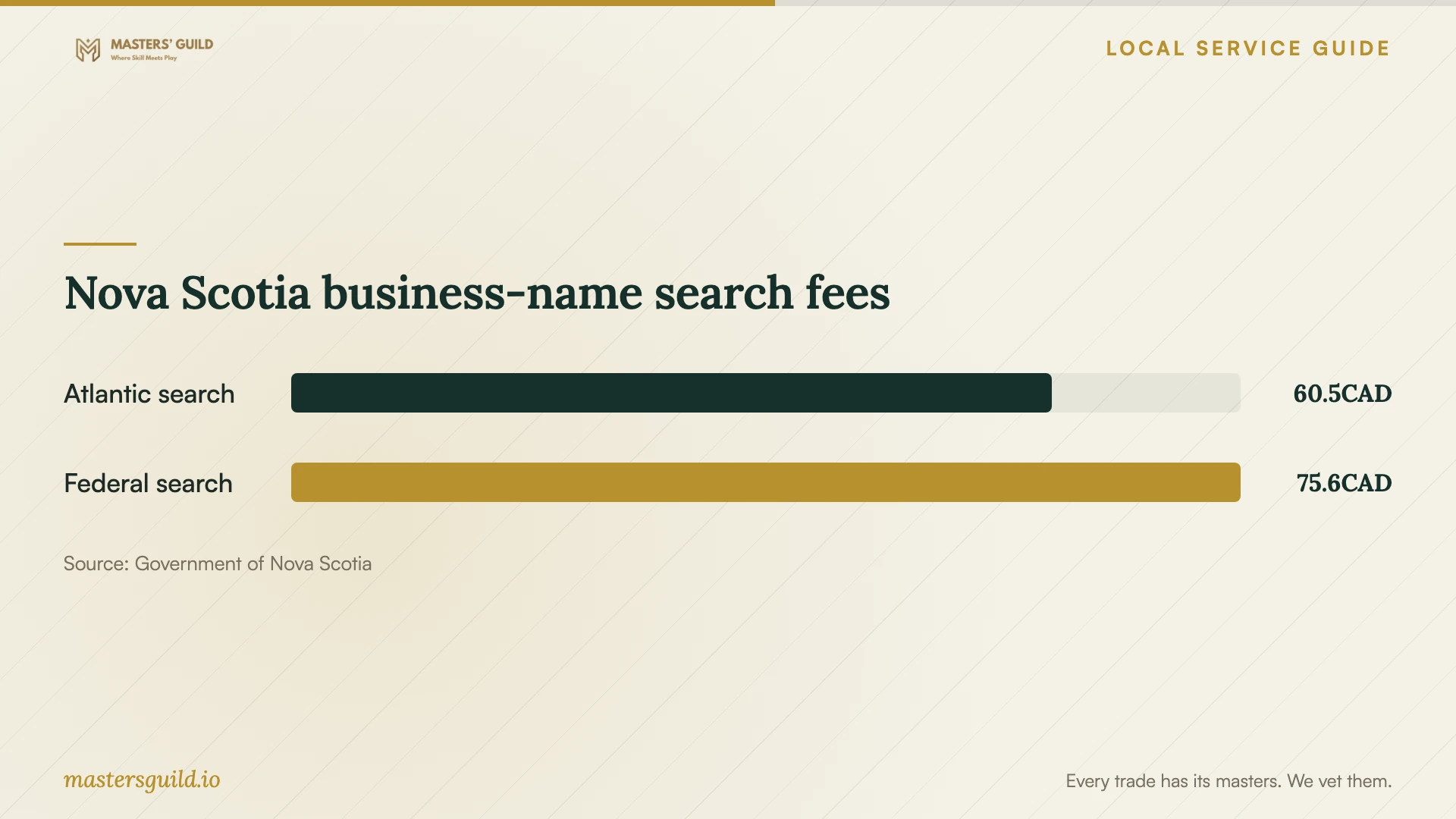
Nova Scotia business-name search fees
Local details that affect your job
Choose the name-search scope before submitting
Nova Scotia directs applicants who plan to operate only in the province to choose the Atlantic region search. It directs applicants planning business beyond Atlantic Canada, or using Canada or Canadian in the name, to choose the federal search. Tell your naming provider about expansion plans before they prepare the application, and include the appropriate search fee in your budget. [1]
Check occupancy when taking over a space
Halifax says you need a stand-alone occupancy permit for a change in operator or ownership, or the activity practised on the premises. If you renovate the new space, its guidance says occupancy permissions form part of the building permit. Clarify which route applies to your opening and assign someone to coordinate it with the branding rollout. [2]
Match your brief to the decision
| Your situation | Scope to request | Question to ask |
|---|---|---|
| Customers struggle to understand your offer | Audience research, positioning and messaging | How will you test whether customers understand the proposed message? |
| You need a consistent visual identity | Identity design and specified applications | Which editable files and usage instructions will I receive? |
| You need to choose marketing channels | Audit, priorities and implementation plan | How will you connect spending decisions to my business goal? |
| You are considering a new business name | Naming work with responsibility for application coordination | Who will manage the name-search and approval steps? |
| You are opening or changing premises | Brand rollout coordinated with premises checks | Who will confirm occupancy and sign-permit requirements? |
Your hiring checklist
- Write the business problem and the customer action you want to improve.
- Gather existing brand files, customer feedback and sales or enquiry records.
- Give candidates the same scope and implementation budget.
- Request named deliverables, review rounds and acceptance criteria.
- Confirm editable files, account access and ownership terms.
- Assign responsibility for name applications and premises approval checks.
- Agree on launch dependencies, payment milestones and extra-work approval.
Frequently Asked Questions
Should I commission a logo before the strategy?
Ask the provider to settle the intended audience, positioning and message before you approve final artwork. If you have those decisions in a usable brief, commission design against it. Request an explanation of proposed strategy work so you can judge whether it answers an unresolved question.
Does a name reservation let me start using the name?
Nova Scotia says you cannot use the name until the Registry approves it and you register or incorporate the business or non-profit. Keep both steps visible in your project schedule before authorizing materials that use the name. [1]
How should I judge a promised marketing result?
Ask the provider to state the starting position, assumptions, measurement method and your implementation responsibilities. Record the deliverables they commit to producing alongside the business outcome you hope to achieve. Put the agreed measures and review dates in the scope.
Can I use provincial tourism data to choose campaign timing?
Use it as context, then compare it with your customer records. In its 2025 room-night discussion, Tourism Nova Scotia identifies July and August as the highest sales months for traditional and non-traditional accommodation room nights province-wide. That observation does not establish demand for your shop, service or offer. [3]
Sources and scope
This guide combines the sources below with practical planning guidance. Figures apply to the stated geography and period; request a written quote for your property.