
Local service guide
Tax preparation and accounting in Greensboro, NC
Tax preparation in Greensboro should start with a written agreement covering the work you need: income-tax returns, bookkeeping cleanup, payroll support and Guilford County business-property reporting. Ask who will handle each task, what it costs and when you must provide records. The North Carolina CPA Board recommends checking credentials and obtaining an engagement letter before work begins; county asset listings and state payroll withholding carry separate requirements. [1] [2] [3]
Choose the work before choosing the accountant
Write a short brief describing your business, ownership, employees and current records. Separate the return you need filed from any cleanup or ongoing support you want. Ask candidates to explain their experience with businesses like yours and identify who will prepare and review your work.
The North Carolina CPA Board advises consumers to compare a CPA’s experience with their needs and ask whether the office operates year-round. If you want help after filing, ask who will answer questions about notices, payroll changes or asset purchases and how the firm charges for that time. [2]
For a Greensboro business with equipment or employees, discuss county property reporting and state withholding during the interview. Guilford County requires annual business personal-property listings from owners of covered property, while NCDOR administers separate withholding registration and filing requirements. Ask the accountant to name the services included in your engagement. [1] [3]
Verify credentials and agree on the fee
If a candidate uses the CPA title, check the relevant licensing record. The North Carolina CPA Board recommends reviewing current, active license status, firm registration and enforcement records. Qualifying out-of-state CPAs may serve North Carolina clients through practice privileges, so ask which jurisdiction licenses the individual if you cannot find a North Carolina record. [2]
Obtain a written engagement before the firm starts. The Board says the letter should identify the work, the employees performing it and the cost. If the firm outsources work, confirm how it protects your private information. [2]
Request separate prices for return preparation, cleanup and recurring accounting. Ask what triggers an additional charge and whether the firm will obtain your agreement before expanding the scope. Compare quotes using the same records and task list; ask each candidate to explain exclusions rather than relying on a headline fee.
Prepare county asset records alongside your books
Guilford County includes computers, furniture, equipment, supplies and certain vehicles among business personal property. Its reporting instructions call for asset costs and acquisition years, including fully depreciated equipment still on the premises. Bring your asset register, purchase records, disposals and leased-equipment details to the accountant. [1]
Do not omit a computer or desk because you bought it for your home before using it in the business. The county says property used in connection with a business requires reporting regardless of its original purpose. Ask the accountant to reconcile your county listing with your records and flag items that need clarification from the county. [1]
The county describes a regular January 1 through January 31 listing period. Its published 2026 timely-filing deadline was February 2, with approved extension deadlines of April 15 for paper listings and May 15 for qualifying online listings. Those dates have passed as of October 15, 2026. If you missed a listing, discuss the outstanding work now and confirm the next cycle’s dates with the county. [1]
Set payroll responsibilities before the next pay run
A federal employer identification number does not replace a North Carolina withholding identification number. NCDOR directs employers to register through Form NC-BR and charges no fee for the withholding number. Give your accountant your registration confirmation and assigned filing frequency, and ask who will monitor account correspondence. [3]
NCDOR bases withholding filing frequency on the average amount withheld each month and requires withholding taxpayers to file the annual NC-3 reconciliation. Its guidance also requires a zero return when an employer has no employees during a reporting period, subject to the stated seasonal-filer exception. Confirm who submits returns, authorizes payments and retains confirmations. [3]
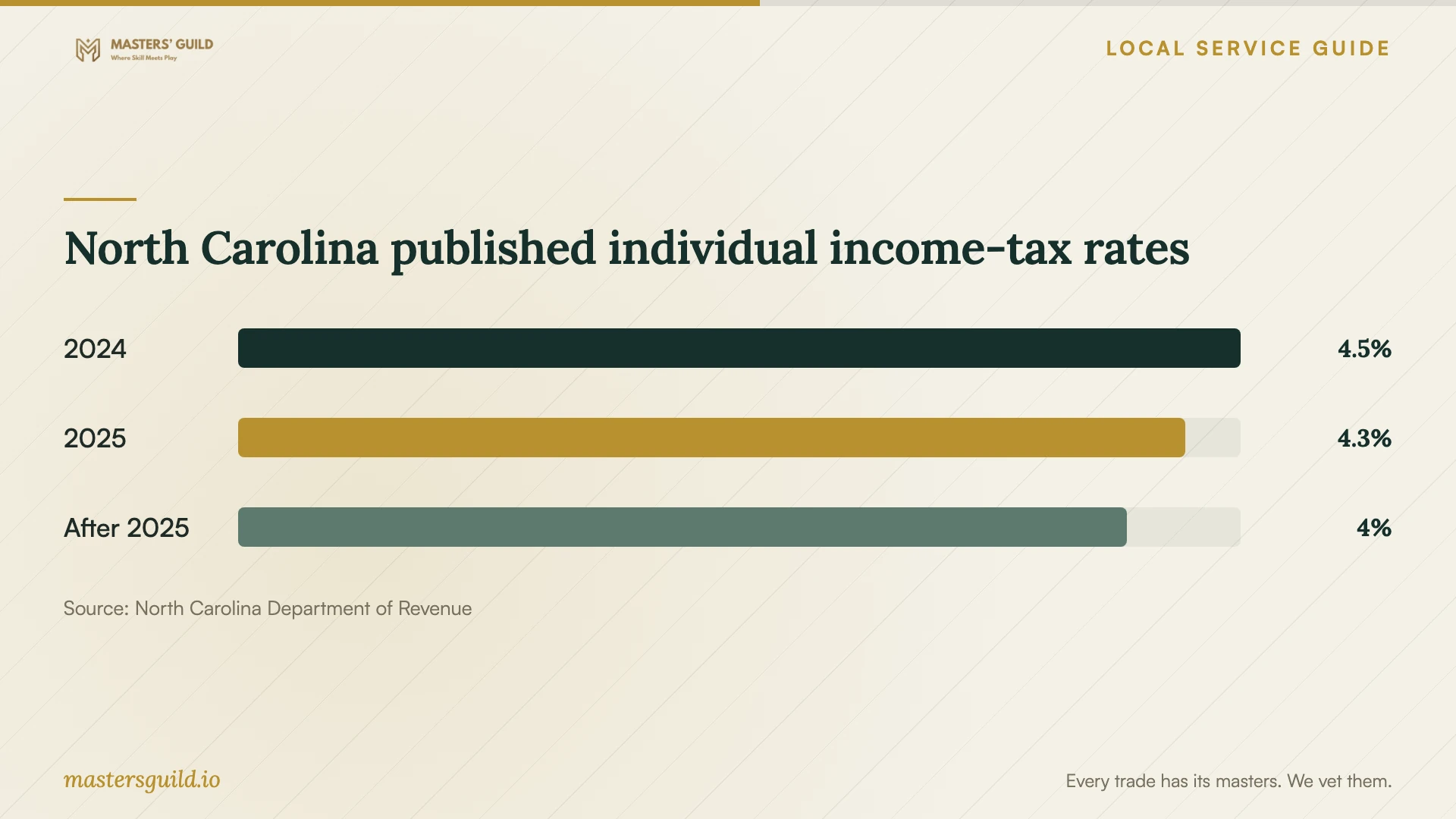
Use the income-tax rate chart as background for a planning discussion. Ask your accountant to explain the calculation for your circumstances and any proposed payroll changes. Agree on a handoff process so that both you and the accountant know when you have supplied complete information and approved a payment.
North Carolina published individual income-tax rates
Local details that affect your job
New and home-based businesses need a county listing plan
Guilford County says businesses new to the county should complete its Enroll Business Form before December 15 to receive a form in the annual mailing. Owners remain responsible for obtaining and completing a required listing even if no form arrives. Include enrollment and asset reporting in your accountant’s scope if you are starting a business from home; contact the county’s business-property staff at 336-641-3345 for listing questions. [1]
A county bill starts a short valuation appeal window
Guilford County uses the business personal-property tax bill as the assessment notice and requires valuation appeals within 30 days of the bill’s date. If you dispute the value, ask your accountant to review the asset costs and acquisition years, then contact the county at 336-641-3345. The county directs unresolved formal appeals to the Board of Equalization and Review at 400 W. Market St., Greensboro, NC 27401. [1]
Match your situation to the engagement
| Your situation | Work to discuss | Question before hiring |
|---|---|---|
| Books are ready and you want return preparation | Defined tax-preparation scope | Which returns and follow-up questions does the fee include? |
| Transactions need sorting or reconciliation | Cleanup before return preparation | Will you quote cleanup separately and agree on when the books are ready? |
| You use equipment in a Guilford County business | Annual business personal-property listing | Will you prepare the county listing and review the asset records? |
| You employ staff | NC withholding registration, filings and annual NC-3 reconciliation | Who files, authorizes payments and checks confirmations? |
| You dispute a county business-property valuation | Review within the 30-day appeal window | Can you review the bill and supporting asset records before the appeal deadline? |
Your hiring checklist
- Describe your business and list the returns, cleanup and ongoing support you want.
- Gather prior returns, current books, bank statements and tax notices.
- Prepare an asset list with purchase costs, acquisition years, disposals and leases.
- Check CPA credentials and public disciplinary records through the relevant board.
- Ask who handles county listings, payroll filings and payment approvals.
- Agree on fees, exclusions, record-delivery dates and secure document transfer.
- Keep the signed engagement and copies of filings and confirmations.
Frequently Asked Questions
How do I verify someone advertising as a CPA?
Check the licensing record, active status and public enforcement documents. The North Carolina CPA Board also recommends checking firm registration. A qualifying out-of-state CPA may work under practice privileges, so confirm the home-state license when applicable. [2]
Does tax preparation include my county business-property listing?
Ask for that task in the written scope. Guilford County requires covered business-property owners to file an annual listing. Have the engagement identify who prepares it, who supplies asset information and who submits it. [1] [2]
Can I use my federal EIN for North Carolina withholding?
No. NCDOR requires a separate North Carolina withholding identification number obtained through Form NC-BR. The department charges no fee for that number. [3]
Can the CPA Board resolve a fee dispute?
The North Carolina CPA Board says it does not adjudicate fee or contractual disputes and cannot award damages. Establish costs and scope in the engagement letter, then raise billing questions with the firm. [2]
Sources and scope
This guide combines the sources below with practical planning guidance. Figures apply to the stated geography and period; request a written quote for your property.