
Local service guide
Snow Removal in Greensboro, NC: Plan Your Service
Arrange Snow Removal in Greensboro by agreeing on the areas to clear, the condition that triggers a visit, the arrival window and the charge for return work. Include steps, a walking route and the driveway entrance in your request. For a home adjoining an NCDOT-maintained road, arrange private clearing of the entrance: NCDOT excludes driveways, driveway entrances and sidewalks from its service. [1]
Define the job before comparing prices
Send each contractor the same photos and description. Show the full driveway, its entrance, parking areas, steps and the route you need between the door and your vehicle. Give approximate dimensions and identify slopes, narrow passages, gates and parked vehicles. Ask the contractor to name the areas included in the quote.
Choose your priority route before discussing equipment. If you need access for a household member with limited mobility, describe the route and the width you need. Ask whether the contractor will shovel steps and tight spaces as part of the visit. Agree on a snow-storage location that keeps the route and your view at the driveway exit open.
Request separate prices for clearing, treatment and return work. Ask whether the contractor charges per visit, per storm or under a seasonal agreement. Have them explain how they count visits during a prolonged storm and what work would require your approval for an additional charge.
Agree on dispatch and road-access limits
Define the dispatch trigger in plain language. Ask whether the contractor comes after a stated snow depth, after precipitation ends or when you request service. Include a separate instruction for ice when snowfall does not reach the agreed depth. Choose an arrival window and a method for receiving delay updates.
For travel on NCDOT-maintained roads, account for the state's clearing priorities. NCDOT gives first priority to its Bare Pavement System, which generally includes interstates, four-lane divided primary routes and other essential routes. It places other paved secondary roads below other U.S. and N.C. routes. This statewide policy does not establish a clearing deadline for your street. [1]
Ask the contractor how access conditions could affect your appointment and whether they will confirm a revised arrival window. If you have a time-sensitive departure, tell them before booking. Avoid treating a cleared driveway as confirmation that your onward route is ready for travel.
Separate snow clearing from ice treatment
Ask the contractor to explain what they propose to remove and what they propose to treat. NCDOT distinguishes the functions of its road materials: salt helps melt snow and ice, while sand adds traction. Its road-treatment guidance also says crews may pretreat with brine depending on conditions. [2]
For a forecast that includes rain before snow or ice, ask when the contractor would apply treatment and whether a repeat application would cost extra. NCDOT applies road brine in dry conditions and explains that rain can wash it away. Use that regional guidance to ask about timing, rather than assuming the contractor should use the state's road-treatment recipe on your property. [2]
Identify the surfaces you want treated, including any areas where you want the contractor to avoid a product. Request the product name, intended application areas and cleanup expectations. Ask who checks the property after the first visit and how you should request further work.
Review the agreement and prepare the property
Ask for proof of insurance and a written description of the work. Identify who will perform the visit and who handles damage reports. Photograph existing pavement edges, edging, fixtures and other features near the clearing area, then share anything the operator could have trouble seeing under snow.
Before the agreed service window, move vehicles and loose objects from the work area when you can do so safely. Confirm gate access and mark the agreed snow-storage area. Keep a copy of the scope so you can check the driveway entrance, steps and walking route against the work you ordered.
Use weather information appropriate to the decision. The National Weather Service's Greensboro airport daily-normal table covers 1981–2010. Those historical averages describe a past climate baseline; do not use them to set a particular storm's dispatch time or decide whether your pavement needs treatment. [3]
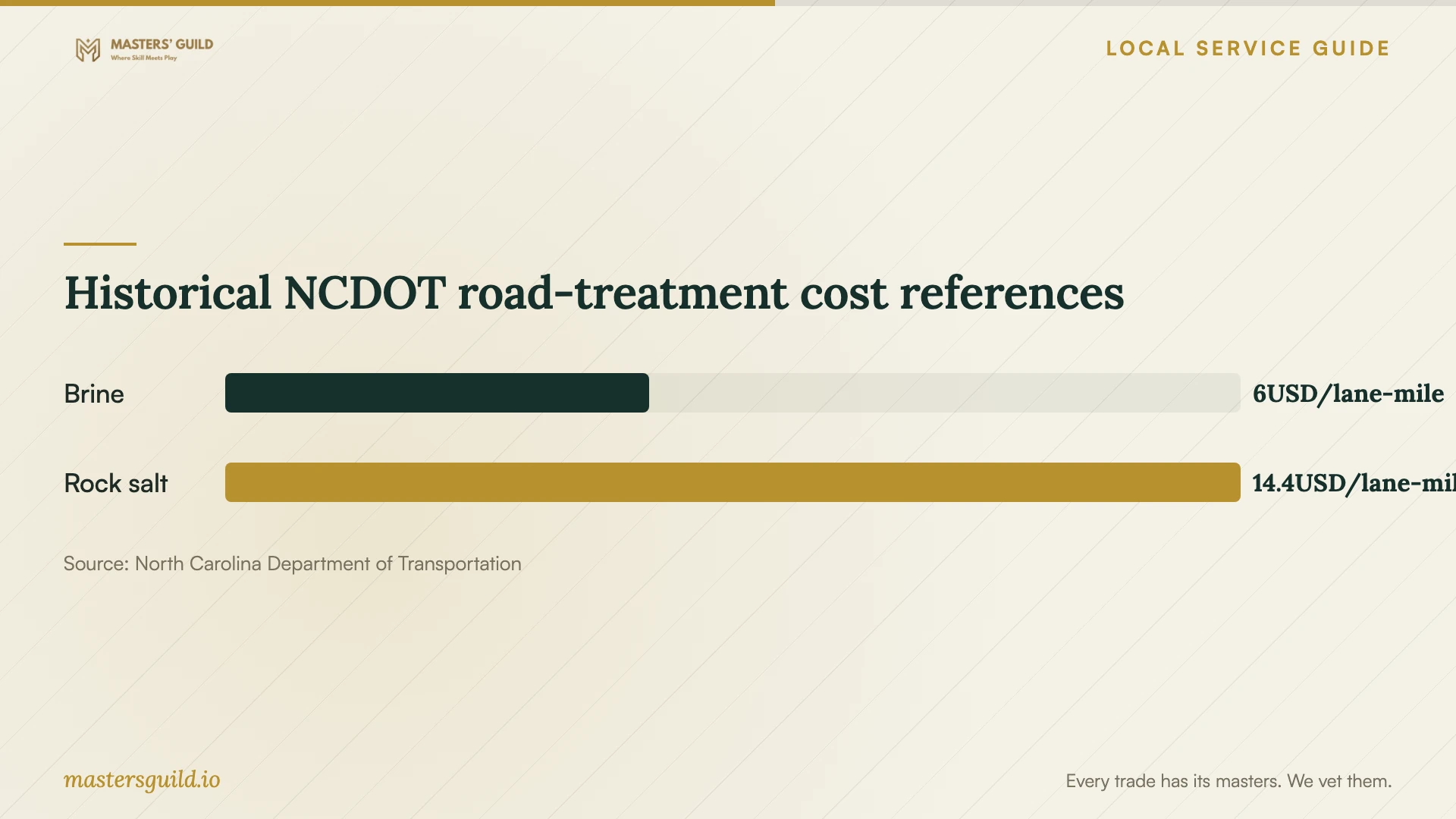
Historical NCDOT road-treatment cost references
Local details that affect your job
State clearing stops short of your driveway entrance
For a Greensboro property adjoining an NCDOT-maintained road, include the driveway entrance and any required sidewalk work in your private service request. NCDOT excludes sidewalks, driveways and driveway entrances from its snow and ice clearing. Ask whether your contractor's price includes another entrance-clearing visit after road crews pass. This is a state-network restriction, not a statement of Greensboro municipal responsibilities. [1]
State road priorities affect the scheduling question
If your contractor must reach you using NCDOT-maintained secondary roads, ask how they handle access delays before accepting a firm arrival promise. NCDOT prioritizes essential major routes, then other U.S. and N.C. routes, followed by other paved secondary routes and unpaved secondary routes. Its policy considers connectivity, traffic volume and emergency access. It does not give your property a service time. [1]
Rain changes the pretreatment discussion
North Carolina's road-treatment guidance says rain dilutes and washes away brine. For your property, ask the contractor how a rain-to-snow forecast changes application timing and the price of repeat treatment. This regional guidance supports a concrete planning question; it does not establish a city rule or prescribe a residential product. [2]
Match the agreement to your access needs
| Your situation | Request in writing | Question to settle |
|---|---|---|
| You want service only when requested | A call-out price and booking process | Does the contractor confirm availability for each request? |
| You need a cleared route by a departure window | Dispatch trigger, arrival window and delay updates | What happens if the contractor cannot reach the property? |
| Your entrance adjoins an NCDOT-maintained road | Private driveway-entrance clearing, which NCDOT excludes | Does a later entrance cleanup count as another visit? |
| The forecast includes rain before snow | Treatment timing and repeat-application terms | How will the contractor account for rain washing away pretreatment? |
| You are considering a seasonal agreement | Covered work, exclusions and cancellation terms | Which visits and materials would cost extra? |
Your hiring checklist
- Send matching photos, dimensions and clearing boundaries to each contractor.
- Identify the walking route, steps and driveway entrance you need cleared.
- Agree on the snow trigger and a separate process for ice-only conditions.
- Request an arrival window and a method for receiving delay updates.
- Confirm treatment products, application areas and repeat-treatment charges.
- Agree on snow storage, vehicle relocation and gate access.
- Request proof of insurance and written terms for damage reports.
- Confirm whether entrance cleanup after road plowing requires another paid visit.
Frequently Asked Questions
Will NCDOT clear the end of my driveway?
NCDOT excludes driveway entrances, driveways and sidewalks from its snow and ice clearing. If your home adjoins its road network, arrange entrance clearing in your private scope and ask about the charge for a return visit. This source does not establish municipal clearing responsibilities. [1]
Should I choose a per-visit or seasonal agreement?
Compare the written obligations before choosing. For per-visit service, define what counts as a visit and how the contractor handles repeat work. For a seasonal agreement, ask about covered events, treatment, exclusions and cancellation terms. Choose based on the access you need and the commitment the contractor offers.
Does spreading sand melt the ice?
NCDOT describes sand as a traction material and salt as a material that helps melt snow and ice. Ask your contractor whether the proposed work aims to remove accumulation, melt ice or improve traction, and identify the surfaces included. [2]
Can I use the chart to budget for my driveway?
Use the chart only as historical context for state road treatment. NCDOT's published figures concern a single road lane over one mile. They do not establish a residential service price. Request a property-specific quote covering labor, access, clearing, materials and return visits. [2]
Sources and scope
This guide combines the sources below with practical planning guidance. Figures apply to the stated geography and period; request a written quote for your property.