
Local service guide
Arrange pest control in Greensboro, NC
Arrange pest control in Greensboro by identifying the pest, requesting an inspection and comparing written treatment scopes. Ask for the supervising North Carolina licensee and the appropriate phase: P for household pests, W for wood-destroying organisms or F for fumigation. For termites, compare inspection findings, treatment methods and warranty obligations before signing. [1] [2]
Check qualifications for the treatment site
North Carolina requires people performing structural pest control for hire to hold a license or work under a licensee’s employment and supervision. Request the supervising licensee’s name, number and applicable phase. The state requires proof of insurance before issuing a license; ask the company for current insurance documentation. [1]
Describe where you want treatment. NCDA&CS distinguishes applications against, above, into or under a structure from applications over land. For a combined indoor and yard service, have the provider explain which credentials cover each application site and who will perform the work. [3]
Check the dates on credential paperwork. Structural pest control cards expire June 30 each year, and applicators must renew them to continue working without interruption. Request confirmation of current status when a provider presents an older card. [1]
Give providers the same quote request
Record where you see activity, when you first noticed it and which treatments you have tried. Include photographs and affected rooms or exterior areas. Request an inspection summary that separates confirmed findings from suspected activity and areas the inspector could not access.
Have each provider itemize the inspection, initial treatment, included return visits and ongoing service. Specify the pests and areas you want covered. For recurring service, request the renewal charge, cancellation terms and total payment commitment. Compare proposals with matching scope before choosing by price.
For control or prevention of wood-destroying organisms in structures, North Carolina requires written contracts. Required details include the license number and phases, foundation diagram, reinspection arrangements, retreatment conditions and total treatment price. Review those details alongside the proposed method. [2]
Arrange a termite inspection before choosing treatment
NC State Extension identifies subterranean termites as North Carolina’s main termite problem. Indoor swarming usually indicates an infestation within the home. Outdoor swarmers near stumps or landscape timbers do not establish a house infestation. Have a pest professional or local Cooperative Extension center identify insects if you cannot distinguish termites from ants. [4]
Contact your existing termite protection provider if you have an agreement. Without one, Extension recommends inspections and proposals from two or three or more companies. Its guidance allows time to compare options because termites do not cause significant damage over a short period. [4]
Request documentation of visible damage, moisture concerns and inaccessible areas. Inspectors cannot see through walls or floor coverings. If they find damage, discuss whether a contractor or engineer should examine it before treatment. Tell the inspector about wells, foundation drains and under-slab ducts, which Extension identifies as potential constraints on liquid treatment. [2] [4]
Read coverage and homeowner obligations
Under a termite warranty, the provider undertakes the corrective action specified in the agreement. Retreatment-only terms obligate the provider to treat returning termites, without requiring damage repairs. For repair coverage, examine the payment limit, exclusions and maintenance duties before accepting the renewal cost. [2]
Keep the original inspection diagram, treatment specifications and subsequent inspection reports. Extension explains that termite contracts do not include other wood-damaging pests unless specified. Request separate coverage if the inspector identifies carpenter ants, carpenter bees, wood-boring beetles or wood-decaying fungi. [4]
Prepare access and agree on follow-up
Request written preparation and reentry instructions before treatment. Discuss pets, food storage, locked rooms and crawlspace entrances. Have the provider identify belongings you should move and any areas you should leave undisturbed. Agree on the next inspection or return visit and how to report continued activity.
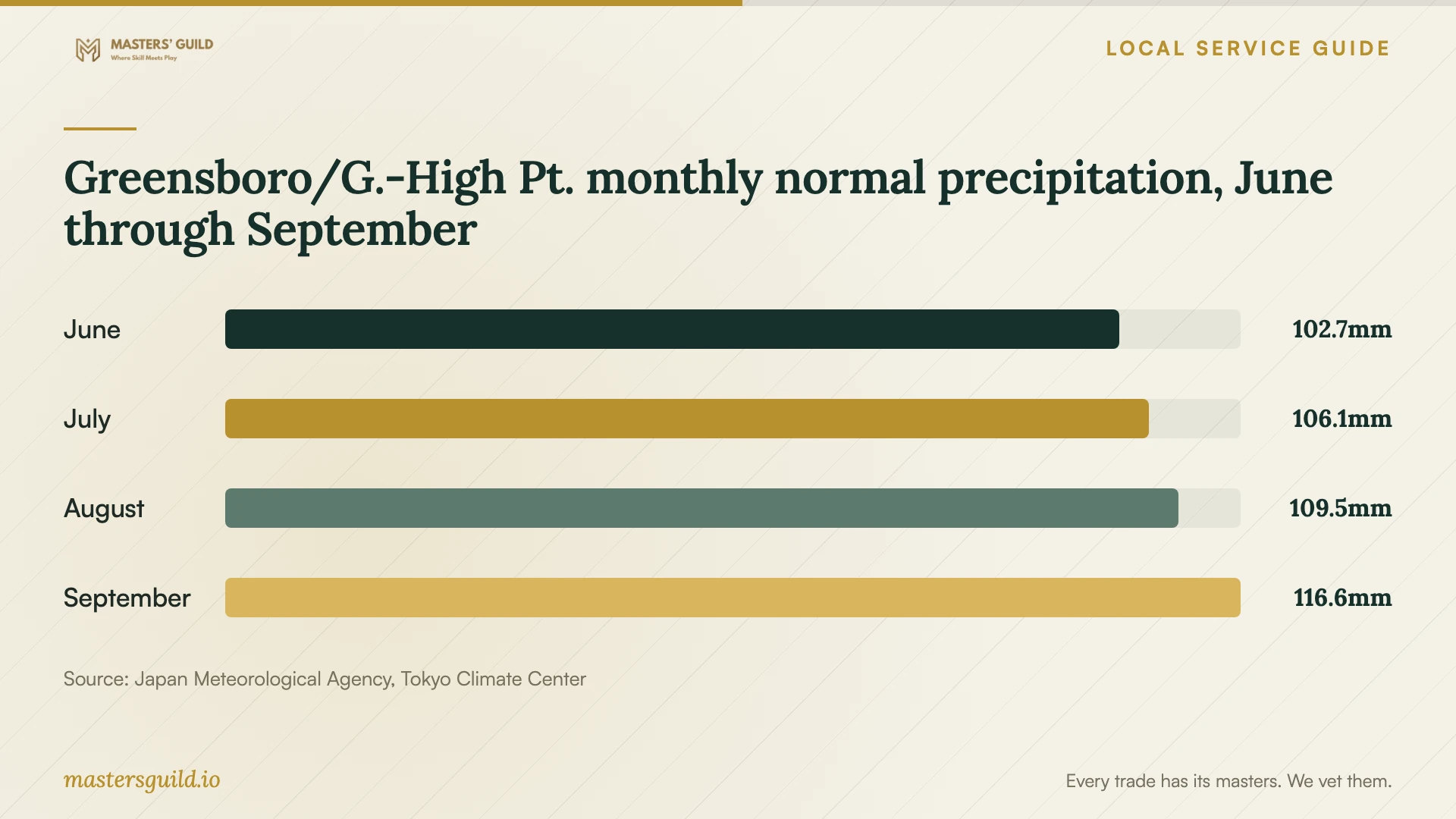
For inspection planning, note where water collects after rain and share photographs with the inspector. The Greensboro/G.-High Pt. precipitation chart gives climate context, rather than an appointment-day forecast. For termite inspections, the state’s consumer guide calls for technicians to locate water sources and identify conditions conducive to infestation. [2] [5]
Greensboro/G.-High Pt. monthly normal precipitation, June through September
Local details that affect your job
Apply North Carolina’s phase system
These statewide requirements apply to work at your Greensboro property. Request W-phase qualifications for termite inspection or treatment. North Carolina assigns household pest control to P, wood-destroying organism control and inspections to W, and fumigation to F. Confirm that the supervising licensee holds the phase your job requires. [1]
Review any North Carolina termite waiver
Extension explains that a new termite treatment contract must identify departures from state minimum treatment requirements on an official waiver that you sign. Before accepting a limited treatment, have the provider explain each omitted procedure, the reason for omitting it and any effect on the guarantee. [4]
Escalate unresolved structural pest concerns
Extension recommends discussing service problems with the company’s manager or owner before contacting NCDA&CS for assistance. The department lists its statewide Structural Pest Control Section at 984-236-4625. Keep your agreement, inspection findings and service records available when explaining the concern. [2] [4]
Choose the next step for your situation
| Situation | Next step | Review before signing |
|---|---|---|
| Household pest treatment | Request P-phase supervision | Named pests, treatment areas and return visits |
| Suspected termites | Arrange a W-phase inspection | Findings, foundation diagram and treatment method |
| Indoor treatment and yard spraying | Clarify credentials for each application site | Who performs and supervises each service |
| Limited termite treatment | Discuss omitted procedures and any required waiver | Reasons for omissions and guarantee limits |
| Termites under an existing agreement | Contact your current provider for inspection | Retreatment and damage-repair terms |
Your hiring checklist
- Photograph activity and record affected locations.
- Request current credentials and insurance documentation.
- Give competing providers the same job description.
- Compare initial, return-visit and renewal charges.
- Read exclusions, waivers and homeowner obligations.
- Arrange access and obtain preparation and reentry instructions.
- Keep inspection diagrams, agreements and service records.
Frequently Asked Questions
How much should I budget?
Obtain a property-specific quote after the provider identifies the pest and treatment scope. Compare inspection, initial treatment, return visits and renewal charges. Request a total for the proposed service period so you can compare one-time and recurring proposals.
Does the visiting technician need their own license?
North Carolina permits structural pest control for hire under a licensee’s employment and supervision. Request the technician’s credential and the supervising licensee’s name and applicable phase. [1]
Can I treat termites with a store-bought spray?
NC State Extension advises against DIY chemical termite control. Spraying visible termites or exposed wood does not stop the underlying infestation or protect the home from further attacks. Arrange an inspection before choosing treatment. [4]
Does an annual termite agreement mean annual spraying?
Extension explains that annual treatment without evidence of activity violates most termiticide labels. Have the provider describe the inspection schedule, conditions for retreatment and your maintenance obligations. [4]
Sources and scope
This guide combines the sources below with practical planning guidance. Figures apply to the stated geography and period; request a written quote for your property.