
Local service guide
Tax preparation and accounting in Grand Rapids
Tax preparation in Grand Rapids should start with a written quote that identifies your federal, Michigan and applicable city returns. Ask the preparer to assess your home address, work location and any move during the tax year before agreeing on scope. The city requires returns from residents with taxable income and from nonresidents with taxable income earned within city limits, subject to its filing thresholds. For rental records or a tax notice, ask about relevant experience and who will handle follow-up. [1]
Define the returns and accounting work you need
Give each candidate the same summary: the tax year, your home and work addresses, move dates, income types, rental properties and any unfinished records. Ask them to identify the returns and schedules they propose to prepare. Request a separate description of accounting work, such as reconciling bank transactions or organizing rental income and expenses.
The city lists rental income among taxable income for residents. For nonresidents, it includes net profits from renting real or tangible property within city limits. If you own a rental, give the preparer the property's address and your residency history so they can assess the city filing requirement. [1]
For a move during the year, bring the dates you changed residence and records of income earned during each period. The city offers a part-year return and says that a part-year resident with no taxable income from within city limits reports income earned while a resident. Ask the preparer to explain how your circumstances fit that guidance. [1]
Match credentials to the help you want
Ask for the name and credentials of the person who will prepare your return. The IRS requires anyone preparing a federal return for compensation to have a PTIN and enter it on the return filed with the IRS. The preparer does not have to display that number on your client copy. [3]
Enrolled agents, CPAs and attorneys have unlimited representation rights before the IRS, including audits, collection matters and appeals. Annual Filing Season Program participants have limited representation rights for returns they prepared and signed. Preparers with only a PTIN have no representation authority for current returns. [3]
For an existing notice, ask whether the professional handles that type of issue and will represent you if needed. For ongoing accounting, ask who reconciles your records, how you approve corrections and what you receive at the end of each month. Discuss tax preparation and accounting as separate deliverables even if one firm performs both.
Compare written fees and completion plans
Request a written fee proposal after describing your records. Ask whether the provider charges a fixed fee, an hourly rate or a combination, and how they authorize extra work. Specify city filing, rental schedules, prior-year corrections, accounting cleanup and notice responses as separate items. This guide does not provide a verified local fee range; use quotes for your stated scope to set your budget.
Agree on a document deadline, a date to review the draft and the person responsible for submitting each return. Ask how you will receive confirmation of filing and payment instructions. If you need bookkeeping, agree on the records the provider needs before promising a completion date.
The city states that individual returns are due April 30 each year, subject to changes when the IRS extends due dates. Its extension process requires a written application and adequate payment by the due date; an extension gives more time to file, not more time to pay. Ask your preparer to confirm the deadline and extension steps for the tax year you are arranging. [1]
Prepare records and review the result
Gather prior returns, income statements, city withholding records, estimated-payment confirmations and tax notices. For rental work, organize rent receipts, expense records and purchase or improvement documents by property. Tell the preparer about missing information at intake and ask for a written list of what they need.
Before approving submission, review your addresses, residency dates, income, withholding and payment amounts with the preparer. Ask them to explain any city income allocation and give you copies of the completed returns. Arrange a separate planning discussion if you want help tracking estimates or keeping rental accounts during the next year.
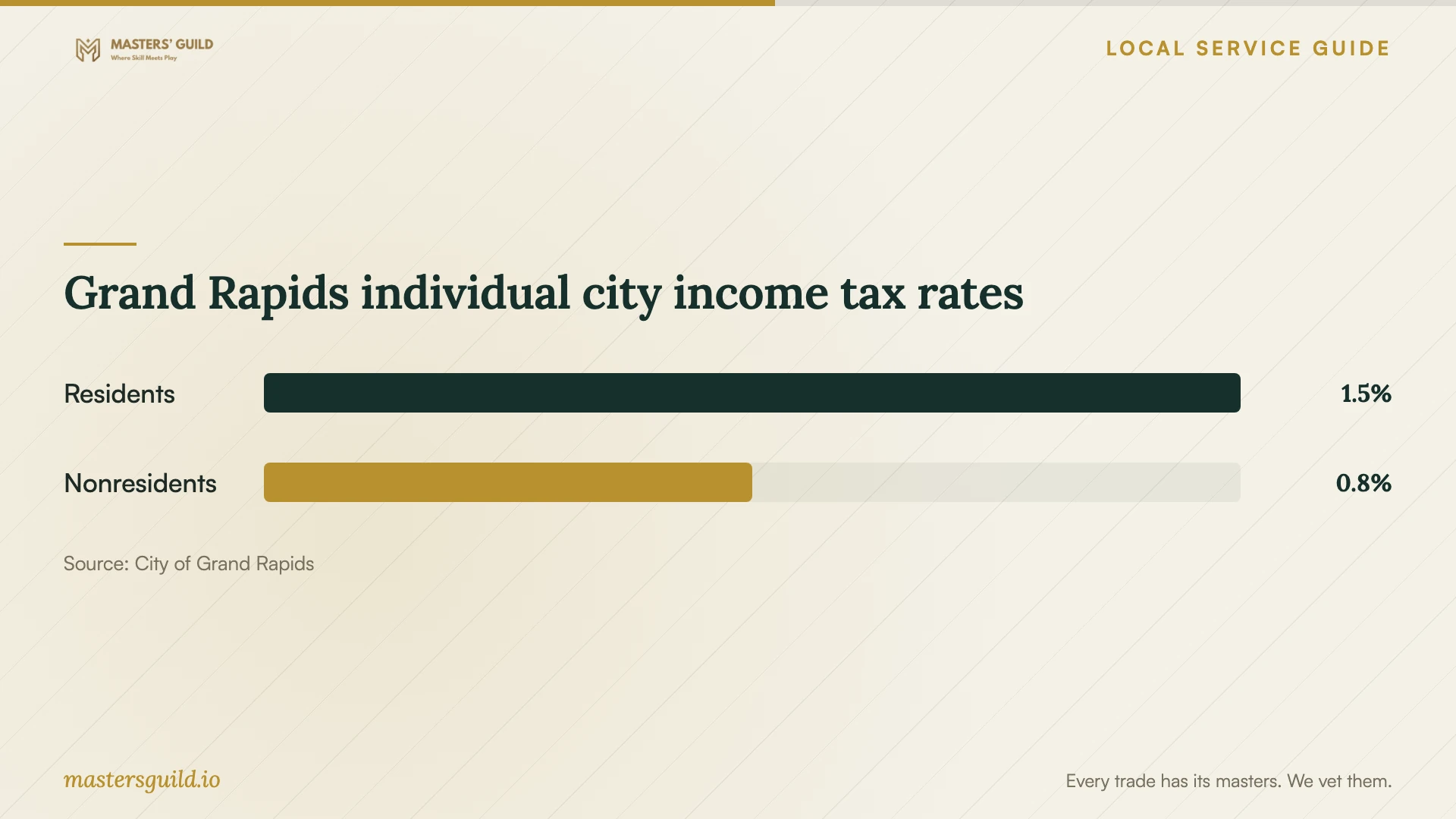
Grand Rapids individual city income tax rates
Local details that affect your job
Confirm the municipality of your address
The city's Individual Taxpayers page directs you to Kent County's Street Directory and tells you to use the Political Jurisdiction column to identify your municipality. It also notes that some addresses, including the Gerald R. Ford Airport, fall partly inside and partly outside Grand Rapids. Use this process for home and relevant work addresses before asking for a city-return quote, and contact the city for guidance on a split-boundary address. [2]
Arrange city estimates alongside annual filing
The city requires quarterly estimated payments if you expect to owe more than $100. Its published calendar lists April 30, June 30, September 30 and January 31, with the final payment in the following year. Ask the preparer to assess your city withholding and expected liability, confirm applicable dates and include payment instructions in the engagement. [1]
Confirm how the city return will reach the department
The city says e-filing is available to residents, part-year residents and nonresidents. It also offers an upload option for returns prepared in electronic programs that do not e-file. Ask which method the preparer will use and who will retain the submission confirmation. The city guide also offers in-person return help at City Hall, 300 Monroe Avenue NW, third floor; ask the department what assistance fits your return. [1]
Choose the engagement that fits your records
| Your situation | Work to request | Question before hiring |
|---|---|---|
| Employment income and organized records | Return preparation with a city-filing assessment | Which federal, Michigan and city returns does the fee include? |
| Move into or out of the city | Part-year residency review | Which move dates and income records do you need? |
| Rental property within city limits | Rental accounting and city-income review | Will you review both the property's location and my residency? |
| IRS notice, collection issue or appeal | Advice and representation from a CPA, enrolled agent or attorney | Will you represent me for this issue, and what does that cost? |
| Unreconciled rental records | Accounting cleanup before return preparation | How will you approve corrections and price the cleanup? |
Your hiring checklist
- Describe the tax year, income types, home and work addresses, and move dates.
- Ask the preparer to assess city residency and filing scope.
- Confirm the preparing professional's credentials and PTIN.
- Request itemized fees for returns, accounting cleanup and follow-up.
- Gather prior returns, income records, payment confirmations and notices.
- Agree on document, review and submission dates.
- Review the completed returns and retain copies and filing confirmations.
Frequently Asked Questions
Do I need a city return if I live outside Grand Rapids?
You may. The city requires nonresidents with taxable income earned within city limits to file, subject to filing thresholds. Give your preparer your work location and any city rental or business income records so they can assess the requirement. [1]
Does a PTIN mean the preparer is a CPA?
No. A PTIN authorizes federal return preparation; it is distinct from a professional credential. The IRS describes CPAs as state-board-licensed professionals and enrolled agents as IRS-licensed professionals. Ask which credential the preparer holds and what relevant work they handle. [3]
Does a city filing extension postpone payment?
No. The city's extension covers filing time. Its guide requires an application and payment adequate to cover the unpaid annual liability by the due date. Ask the preparer to explain the amount and submission steps for your situation. [1]
Should I hire one provider for accounting and tax preparation?
Ask each candidate to describe both services and identify who performs them. Agree on record ownership, reconciliation work, return preparation and follow-up. Compare the combined proposal with separate engagements using the same deliverables.
Sources and scope
This guide combines the sources below with practical planning guidance. Figures apply to the stated geography and period; request a written quote for your property.