
Local service guide
Special Item Transport in Grand Rapids, MI
Arrange Special Item Transport by asking a mover to assess your item, both access routes, and the handling plan before you accept a written quote. For a piano, safe, slate table, or fragile piece, ask who will handle disassembly, protection, transport, and final placement. In Grand Rapids, settle curb access before confirming the move: the city accepts meter reservations for moving and deliveries and requires requests at least two business days ahead. [1]
Choose a mover around the item and the route
Ask each candidate to describe how they would move your particular item from its current position to its destination. Request an explanation of how they would handle stairs, landings, doorways, and the transition into the truck. Ask for examples of comparable work and clarify whether the people assessing the job will also direct the handling.
For a piano, ask who will prepare and reassemble it. For a pool table, specify whether your request includes dismantling, transport, reassembly, and leveling. For a safe, provide the model and manufacturer weight if available, and ask who will handle any anchoring work. For art or antiques, ask the mover to propose wrapping or crating and explain how you should document existing condition.
Request written coverage terms for the item and damage to the premises. Ask about exclusions, deductibles, valuation limits, and the claims procedure. Keep this discussion separate from any insurance paperwork required for use of city property.
Get a quote that covers the complete move
Give each mover the same scope so you can compare offers. Include the item, origin and destination rooms, stairs, elevator arrangements, walking distance from the proposed truck position, and any preparation or setup you want. Ask the mover to identify assumptions that could change the quote after arrival.
Ask for separate treatment of handling, packing or crating, transport, setup, storage, and access arrangements. Confirm who pays city charges and who submits applications. Ask whether the quote includes waiting time and what happens if the crew cannot use the planned loading location.
The supplied official sources establish local access requirements and published meter fees; they do not establish specialty-moving labor prices. Get a job-specific quote rather than treating those municipal charges as the cost of the move. [1] [2]
Reserve a workable loading position
The city offers parking meter reservations for moving and deliveries on a first-come, first-served basis. Submit a new request at least two business days before the reservation starts. Identify the preferred meter numbers from the meters or the city's interactive map, and agree with the mover which spaces suit the proposed truck position. [1]
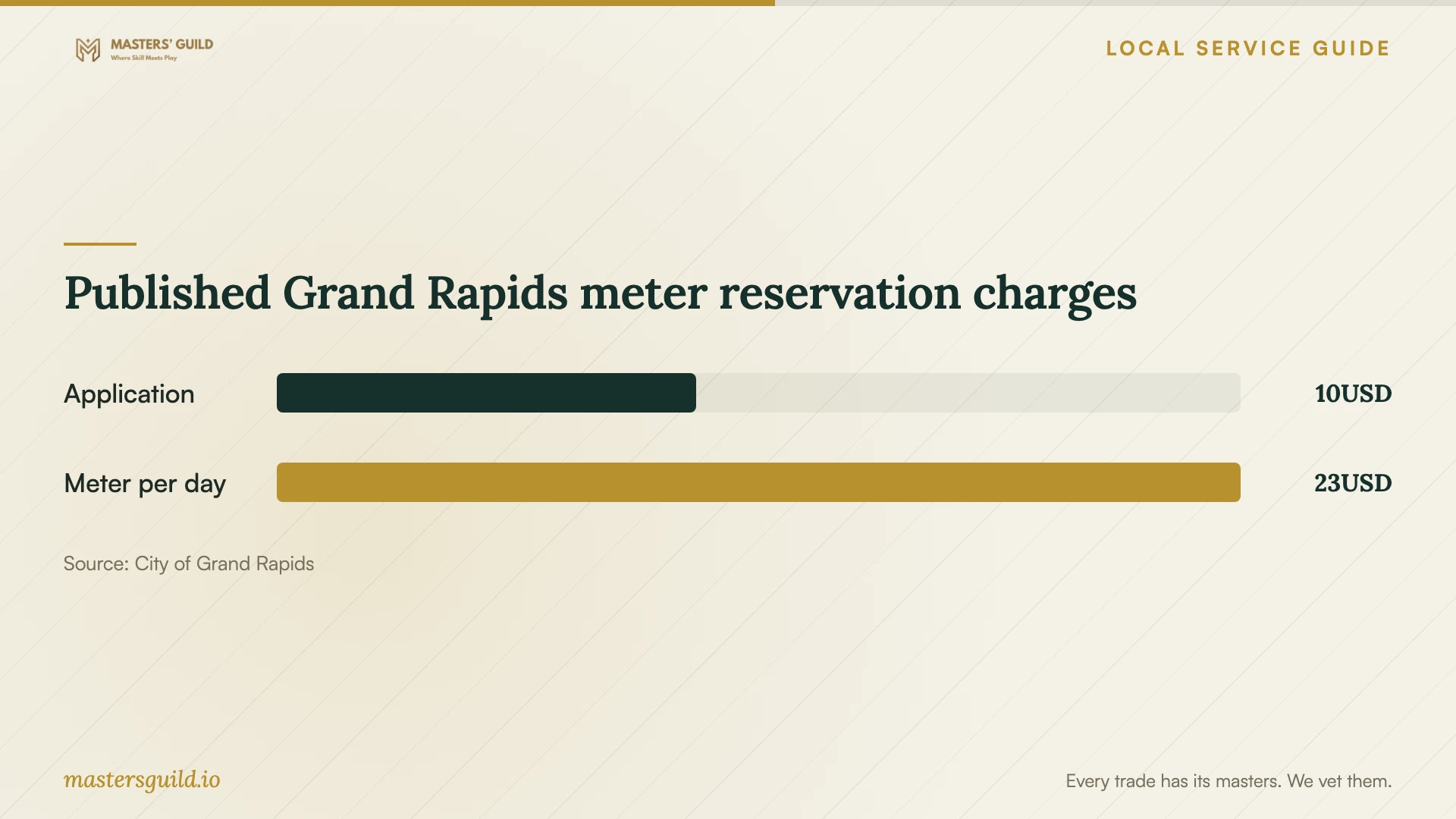
The city charges $10 per application and $23 per meter per day, including weekends. Tell the city if your dates change or you need to cancel; its instructions state that it will bill the requested reservations without that notice. When using the reserved meters, display the permit and company logo in the vehicle's front window as directed. [1]
Resolve public-space occupation before scheduling
Grand Rapids requires a Temporary Occupancy Permit for short-term private use of a road, sidewalk, or other public right-of-way. The city lists POD units, equipment staging, and safety buffers among its examples. If your handling plan needs such space, ask the Development Center about the proposed arrangement before you commit to a delivery date. [2]
Apply through Citizen Access or visit the office to complete an application. The city requires a certificate showing at least $500,000 in liability coverage, naming the city as additionally insured and identifying the project location. It also requires a traffic control plan, with an exception for dumpster and POD requests. Reserve and hood any parking meters within the closure or job site through Mobile GR. [2]
The city says to expect an initial response within one to two business days and warns that applicants may need to revise missing or incorrect information. Allow time for those revisions. Agree with the mover who will prepare the documents and confirm approval before using the space. [2]
Prepare the route and agree on weather decisions
Photograph the item before packing and walk both routes with the mover's plan in hand. Discuss floor protection, thresholds, handrails, overhead clearance, and the final placement. Arrange building access and any elevator booking with the property manager. Keep children and pets away from the handling route.
For a winter move, agree on who will clear the exterior route, protect the item during loading, and decide whether conditions require postponement. The National Weather Service recorded 15.5 inches of snowfall in Grand Rapids during December 2025; its December normal for 1991 through 2020 was 20.8 inches. Those monthly figures provide winter planning context, not a forecast for your appointment. [3]
Published Grand Rapids meter reservation charges
Local details that affect your job
Meter reservations need advance action
Submit meter requests at least two business days ahead and identify the spaces by meter number. Ask the mover to confirm the truck position before applying. For help with the application, the city directs applicants to 311 or its customer service location at 50 Ottawa Ave NW. [1]
A POD needs more than a meter reservation
The city's meter instructions require a Temporary Occupancy Permit for non-plated vehicles or objects left in the public right-of-way, including moving pods and lifts. Its occupancy process requires insurance documentation and exempts POD requests from the traffic control plan requirement. Ask the Development Center at 616-456-4100 about your proposed placement. [1] [2]
Match the access plan to the next step
| Your situation | Next step | Confirm before moving |
|---|---|---|
| You need metered curb space | Request a meter reservation at least two business days ahead | Meter numbers, dates, permit display, and company logo |
| You plan a POD in public right-of-way | Apply for a Temporary Occupancy Permit | Placement and required insurance documentation; POD requests do not require a traffic control plan |
| You need public-space equipment staging | Review the occupancy application with the city | Insurance, traffic control plan, and any meter reservations |
| The item must pass tight turns or stairs | Request an access assessment before accepting the quote | Handling method, equipment, protection, and scope changes |
Your hiring checklist
- Send item photographs, measurements, model information, and available manufacturer weight.
- Document stairs, turns, thresholds, and the route between each room and the proposed truck position.
- Specify packing, disassembly, setup, and final placement in the written scope.
- Ask who will arrange loading access and any required city applications.
- Read item coverage terms, exclusions, and claims instructions before accepting.
- Agree on route clearing, weather protection, and postponement terms.
- Photograph condition before packing and inspect the item after placement.
Frequently Asked Questions
How much should I budget for the transport itself?
Request a written quote for your item and both access routes. Ask the mover to identify handling, packing, transport, setup, and access charges. The cited city fees cover meter reservations; they do not establish the mover's price. [1]
Does reserving meters cover a moving POD?
Arrange a Temporary Occupancy Permit for a POD in the public right-of-way. The city identifies that requirement in its meter reservation instructions. If the site includes parking meters, its occupancy instructions also require reserving and hooding them. [1] [2]
Can I assume the occupancy permit will arrive within two days?
Plan around confirmed approval. The city describes one to two business days as the time to expect a response and says applicants may need to revise their submissions. [2]
What should I ask about damage protection?
Request written terms covering your item and the premises. Ask how the mover values a loss, which exclusions apply, and how you would submit a claim. Photograph the item before packing and agree on an inspection at delivery.
Sources and scope
This guide combines the sources below with practical planning guidance. Figures apply to the stated geography and period; request a written quote for your property.