
Local service guide
Concrete Work in Glendale, AZ: Hiring and Planning
For Concrete Work in Glendale, choose a contractor whose Arizona license covers your project, then compare written scopes for demolition, preparation, drainage, placement and cleanup. Arizona generally requires a contractor license when labor and materials exceed $1,000 or the work requires a permit at any price. For a concrete driveway, check the classification with care: the residential hardscaping classification excludes concrete driveways. Before accepting an offer, ask who will confirm city approvals and any county dust permit requirements. [1]
Define the job before requesting bids
Describe what you need the concrete to do: carry vehicles, provide an outdoor seating area, replace a walkway or repair an uneven section. Give contractors approximate dimensions and photos showing the whole area, nearby doors, gates and adjoining surfaces. Ask them to confirm measurements during a site visit.
For existing concrete, ask each bidder to explain the proposed repair and the reason for choosing it. Request an assessment of uneven edges, visible cracking and places where water collects. If a contractor recommends replacement, ask which sections they would remove and how they would address the underlying concern.
Mention future plans before approving the scope. Tell the contractor if you intend to add a patio cover, outdoor equipment or another structure. Ask whether the proposed slab suits that intended use and whether you need design advice before proceeding.
Match the Arizona license to the concrete scope
The Arizona Registrar of Contractors lists R-9 Concrete for residential installation and repair of concrete, concrete products and related accessories. CR-9 combines the commercial C-9 and residential R-9 scopes. Ask for the contracting business’s license number and verify its status and scope with the Registrar. [1]
Check the classification rather than relying on a description such as landscape contractor. R-21 permits non-loadbearing concrete but excludes concrete driveways, load bearing walls and pool deck coatings. For those projects, ask the bidder to identify the license authority covering the proposed work. [1]
Keep the contracting business’s name consistent across the proposal, contract and license check. Arizona issues the license to the business rather than its qualifying party. Request current insurance documentation and identify any subcontractors before signing. [1]
Resolve approvals and dust responsibilities before excavation
Ask the contractor to confirm the city approval requirements for your exact address and scope. Request a written allocation of responsibility for applications, fees and inspections. Treat work at a street connection, sidewalk or property boundary as a question to resolve before approving the layout.
For county dust permitting, use the surface area the project will disturb rather than assuming the finished slab area settles the question. Maricopa County requires a dust control permit at 0.10 acre, or 4,356 square feet, of disturbance. Have the contractor describe the excavation and preparation footprint when checking that threshold. [3]
The county distinguishes the responsible project owner’s dust permit from registration for subcontractors working at a permitted site. Ask who will hold the permit and whether participating subcontractors need registration. The county handles both activities through its Dust and Miscellaneous Portal. [3]
Compare complete quotes and a usable work schedule
Request a written scope covering removal and disposal, excavation, base preparation, slab thickness, reinforcement, joints, finish and cleanup. Ask the contractor to specify the proposed drainage direction and transitions at doors or existing paving. Have each bidder identify exclusions and the process for pricing unexpected conditions.
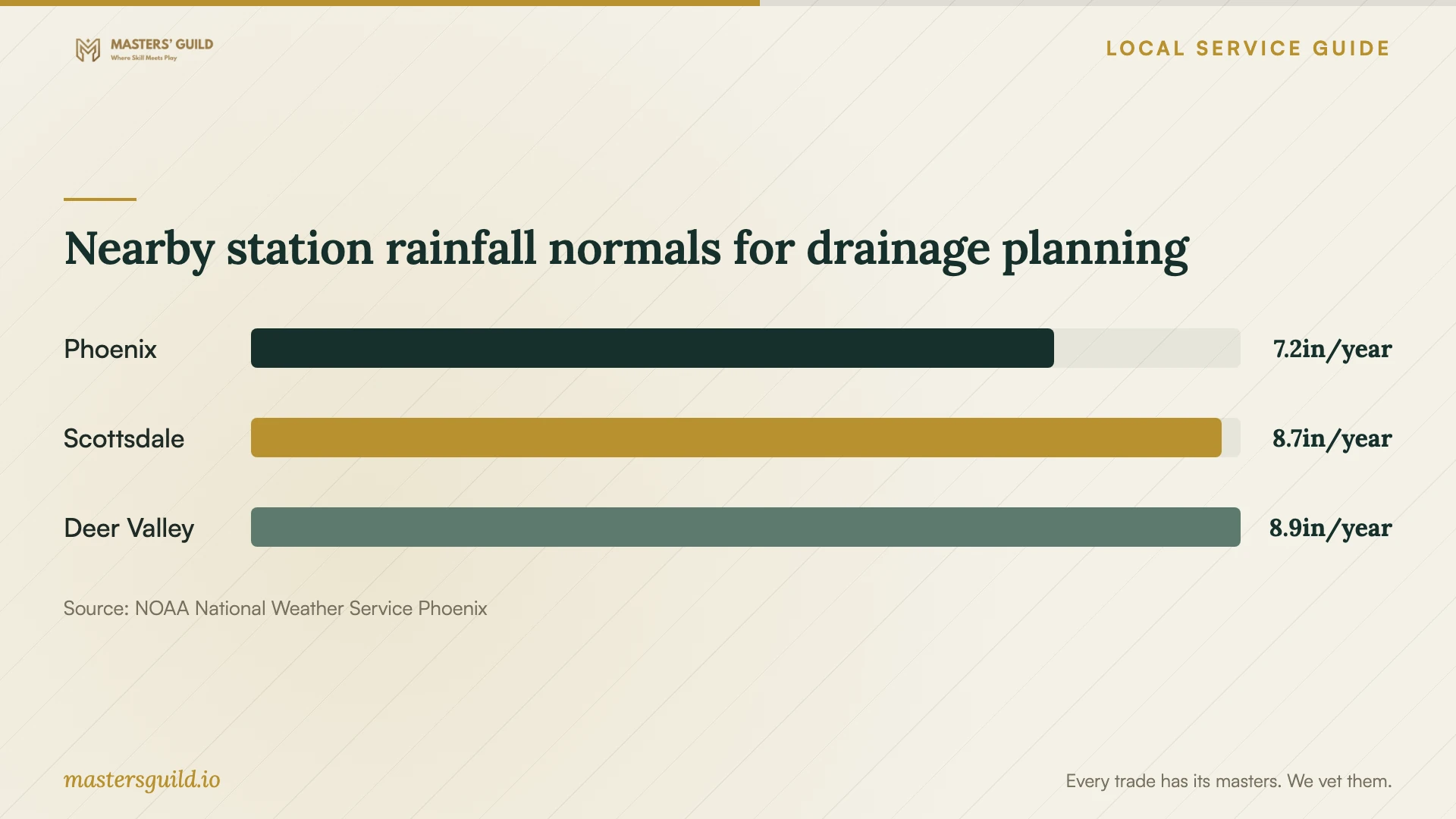
Ask each contractor to explain the pour-day weather plan, curing method and your aftercare responsibilities. Use the regional rainfall chart as background for a drainage discussion, then ask the contractor to assess your property. Do not use an annual climate average to select a pour date. [2]
Agree on access before scheduling. Identify the equipment route, gate clearance, material staging area and arrangements for pets or parked vehicles. Request separate milestones for site preparation, placement, permitted foot traffic and vehicle use. Have the contractor give reopening instructions for your specific project in writing.
Nearby station rainfall normals for drainage planning
Local details that affect your job
A hardscaping license has a driveway restriction
Arizona’s R-21 residential hardscaping classification excludes concrete driveways despite allowing non-loadbearing concrete. For a Glendale driveway bid, verify that the business holds a classification covering the driveway scope, such as R-9 or CR-9, before comparing its offer with others. [1]
Larger site preparation can trigger county dust permitting
Maricopa County sets the dust control permit threshold at 4,356 square feet of disturbed surface. For a project near that size, ask for the disturbance calculation before scheduling demolition or excavation. Use the county’s Dust and Miscellaneous Portal for the application, and distinguish the responsible party’s permit from subcontractor registration. [3]
Questions to resolve before accepting a concrete bid
| Your project | Decision before hiring | Ask the bidder |
|---|---|---|
| Concrete driveway | Confirm a classification covering concrete driveways; R-21 excludes them. | Which license classification authorizes this driveway scope? |
| Patio or walkway repair | Request an assessment before choosing repair or replacement. | What condition will your proposed method address? |
| Disturbance near 4,356 square feet | Check the county dust permit threshold using disturbed surface area. | Who calculated the disturbance area and who will hold any required permit? |
| Slab for a future structure | Resolve the intended use and approval questions before placement. | Does this proposal account for the structure I plan to add? |
Your hiring checklist
- Record the intended use, approximate dimensions and areas needing repair.
- Photograph access routes, adjoining paving, doors and places where water collects.
- Verify the contracting business’s active license and scope with Arizona ROC.
- Assign responsibility for checking city approvals and county dust requirements.
- Compare preparation, thickness, reinforcement, joints and finish in writing.
- Agree on access, cleanup, payment milestones and written change approvals.
- Obtain curing instructions and dates for resuming foot and vehicle traffic.
Frequently Asked Questions
Does a small concrete repair require a licensed contractor?
Arizona ROC says a license is generally required when labor and materials exceed $1,000 or a permit is required at any price. Check the project’s permit requirements before assuming a small repair qualifies for an exemption. [1]
Does the county dust threshold determine whether I need a city building permit?
Treat these as separate checks. Maricopa County’s 4,356-square-foot threshold concerns a dust control permit. Ask the city to confirm building or other approval requirements for the proposed scope. [3]
How should I compare concrete prices?
Give bidders the same project description and request itemized scopes. Compare removal, preparation, concrete specifications, finish, access arrangements and cleanup. Ask each bidder to explain allowances and exclusions before comparing totals.
How long will I lose access to my driveway?
Ask the contractor for a project-specific schedule covering demolition, placement, curing and vehicle access. Arrange parking around the written reopening instructions and confirm who will tell you if the schedule changes.
Sources and scope
This guide combines the sources below with practical planning guidance. Figures apply to the stated geography and period; request a written quote for your property.