
Local service guide
Junk removal in Gatineau: Pickup, Fees and Planning
Plan junk removal in Gatineau by checking municipal collection before hiring a crew. The City allows four bulky items per registration and uses separate collection routes for electronics and refrigerant appliances. Consider a private crew for indoor lifting, items municipal crews refuse or a removal deadline. Ask for written item acceptance, disposal destinations and a complete price before loading. [1]
Check whether municipal pickup fits your load
The City offers 18 registered bulky-item collections per year. Each registration allows four articles, or 12 for multi-unit buildings. Check your address-specific dates in DTRITUS. For additional articles, the City directs you to the next available collection or an ecocentre, where charges may apply. [1]
Municipal crews refuse windows, mirrors and patio-door glass; branches over 10 cm in diameter; assembled wooden sections such as stairs, walls or fences; and heavy articles over 50 kg that two people cannot transport. Photograph these items and ask a private hauler to confirm acceptance before booking. [1]
Place accepted items at the curb. At buildings with waste containers, use the area near the container or the location your manager specifies. Roll and tie carpets, place small wood pieces in an open container, and remove or bend nails and screws. Confirm your building’s placement arrangements before carrying items downstairs. [1]
Compare self-haul fees with a complete crew quote
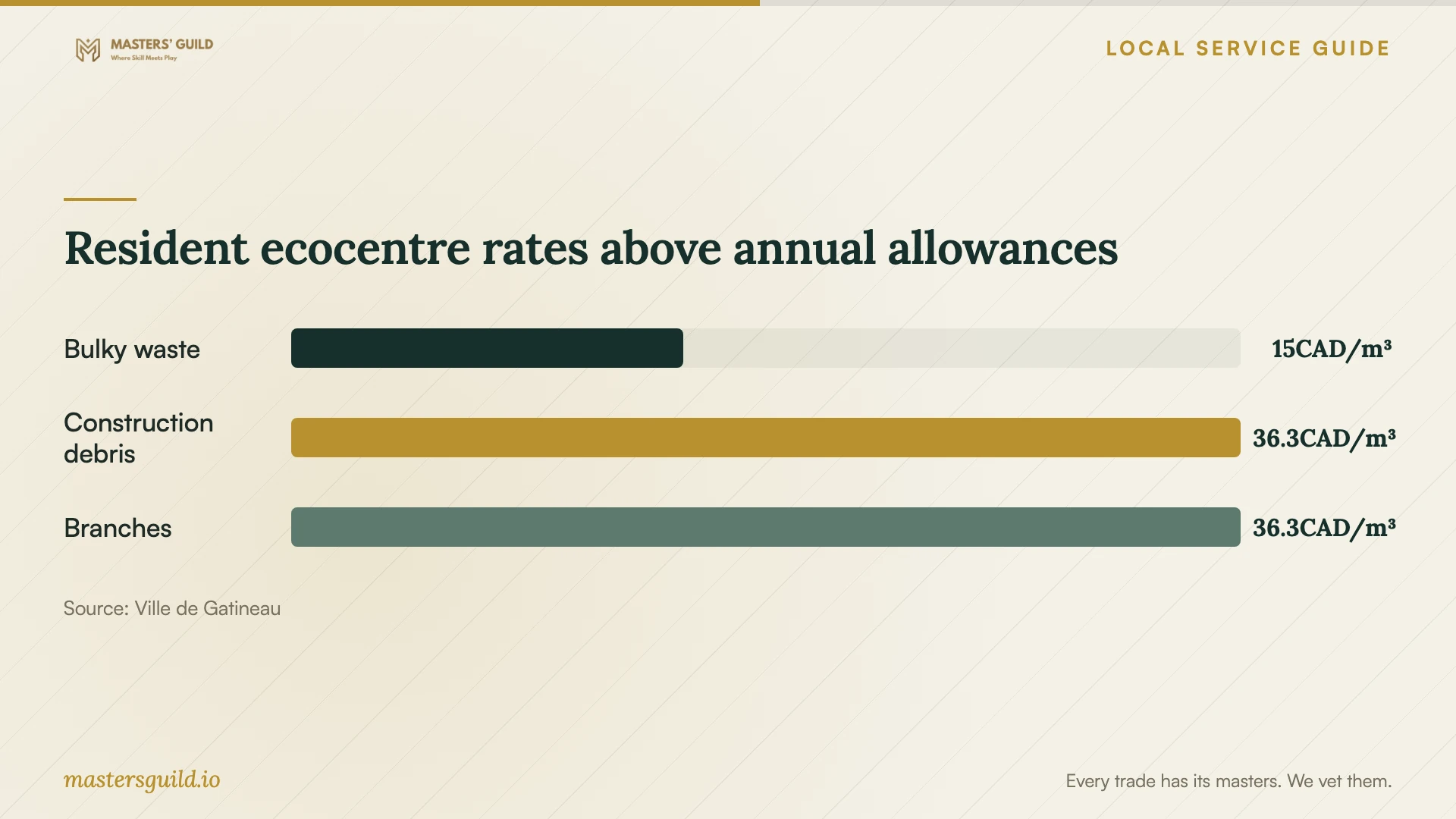
Resident annual ecocentre allowances cover 6 m³ of bulky waste, 12 m³ of construction debris and 12 m³ of branches. Excess volumes cost $15/m³ for bulky waste and $36.30/m³ for construction debris or branches. Tenants bringing construction debris from their rental dwelling fall under the small-business category: they pay $36.30/m³ without the resident construction allowance. The City bills chargeable visits for at least 1 m³. [2]
Bring valid residence and identity proof, sort materials before arrival and arrange your own unloading. Ecocentres do not accept household garbage. The transfer station accepts it from residents at $185 per tonne with a $50 minimum. The City may refuse construction debris mixed with household garbage or other unacceptable materials. [2]
Ask a hauler which facility and customer category it will use. The City sets different acceptance rules for residents, small businesses and large businesses, including companies operating waste-collection trucks. Do not assume a commercial load can use your household’s free allowance. [2]
Send each crew the same photographs and item list. Include dimensions, stairs, elevator access, parking distance and disassembly needs. Ask whether the quote covers a fixed inventory or depends on volume or weight. Request labour, transport, disposal charges and applicable taxes in the written total.
Arrange separate routes for appliances and electronics
Use GoRecycle to register refrigerant-appliance home collection. The City’s current surplus-materials page confirms this route. Its June 9, 2026 announcement dates the transition to July 6, 2026, but warns that announcement details may be outdated. Confirm appliance eligibility, pickup position and preparation requirements when arranging collection. [1] [3]
Register electronic products through the separate electronics form in DTRITUS. The City uses a separate collector because electronics contain heavy metals and cannot travel in the compacting trucks used for other bulky items. Permanent ecocentres accept up to two pallets, or 2 m³, of electronics per visit. [1] [2]
Residents can bring household hazardous waste to permanent ecocentres without a charge. Keep paint, oils, batteries and unidentified materials separate from the general cleanout inventory. Retain labels and ask a private crew to identify any materials it will leave behind. [2]
Agree on the work before removal day
Mark belongings that must stay and identify each pickup location: indoors, garage or curb. Agree on furniture dismantling, floor protection and cleanup after loading. Request confirmation of insurance and ask how the company handles accidental property damage.
For renovation debris, photograph wood, drywall and metal as separate groups. The City requires ecocentre users to separate construction materials by category before arrival, even when those materials share the same rate. Ask your crew to explain its sorting plan and intended destinations. [2]
Walk through the inventory with the crew and confirm the price before work starts. Decide how to handle additional material before anyone loads it. Keep the final invoice and request disposal receipts where available.
Resident ecocentre rates above annual allowances
Local details that affect your job
Choose the facility before loading your vehicle
The permanent ecocentres operate at 26, rue Pierre-Ménard and 860, boulevard de la Carrière. The transfer station shares the boulevard de la Carrière street address but uses separate hours and fees. The ecocentre lists weekday evening hours; the transfer station lists weekday daytime hours and closes on weekends. Check the specific facility’s schedule before travelling. [2]
Separate eligible autumn yard waste
The City schedules three autumn green-waste collections between October 12 and November 20, 2026; check DTRITUS for your dates. Each collection allows up to 20 paper bags and five tied branch bundles. Eligible branches must measure under 4 cm in diameter and no more than 1.5 m long. Branches between 4 and 10 cm require registered bulky-item collection. The 25 kg maximum applies per bag, round garbage can or branch bundle. The City also accepts qualifying rolling bins identified with a V. [1]
Check municipal authorization for another resident’s belongings
For use of the City’s ecocentres or transfer station when disposing of belongings for a deceased resident or a resident unable to travel because of illness, the City directs you to submit an online request. It asks for a death certificate for a deceased resident, or a protection mandate, tutorship proof or power of attorney for an ill resident. Call 311 if you cannot submit the request online. This municipal facility procedure does not establish the requirements for a private estate-cleanout arrangement. [2]
Choose a route for your load
| Your situation | Route to consider | Check before arranging |
|---|---|---|
| A few accepted bulky items | Registered municipal collection | Four articles per registration, or 12 for multi-unit buildings; follow placement instructions. |
| Sorted material you can transport and unload | Permanent ecocentre | Bring residence and identity proof. Tenants’ rental-dwelling construction debris uses small-business rates without the resident construction allowance. |
| Refrigerant appliance | GoRecycle home collection | Use the separate registration route and confirm preparation requirements. |
| Household garbage for self-haul | Transfer station | Residents pay $185 per tonne with a $50 minimum. |
| Indoor lifting or municipally refused items | Private crew | Request item acceptance, an access plan, disposal destinations and a written total. |
Your hiring checklist
- Photograph the full inventory and mark belongings that must stay.
- Separate furniture, electronics, refrigerant appliances, renovation debris and hazardous materials.
- Check municipal acceptance and your collection calendar before choosing a paid pickup date.
- Describe stairs, elevator arrangements, parking and carrying distances.
- Request written acceptance for glass, heavy objects and assembled structures.
- Confirm the complete price, disposal destinations, exclusions and cleanup scope.
- Review the inventory and approve price changes before loading.
Frequently Asked Questions
Can I leave an old sofa at the curb without registering?
Register accepted bulky items through DTRITUS and check the collection date before setting them out. The City limits registrations to four articles, or 12 for multi-unit buildings. [1]
Do municipal disposal fees tell me what a private crew will charge?
The City’s published fee schedule covers ecocentres and the transfer station. Use it to assess disposal options, then request a private quote for your inventory, access conditions, labour and transport. [2]
Can I take a mattress to an ecocentre without paying?
The City classifies mattresses as bulky waste. Residents receive a 6 m³ annual allowance for that category, then pay $15/m³ above it. Check your remaining allowance and bring residence and identity proof. [2]
Do tenants get free construction-debris disposal?
Tenants bringing construction debris from their rental dwelling count as small-business users. The City charges $36.30/m³ without the resident construction allowance and bills chargeable ecocentre visits for at least 1 m³. [2]
Sources and scope
This guide combines the sources below with practical planning guidance. Figures apply to the stated geography and period; request a written quote for your property.