
Local service guide
Flooring installation and repair in Gatineau
Arrange Flooring installation and repair in Gatineau by requesting an inspection and a written quote covering preparation, installation and debris removal. Verify the contractor’s RBQ licence for the work: Quebec’s regulator identifies subclass 9 for floor coverings and finishing. Before authorizing demolition, resolve concerns about asbestos in older materials and check whether the full renovation requires a municipal permit. [1] [3] [4]
Define the repair before choosing a replacement
Show the installer the problem you want solved: a damaged patch, loose boards, an uneven area or a room you want renewed. Request separate repair and replacement proposals where both deserve consideration. For a patch, ask the contractor to explain the proposed material match, repair boundary and appearance you should expect.
Ask the contractor to inspect the supporting surface and explain any preparation allowance before you order materials. For a basement or a room with previous water damage, request a moisture assessment and a plan for investigating the cause. Describe leaks you have seen and repairs you have arranged.
For each proposed product, request its installation instructions and have the installer explain suitability for your room, supporting surface and any floor heating. Include door clearances, transitions to adjoining rooms, stairs and trim in the walkthrough. Agree on the finished layout before installation starts.
Verify the licence and the complete permit scope
The RBQ states that contractors doing residential renovation for a homeowner for profit need the appropriate licence subclasses. Its guidance names subclass 9, Entrepreneur en travaux de finition, for floor coverings and their finishing. Ask for the licence number and check the current record through the RBQ’s licence-verification service. [3]
Describe the whole renovation when checking municipal requirements. Gatineau’s exemption concerns existing-building work costing less than $26,000 before tax for labour and materials, subject to exceptions. The City requires permits regardless of cost for work involving a building’s structure or interior walls, among other listed activities. Ask the City to classify proposed subfloor repairs if their structural scope is unclear. [1]
Use Gatineau’s URBAIN assistant with your address and the full list of planned work. The City describes its results as informational; URBAIN does not replace a permit application. For an unusual project or an uncertain result, contact 311 to submit an information request before setting the construction date. [1]
Resolve suspect materials before demolition
Quebec identifies vinyl tiles, linoleum sheets, flooring adhesives and underfloor membranes as possible asbestos sources. The province notes that builders used asbestos-containing products mainly between the 1930s and 1990s. Discuss a construction or renovation history from that period before anyone disturbs the existing floor. [4]
If you have doubts, Quebec recommends an assessment by a qualified contractor or a specialized laboratory. Cutting, sanding or breaking asbestos-containing materials can release fibres. If an inspection confirms asbestos, the province directs homeowners to entrust the work to a qualified contractor. [4]
Ask the flooring contractor to state whether assessment and specialist removal fall within the quote. Agree on a stop-work procedure for unexpected layers or suspect material, including who authorizes additional costs. Request a separate allowance for unresolved removal work so you can see what the installation price includes.
Compare complete quotes and arrange the room
Request separate amounts for materials, installation, old-floor removal, preparation, transitions, trim, furniture moving and disposal. Ask each contractor to use the same room measurements and scope. For concealed damage, request a written allowance or a method for pricing extra work, with your approval before proceeding.
Build your budget from site-specific written quotes. Ask contractors to identify taxes, exclusions, payment stages, warranty terms and responsibility for materials you purchase yourself. Have each contractor explain what happens if the delivered material falls short, arrives damaged or differs from your approved selection.
Before booking, agree on delivery, material storage, room clearing, access and cleanup. Ask when you can walk on the floor and return furniture under the chosen product’s instructions. For an occupied home, arrange how you will reach bedrooms, bathrooms and exits during each stage.
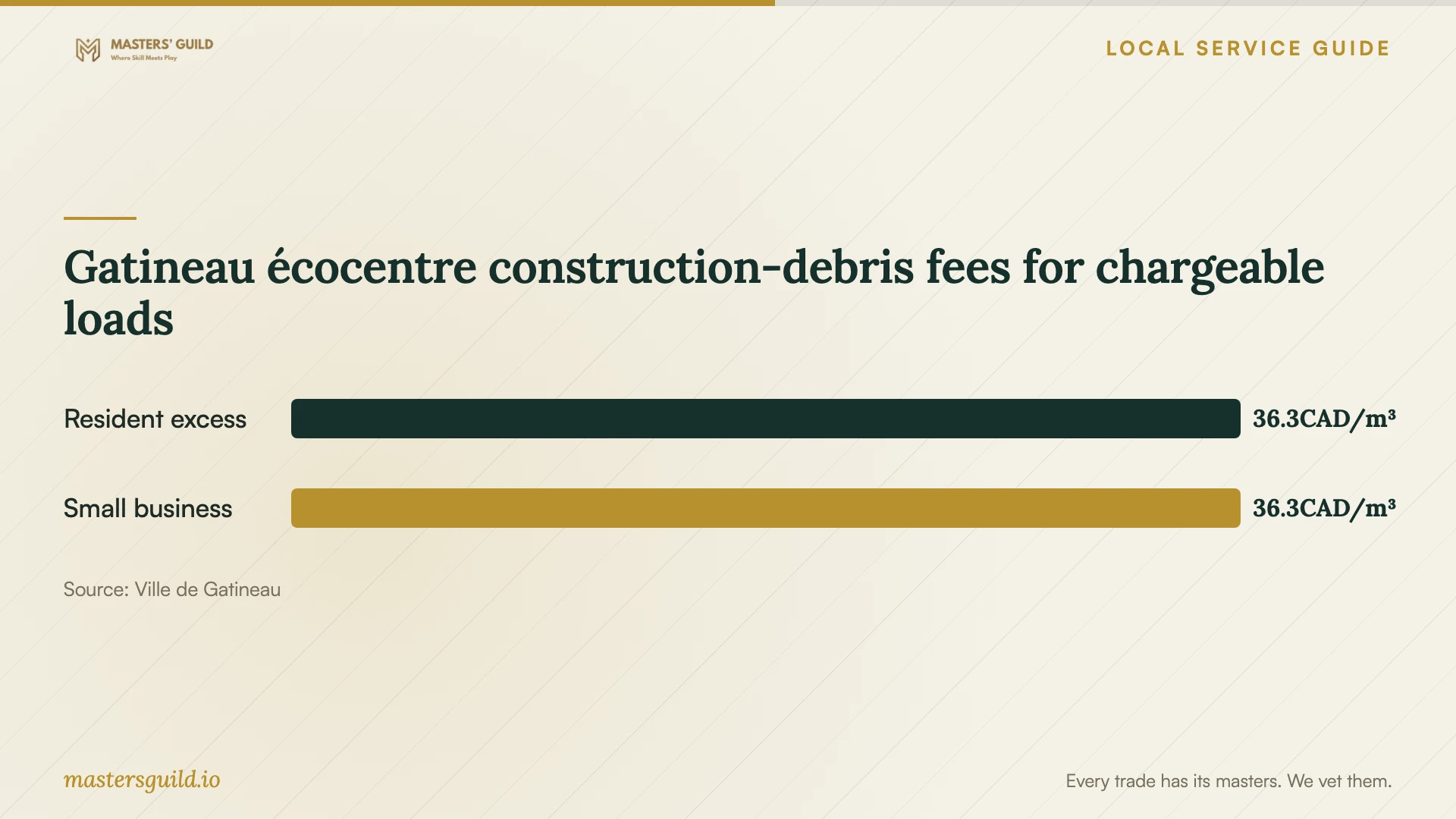
Gatineau écocentre construction-debris fees for chargeable loads
Local details that affect your job
Assign responsibility for the permit application
Gatineau allows the owner or their representative to submit an online application; a representative must attach authorization. If your project requires a permit, write down who will apply and supply the documents. The City says processing depends on request type, workload and complexity, so allow for that review when arranging the start date. [1]
Confirm eligibility before assuming free disposal
Under Gatineau’s rules effective June 29, 2026, eligible residents receive 12 cubic metres of construction-debris disposal per calendar year at the écocentres, then pay $36.30 per cubic metre. Small businesses pay $36.30 per cubic metre. The City classifies a tenant bringing construction debris from their dwelling as a small-business user. Confirm the applicable category before deciding who will haul the floor. [2]
Use a permanent facility and sort the load
Gatineau lists permanent écocentres at 26, rue Pierre-Ménard and 860, boulevard de la Carrière. Users must sort materials before arrival and unload them themselves. Mobile écocentres refuse construction debris. Before loading discarded flooring, confirm material acceptance and current hours with the permanent facility. [2]
Choose the next step for your floor
| Situation | Next step | Before you commit |
|---|---|---|
| Damage limited to one area | Request a repair assessment alongside replacement | Agree on the repair boundary and expected appearance |
| Subfloor work may affect the structure | Ask Gatineau to confirm permit requirements | Structural work requires a permit regardless of cost |
| Suspect old vinyl tiles, linoleum or adhesive | Arrange qualified assessment before disturbance | Quebec lists these materials as possible asbestos sources |
| You plan to haul construction debris | Confirm your user category and remaining allowance | Tenants bringing debris from their dwelling use the small-business category |
Your hiring checklist
- Photograph the damage, room edges and adjoining floor heights; record approximate room dimensions.
- Request repair and replacement options, including the expected finish match.
- Verify the contractor’s licence for the complete scope and request proof of insurance.
- Resolve permit questions and suspect-material assessment before authorizing demolition.
- Compare itemized quotes with preparation allowances, exclusions and written approval for extras.
- Assign responsibility for furniture, delivery, debris sorting, transport and disposal charges.
- Agree on access, payment stages, room-use restrictions and a final walkthrough.
Frequently Asked Questions
Does a flooring installer need an RBQ licence?
For paid residential renovation carried out for a homeowner, the RBQ requires the appropriate contractor licence. Its guidance identifies subclass 9 for floor coverings and finishing. Verify that the contractor’s current licence covers your complete project, including additional repair work. [3]
Does replacing a floor require a Gatineau permit?
An existing-building project costing less than $26,000 before tax for labour and materials may qualify for the City’s exemption. Exceptions include structural and interior-wall work, plus interventions subject to certain heritage or PIIA requirements. Check the full project through URBAIN or ask the City if you are unsure. [1]
Can I remove old vinyl flooring myself?
Resolve any asbestos concern first. Quebec lists vinyl tiles, linoleum and flooring adhesives as possible sources and recommends qualified assessment when in doubt. If an inspection confirms asbestos, entrust the work to a qualified contractor. [4]
Should the removal quote assume free disposal?
Ask the contractor to state the disposal arrangement. Gatineau’s eligible-resident construction-debris allowance is 12 cubic metres per year. Small businesses pay $36.30 per cubic metre, and tenants bringing construction debris from their dwelling fall into that category. Confirm eligibility before relying on the resident allowance. [2]
Sources and scope
This guide combines the sources below with practical planning guidance. Figures apply to the stated geography and period; request a written quote for your property.