
Local service guide
Concrete work in Garland, TX: Hiring and Permits
Arrange Concrete work by separating your private slab from any driveway approach or public sidewalk, then ask contractors to price each part and identify who handles permits. Garland requires permits for new or widened driveways and public sidewalk repairs; sidewalk repairs also require a bond on file for whoever performs the work. Before commissioning sidewalk reconstruction, check the city's cost-sharing program. [1] [2]
Define the work before asking for prices
Give each contractor the same description: the surface you want repaired or installed, approximate dimensions, intended use, and photographs of cracks, uneven edges, and standing water. Mark the limits of removal and replacement on a sketch. Ask the contractor to inspect the site before committing to a repair method or final price.
For an existing slab, request a written explanation of why the contractor recommends patching, leveling, partial replacement, or full replacement. Ask how the proposed work addresses the condition beneath the slab and any drainage concern you have observed. For steps or a slab intended to support a structure, ask who will determine the design requirements before accepting a flatwork quote.
Keep the private walk to your front door separate from the public sidewalk in your scope. Garland's public sidewalk repair permit requirement excludes that private walk. Do not extend that exclusion to a patio, structural slab, or other project without checking the requirements for that work. [1]
Check driveway layout and reinforcement
Garland requires a permit when you widen an existing driveway or pour a new one. For front or side yard driveways, the city lists reinforced concrete or concrete pavers as material options, subject to its exceptions for older properties. For reinforced concrete, it specifies 4 inches of concrete with Number 3 rebar at 18 inches on center and rebar chairs. [1]
Ask the contractor to draw the proposed footprint before pricing a widening. The city prohibits driveway coverage above 50 percent of the yard, with exceptions allowing up to 65 percent for circular driveways with two approaches and residential front yards where an ordinance prohibits or restricts street parking. Have the city confirm which limit applies to your layout. [1]
Describe the vehicles and loads you expect to use on the driveway. Ask whether the proposed design suits that use, and have the contractor identify any design provisions beyond the city's published residential specifications. Avoid accepting a quote that describes reinforcement only as included.
Compare complete quotes and access plans
Request separate prices for demolition and disposal, excavation, base preparation, concrete placement, reinforcement, finish, and site restoration. Ask each bidder to state the measured area and planned thickness. Compare exclusions as well as totals, and require written approval before the contractor adds work.
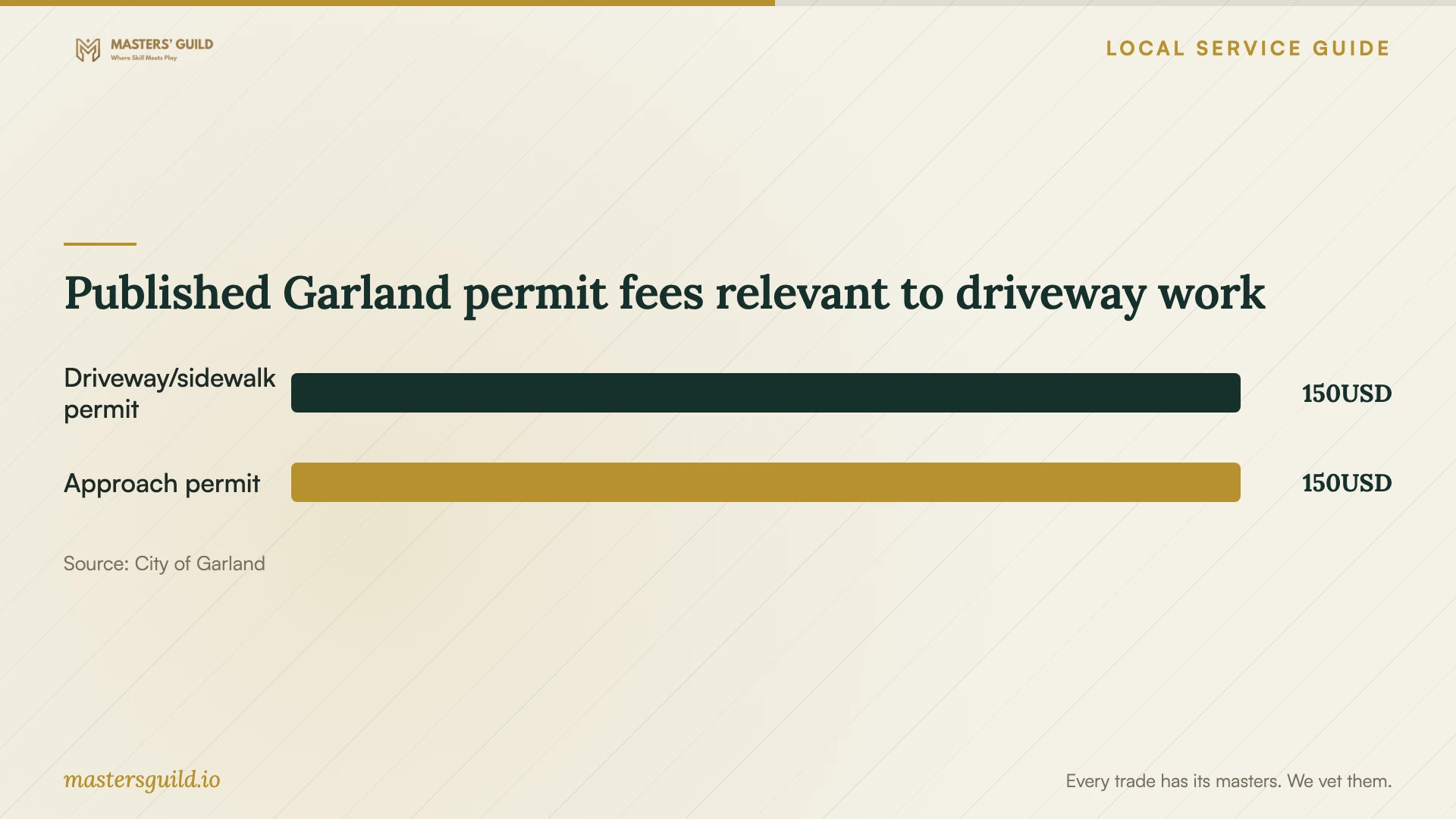
Name the person responsible for permit applications, inspections, and city coordination in the contract. Garland lists a $150 driveway/sidewalk permit and a $150 approach permit per approach, plus a 4.5 percent technology/equipment surcharge on permits issued by Building Inspections. Ask which charges apply to your project before treating any published fee as your total. [1]
Plan where you will park and how people will reach the front door during construction. Ask the contractor to document weather postponement terms, curing care, and when you may walk or drive on the finished surface. Include responsibility for protecting nearby landscaping and cleaning up after demolition.
Verify the contractor for the work location
For work involving the city right-of-way, ask the city which contractor registration requirements apply. Garland's ROW registration process requires a certificate of insurance naming the city as certificate holder. The city provides registration verification through its ROW Management Department. Ask for verification that covers the planned construction dates. [3]
Treat registration, insurance, and the sidewalk bond as separate questions. Garland requires a sidewalk bond on file for whoever repairs a public sidewalk; its ROW registration page also states that a General Repair Bond does not replace the required certificate of insurance. Ask the contractor to identify the documents required for your exact scope. [1] [3]
Request references for comparable work and ask to see examples with similar access and finish requirements. Put the payment schedule, change-order process, warranty terms, and completion conditions in the agreement. Before final payment, walk the project with the contractor and record any unfinished items.
Published Garland permit fees relevant to driveway work
Local details that affect your job
The driveway approach needs separate city coordination
Garland assigns approach review and approval to its Transportation Department. The city requires a 5-foot flare for paved alley approaches and a 5-foot radius for front entrance approaches, without extending beyond property boundaries. Paving in the city right-of-way must comply with city engineering specifications. Ask the contractor to distinguish the approach from the private driveway on the drawing and obtain approval before setting its shape. [1]
Check sidewalk cost sharing before choosing a private contract
Garland offers a baseline 50-50 share of sidewalk reconstruction costs and additional reductions that may leave a qualifying owner paying as little as 10 percent. The city publishes an overall expectation of 8 to 12 months. Its eligibility prose refers to disability or age 65 and older, while its examples also refer to military or veteran status. Confirm eligibility, documentation, and timing with the Street Department at 972-205-2930 before relying on a reduction or scheduling private work. [2]
Choose the next step for your project
| Project | Local requirement or option | Next step |
|---|---|---|
| New or widened driveway | Garland requires a permit. | Confirm the footprint and applicable yard coverage limit before approving the quote. |
| Driveway approach | Transportation reviews and approves approaches. | Separate approach design and city coordination from the private driveway scope. |
| Public sidewalk repair | A permit and sidewalk bond on file are required. | Confirm who obtains the permit and whose bond covers the work. |
| Sidewalk reconstruction with flexible timing | The city offers cost sharing and publishes an 8 to 12 month overall expectation. | Confirm eligibility and the current schedule before signing a private contract. |
Your hiring checklist
- Photograph the surface and mark the proposed work boundaries.
- Separate the private slab, driveway approach, and public sidewalk in the scope.
- Ask the city to confirm permits and any applicable contractor registration.
- Request dimensions, thickness, reinforcement, base preparation, and finish in each quote.
- Check sidewalk program eligibility before committing to reconstruction.
- Agree on parking, pedestrian access, weather delays, and curing instructions.
- Record payment stages, change approvals, warranty terms, and cleanup responsibilities.
Frequently Asked Questions
Does replacing a driveway require a permit?
Garland expressly requires a permit for a new driveway or widening. For replacement within an existing footprint, describe the removal and replacement scope to the city and confirm the permit requirement before work begins. [1]
Does a public sidewalk use the same reinforcement spacing as a driveway?
Garland lists different spacing: Number 3 rebar at 24 inches on center for public sidewalk repairs and 18 inches on center for reinforced concrete front or side yard driveways. Both specifications call for 4-inch concrete and rebar chairs. The sidewalk specification also requires at least 3 inches between the rebar and each side edge. [1]
Can I widen my driveway with gravel?
Do not assume gravel qualifies. Garland generally requires reinforced concrete or concrete pavers for front or side yard driveways. It allows a limited parking surface for homes constructed on or before January 1, 1970 that lack paved alley access, but still requires a concrete approach. Confirm your property's eligibility before choosing materials. [1]
How much should I budget for the concrete work?
Get site-specific written quotes rather than treating city permit fees as construction prices. Ask bidders to separate removal, preparation, placement, finish, and restoration, and to identify any allowance for conditions they cannot inspect before excavation.
Sources and scope
This guide combines the sources below with practical planning guidance. Figures apply to the stated geography and period; request a written quote for your property.