
Local service guide
Plan lawn mowing in Fremont, CA
Arrange lawn mowing in Fremont by requesting a property-specific quote that defines the lawn area, cutting height, edging, cleanup, and clipping handling. Ask the provider to match visits to grass growth so each cut removes no more than one-third of the leaf, as UC recommends. If you are an ACWD customer, include your irrigation schedule in the discussion before authorizing sprinkler changes. [3]
Give providers enough detail to quote the job
Send photos of each lawn and an approximate mowable area. Include the gate opening, steps, slopes, and any route through the property. Point out planted beds, exposed roots, furniture, and sprinkler heads. Ask the provider to confirm that their equipment can reach the work area.
Request a written price for mowing, trimming around obstacles, edging along pavement, and cleanup. Specify whether you want cuttings left on the lawn, collected into your container, or removed from the property. Ask who supplies bags and whether the provider charges for removal.
For recurring service, confirm payment timing, cancellation terms, and how the provider handles missed visits. Require your approval before extra work. Ask for proof of insurance and a clear process for reporting damage to a gate, irrigation head, or planted area.
Choose visits around the lawn's growth
Choose a weekly or biweekly arrangement only after discussing how much your grass grows between cuts. UC recommends removing no more than one-third of the leaf at a time. Its guidance also explains that water and fertilizer affect growth, so the calendar alone cannot determine the right interval. [3]
Ask the provider to identify whether you have cool-season or warm-season turf. UC says cool-season grasses grow most actively in spring and fall, while warm-season grasses grow most actively in summer. Include a way to approve schedule and price changes when growth changes. [3]
If the lawn has become overgrown, request a staged return to its recommended height and a separate price for that work. UC advises more frequent cuts for a period and lowering the height across successive mowings while following the one-third rule. [3]
Specify the height and discuss weed concerns
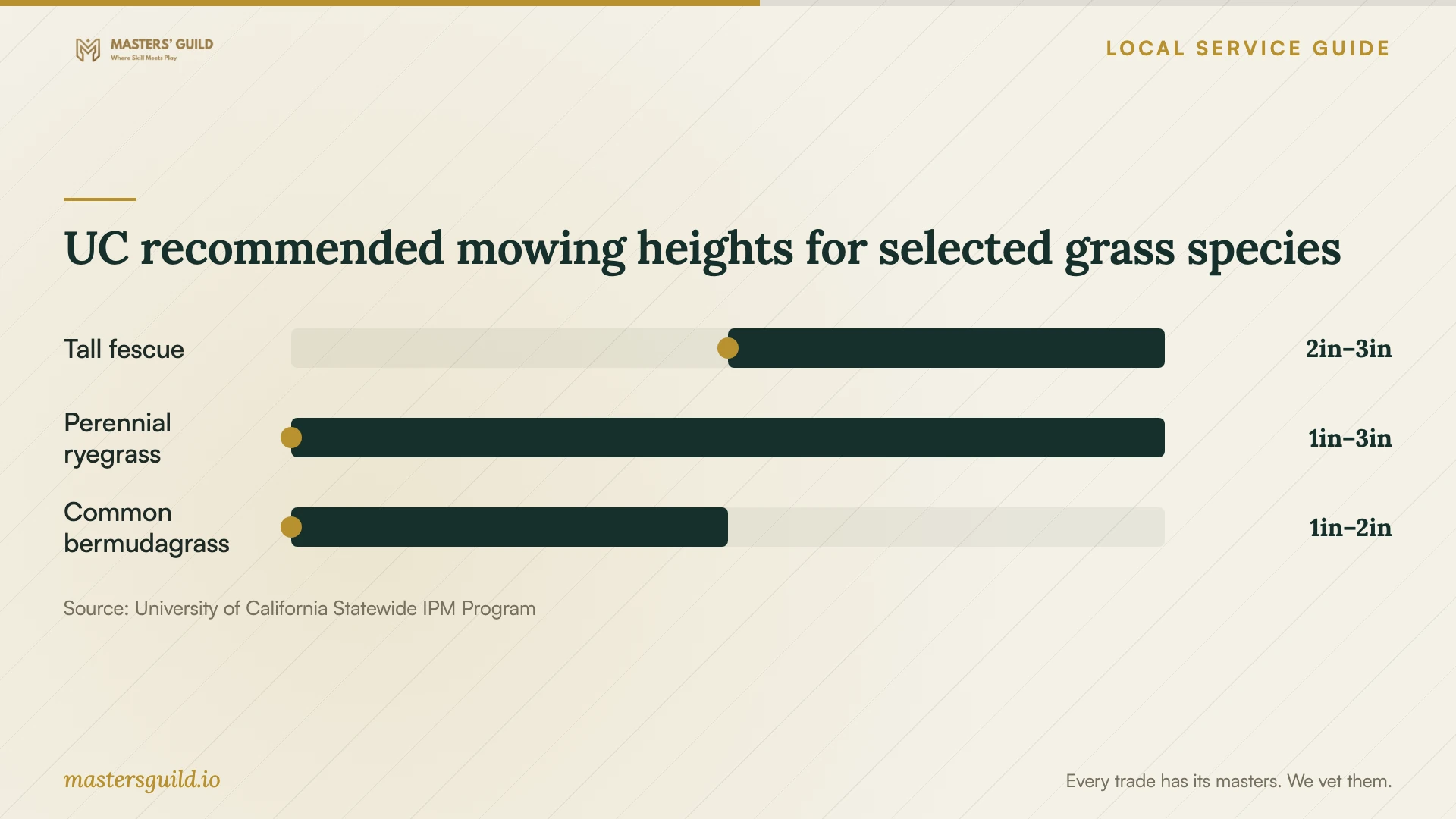
Record the target cutting height after the provider identifies your turf. The chart gives UC's recommended ranges for three selected species. UC warns that mowing too short and too often can thin the lawn and create openings for crabgrass. [2]
Point out suspected crabgrass before work starts. UC advises cleaning the mower after cutting crabgrass-infested turf to avoid transferring seeds to uninfested sites. Ask how the provider handles equipment cleaning when moving between affected and unaffected areas. [2]
Authorize weed treatment as a separate task if you want it. Ask the provider to identify the weed and explain the proposed treatment before applying a product. UC notes that herbicide suitability depends on the turf and application site; a mowing agreement should state who approves treatments. [2]
Prepare access and review the completed work
Before arrival, remove toys and movable furniture, secure pets, and provide gate instructions. Mark sprinkler heads or other features you want the provider to avoid. Share your watering schedule and agree on how to handle a visit when the lawn needs more time before equipment enters.
After the first visit, check edging, clumps of cut grass, cleanup, and the gate latch. Ask the provider to explain any area they skipped. Photograph damage or an unresolved concern and discuss the remedy before the next visit.
For an ACWD customer who wants irrigation help, define whether the provider will report visible problems, inspect the system, or change controller settings. ACWD recommends adjusting sprinklers to avoid watering sidewalks and driveways. Use that guidance to request a specific inspection task rather than giving open-ended permission to alter irrigation. [1]
UC recommended mowing heights for selected grass species
Local details that affect your job
ACWD customers: plan seasonal sprinkler changes
Check your water bill to confirm your supplier before applying ACWD guidance. If you are an ACWD customer, the district recommends early-morning watering, deep and infrequent summer watering, reducing sprinkler use in fall, and turning sprinklers off in winter. It also recommends shorter cycle-and-soak runs to prevent runoff. For an October service arrangement, ask who will assess and approve seasonal controller changes. Check any applicable restrictions before adjusting watering; the tips page does not establish that a water-shortage emergency ordinance is currently in effect. [1]
Inside-district ACWD accounts: separate water costs
For an inside-district ACWD account, the published consumption rate effective March 1, 2026 is $5.38 per unit, which the district defines as 748 gallons. ACWD lists a separate fixed charge of $68.95 per two-month billing period for a 5/8-inch or 3/4-inch meter. Keep these utility charges separate from the mowing quote. If you hire the provider to investigate water use, request a defined irrigation inspection and evaluate changes against the consumption portion of your bill; do not count the fixed meter charge as usage savings. [4]
Match the arrangement to the lawn
| Situation | Arrangement to discuss | Basis |
|---|---|---|
| Grass exceeds the one-third cutting limit between visits | A shorter interval | UC recommends removing only one-third of the leaf per cut. |
| The lawn is overgrown | A staged initial service | UC recommends gradual height reduction across successive cuts. |
| You suspect crabgrass | Equipment cleaning after affected turf | UC advises cleaning the mower to avoid transferring seeds. |
| You are an ACWD customer reviewing fall irrigation | An authorized controller review | ACWD recommends reducing sprinkler use in fall. |
Your hiring checklist
- Send lawn photos, approximate mowable area, gate width, and access instructions.
- Record the grass type and agreed cutting height.
- Specify where the provider should put or take clippings.
- Confirm who can approve additional work and charges.
- Identify your water supplier before requesting utility-specific irrigation changes.
- Clear movable obstacles, secure pets, and mark vulnerable features.
- Agree on a contact method for missed visits or damage.
Frequently Asked Questions
Does a shorter cut help prevent crabgrass?
UC warns that cutting too short and too often can thin turf and allow weeds to establish. Ask the provider to use the recommended range for your grass species. UC also notes that smooth crabgrass can produce seed even when mowed to half an inch, so close mowing does not resolve the problem. [2]
Should I authorize sprinkler changes with mowing?
Give separate approval for controller changes. Ask the provider to explain the proposed settings and whether the quote covers inspection or adjustment. If you are an ACWD customer, its guidance recommends seasonal changes and cycle-and-soak watering to prevent runoff. Confirm applicable restrictions before approving new settings. [1]
How can I compare quotes that bundle lawn care tasks?
Ask each provider to list mowing, edging, trimming, cleanup, clipping removal, and any added treatment as separate scope items. Confirm which lawns they will service and whether they require a minimum commitment. Use the same requested tasks when comparing the total price.
Sources and scope
This guide combines the sources below with practical planning guidance. Figures apply to the stated geography and period; request a written quote for your property.